Winter and Monsoon Special Offer! Get 5% off on all trekking packages in Nepal . Visit during June , July, August, December , January and February and take advantage of this limited-time deal.

Lukla Nepal: Complete Guide to the Gateway of Everest
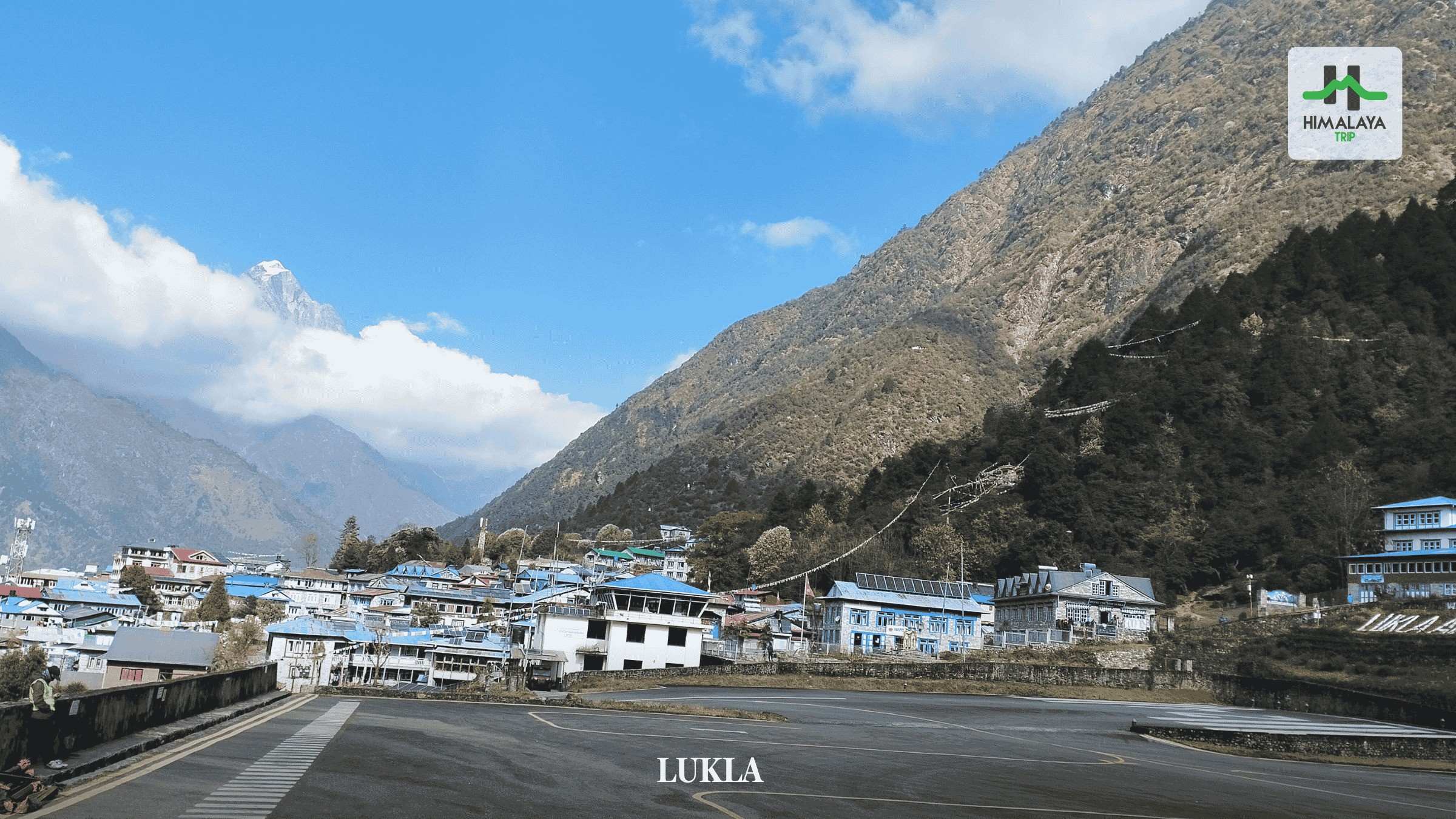
The legendary gateway to Everest, Lukla, is not just a mountain town but also the first step of every Everest adventure. Located in Nepal’s Khumbu (Everest) region, this small but vibrant settlement is the main entry point for trekkers and climbers. It is also popular for the world’s most thrilling airport, the narrow mountain airstrip known as the Tenzing-Hillary Airport. As soon as you land in Lukla, your journey begins, and excitement and anticipation start to build.
The name Lukla in the local language refers to the “place with many goats and sheep.” “Lu” or “Luk” means sheep or goats, and “La” means place, pass, or highland area. The name perfectly captures the history of the town. Lukla gives visitors a breath of the first true taste of high-altitude air. Along with the cool mountain air, you will get the first glimpse of the Sherpa culture and villages. Walking through the town, you can see traditional stone houses, colorful prayer flags, Buddhist monasteries, mani walls, and chortens. You will also hear the sound of yaks’ bells, the chattering of locals, and the buzz of expedition teams and trekkers.
The importance of Lukla goes beyond being just a stop on the Everest trek or expedition. The road ends here, and the trail begins from here. It is also a town that shapes your mindset and prepares you for the Himalayan journey ahead. There is more to Lukla than meets the eye. So, let us explore more about this charming town and everything that makes it special.
Table of Contents
Where Is Lukla?
Lukla is located in the Solukhumbu district of northeastern Nepal. It falls within the Khumbu Pasang Lhamu Rural Municipality in the Koshi Province. The town sits at an altitude of 2,860 m on a steep hillside in the lower Khumbu region. It is the southern gateway to the region and also the main entry point. Lukla is situated at the entry of the Dudh Koshi river valley system. Hence, the town serves as the natural gateway to the Everest region. It is home to Sherpa communities who have deep cultural roots and a connection to the Himalayas. Towering peaks like Everest, Ama Dablam, and Lhotse surround the beautiful town.
Lukla is the common starting point for the Everest Base Camp (EBC) Trek. The trekking trail follows the Dudh Koshi valley and gradually ascends towards Namche Bazaar and beyond. The classic one-way distance from Lukla to EBC is around 65-70 km. Depending on the itinerary, 8 to 10 days, including acclimatization. Flying to Lukla is the fastest way to get to Everest Base Camp. Without Lukla, it will take more days of remote trekking from the lower regions.
There is no road that connects to Lukla. The extreme geography of the town makes road construction difficult and environmentally risky. The high risk of landslides, erosion, and unstable ground prevents road construction. Additionally, cliffs, deep valleys, and unstable mountain terrain surround the town, which further adds to the challenge. Trekkers have to either fly to Lukla or take a long trekking route from lower elevations. The route from Lukla takes trekkers through lush forests, suspension bridges, alpine meadows, and high-altitude settlements. As you trek through the region, the landscape changes continuously until you reach the Everest Base Camp.
Why Lukla Matters for Everest Treks
Lukla is the gateway to the Everest region, making it an essential starting point for trekkers, expeditions, and even for supplies. As a result, it is the region’s operational heart. It is the main starting point for the Everest Base Camp. Before the construction of the Tenzing Hillary Airport in 1964, trekkers, expedition teams, and porters had to walk for around a week to reach Lukla. Now, one can take a short 35-minute mountain flight, saving time and effort.

As we mentioned before, there is no road connecting to Lukla. Hence, all supplies arrive by air cargo, porter, or animal transport. Everything to the upper Khumbu region moves from Lukla. From food and fuel to construction materials and even emergency medical supplies, transport is available from here. Even everyday items like eggs, bottled water, and gas cylinders have to be carried from Lukla to the upper Khumbu valleys. It makes the small town a crucial gateway for regional supplies. Similarly, Lukla is also the first checkpoint, making it an administrative gateway. Most trekkers obtain the permits, i.e., Khumbu Pasang Lhamu Rural Municipality Permit and Sagarmatha National Park Permit in Lukla.
The trekking route from the town usually passes through Phakding, Monjo, and Namche Bazaar before branching into destinations in the Everest region. It is the place where guides coordinate pacing and acclimatization schedules. Porters and yaks or dzopkyos carry trekkers’ luggage, expedition freight, and sorting of climbing gear also starts from here. The town is also the last stop for shopping supplies or gear, pharmacies, bakeries, ATMs, and other comfort services. As a result, Lukla is considered the first chapter for every Everest trek.
Lukla Airport (Tenzing-Hillary Airport)
The Lukla Airport is named after Tenzing Norgay and Sir Edmund Hillary, the first climbers to successfully reach the summit of Mount Everest. The Tenzing-Hillary Airport is one of the most thrilling airports in the world with unique operational conditions. With a runway length of 527 m and a width of 20 m, the airport has an extremely short runway compared to standard commercial airports. Its runway also has a 12% incline, which is uncommon for a public commercial airport. This allows the aircraft to slow down quickly during landing and gain lift faster during takeoff.
One of the unique features of the Tenzing-Hillary Airport is its location. It is built into a narrow Himalayan ridge with a steep drop on one side. Rock walls block the other side of the airport. Due to the terrain constraint, the runway cannot be extended. To land safely on the runway, pilots must precisely align the aircraft before touchdown. There are no go-around options, and the aircraft’s braking performance is crucial. Flights to Lukla operate STOL (Short Takeoff and Landing) aircraft such as Dornier 228 and the Twin Otter. These aircraft can operate on short runways, perform efficiently at high altitudes, manage steep approaches, and operate in the conditions of Lukla airport.

In addition to the geographical constraint, the weather also affects the operation of Lukla airport. The weather in the Everest region changes rapidly. Thus, the flight window is short and unpredictable. Flight delays or rescheduling are common, especially during the monsoon season. Flights from Tenzing-Hillary Airport generally depart early in the morning. The weather in the Himalayas is most stable in the morning. Similarly, the skies are clearer, the wind is lighter, and visibility is better. These conditions provide safe conditions for flying to and from Lukla.
Tenzing-Hillary Airport is a highly specialized mountain airport that is shaped by its extreme geography. Its extreme terrain, short, sloped runway, and dependence on weather make it one of the most unique and adventurous airports in the world. The famous airport is the lifeline for trekkers, expedition teams, and the delivery of essential supplies to the Khumbu region. It is undoubtedly a crucial and irreplaceable part of the Everest experience.
Kathmandu to Lukla Flights
The flight from Kathmandu to Lukla is the most common way of starting the Everest journey. You will fly from Tribhuvan International Airport’s domestic terminal in Kathmandu to Tenzing-Hillary Airport in Lukla. The flight is short and takes around 35 minutes. Although short, it is considered one of the most scenic flights in Nepal. From spectacular views of the hills, valleys, and forests to an aerial view of the Himalayas, the experience is truly unforgettable.
Tara Air, Summit Air, and Sita Air (seasonal operation) mainly operate flights between Kathmandu and Lukla. These airlines rely on visual flight operations as they are heavily dependent on Everest’s weather conditions. Pilots follow strict go/no-go decisions based on visibility, cloud cover, and wind conditions. Similarly, due to the challenging terrain and weather in the Tenzing-Hillary region, flight schedules are often flexible.
The flight to Lukla usually operates between 6:00 and 10:00 AM when the weather is the most stable. The check-in time is 2 hours before departure. As the aircraft are smaller and have limited high-altitude performance, the total baggage limit is only 15 kg (10 kg for checked baggage and 5 kg for hand carry). If the luggage exceeds the limit, travelers have to pay an excess weight fee of around USD 1 per kilo.
Flights from Kathmandu are often rerouted to Manthali Airport in Ramechhap during the peak trekking season (spring and autumn). The main reason behind this is the heavy air traffic at Kathmandu Airport. In such a case, one has to drive to Ramechhap first, which takes around 5 hours. The flight from Manthali Airport to Lukla is shorter, taking about 15 minutes. It helps to reduce air traffic delays and improve operational efficiency during peak seasons.
Here are some ways to prepare for the Kathmandu to Lukla flights:
- Book flights early during peak seasons, as seats fill up quickly.
- As the changing weather in Lukla is notoriously unpredictable, plan for at least 1 to 2 buffer days in your itinerary.
- The total baggage limit is 15 kg, so pack light and smart.
- There is a high chance the Lukla flight will be rerouted to Ramechhap during peak season, so plan for driving and overnight stays.
Lukla Flight Delays & Weather
We keep mentioning flight delays and unpredictable weather in the sections above. Let us dive deeper into the topic.
The Lukla flight depends on visual flying conditions. The pilots must clearly see the route, surrounding ridgelines, and the runway. When visibility is low, flights are usually delayed, diverted, or canceled. Some of the reasons for the Lukla flight delays are as follows:
- Fog: It is the most common and biggest reason for Lukla flight delays. The fog forms when cold air settles overnight, and moisture condenses in valleys. The lack of visibility prevents the aircraft from landing safely.
- Cloud cover: The flight depends not only on Lukla’s weather but also on the entire flight corridor between Kathmandu or Ramechhap and Lukla. The low cloud cover can block mountain passes and terrain. When the visibility drops, aircraft may even have to turn back mid-flight.
- Wind and crosswinds: Mountain valleys create unpredictable conditions such as sudden gusts, changing valley winds, and turbulence near the Lukla airport runway. Hence, even when the visibility is clear, wind and crosswinds can disrupt the flights, causing delays. It is riskier for Tenzing–Hillary Airport with its short runway. The pilots prefer to wait for the winds to calm rather than attempt a risky landing.
- Monsoon disruption (June to September): During the monsoon season, flights to Lukla are frequently delayed or canceled. The season brings persistent cloud cover and heavy rainfall. It causes the runway to get wet, and visibility also drops significantly. Delays and multi-day cancellations are expected due to bad weather at this time of year.
Always put extra buffer days in your itinerary to be on the safe side. It is strongly recommended that you don’t schedule your international departure or other important plans immediately after the Everest Trek. You can opt for a helicopter return, but it is expensive and still weather-dependent. For financial safety, look for travel insurance that covers flight delays, trip interruptions, and helicopter evacuation in addition to the high-altitude trekking.
What Lukla Is Actually Like
Lukla feels like a small mountain town at the edge of the Himalayas, shaped by trekking life. Everything feels connected to the Everest trekking routes. The town is always lively with trekkers, porters, yaks, and supplies moving continuously along narrow stone-paved paths and through tightly packed buildings. The busy atmosphere continues throughout the day without being chaotic. What you may notice is that the Lukla airport activity itself is part of Lukla. Small aircraft land and take off early in the morning, guides wait for groups, and porters carry luggage from the arrival flight. When the flights are grounded, the town feels slow, but it does not come to a complete stop.
Lukla offers you the first introduction to the teahouse hospitality in the Everest region. Compared to those in the higher-altitude villages, the teahouses in Lukla offer more facilities and amenities. There are also small bakeries and cafes around the town. Fresh breads and pastries are baked early in the morning. Similarly, the cafes offer a variety of espresso-style drinks. You can enjoy a slow morning in Lukla before starting your trek. There are also several trekking shops. From trekking poles to clothing, hydration items, and medical supplies, you can do their last-minute shopping before they head out. The town is like a final gear and a supplies checkpoint.
You can also feel the first-night trekking energy in Lukla. There is an air of excitement, anticipation, and slight uncertainty. The guides gather the groups, explain the trail, and organize and reorganize the gear. From here on, the idea of the Everest journey becomes a reality. After resting in the town for the night, the real trekking begins the following morning. Lukla may be a small hub between the lowlands and the high mountains, but it is always active. It has a deep connection to the energy of Everest trekkings and expeditions.
Accommodation & Food in Lukla
The main accommodation type in Lukla is teahouses, but there are also comfortable lodges around the town. Since the accommodation here is more comfortable and well-equipped, it is possible to find private rooms with attached bathrooms. The rooms also have slightly better insulation and bedding. These teahouses and lodges have a communal dining hall with a central stove for heating. Facilities like hot showers, internet, and charging facilities are also better, and pricing is relatively cheaper than in higher regions.

The food menu in Lukla is also wider, and the quality is better. Ingredients are fresher, and access to supplies is easier. Hence, the meals are closer to what you get in the town. Some of the most common meals here are Dal Bhat, noodles, momo, pasta, fried rice, eggs, toasts, pancakes, and soups. You can also find different types of bakery products. As you move to higher altitude areas, the food becomes more carb-heavy and repetitive. Hence, Lukla is the last place to enjoy diverse meals and comfort before heading deep into the remote Khumbu region.
Lukla Altitude & Acclimatization
Lukla is located at an altitude of 2,860 m above sea level in a high-altitude environment. The elevation will continue to rise, and oxygen levels will gradually decrease from here onwards. At this elevation, most trekkers will experience no serious altitude issues. A few trekkers may experience mild headache, fatigue, reduced appetite, and slightly elevated breathing when walking. However, these effects are usually temporary. More than physical, the effects at Lukla are psychological.
Although Lukla is the starting point, you must start following acclimatization rules right away. You need to stay hydrated properly throughout the day. Dehydration on the early day can quickly lead to discomfort that can feel like altitude sickness. Similarly, you need to walk at a steady and slow pace. Rushing to a higher elevation too quickly can lead to over-exertion and increase the risk of altitude sickness. It is important to keep in mind that high-altitude trekking is not about speed, but about adaptation and energy management.
The trekking route from Lukla ascends gradually to facilitate acclimatization. The first section from Lukla to Phakding has gentle uphill and downhill climbs. Then, it climbs up to Namche Bazaar, a strategic acclimatization stop. Following this route allows your body to adapt to the elevation over 2 to 3 days. Likewise, it helps build stamina before ascending to higher altitudes and reduces the risk of altitude sickness later.
Lukla serves as one of the key points for acclimatization transition. It is not high enough for you to experience altitude sickness, but it is high enough for your body to start adapting to the altitude. Hence, Lukla is where the trekking schedule, pace, and hydration start to shape the rest of the journey.
Common Mistakes Trekkers Make in Lukla
Many trekkers may face difficulties when they are unfamiliar with how the operation works in Lukla. Hence, it is important to understand common mistakes to avoid unnecessary challenges or stress. Here are some of those common mistakes trekkers make in Lukla that you must avoid:
- Underestimating frequent weather delays and schedule changes.
- Not checking weather updates early in the morning before flight operations.
- Scheduling connecting international flights too closely without considering buffer days for delays or cancellations.
- Planning fixed schedules instead of a flexible itinerary.
- Packing too much gear, making travel and porter loads heavier than they need to be.
- Not staying hydrated before and during the trek.
- Keeping your essential items such as documents, medications, and valuables in checked luggage instead of hand carry.
Trekking Routes That Start from Lukla
From Lukla, well-defined paths branch off into different valleys and high-altitude areas. As a result, the town is the main trekking hub for most trekking destinations in the Khumbu region. The airway connection and its strategic location have established it as the gateway to the region. Some of the most popular trekking routes of Nepal start from here. The most popular one is the iconic Everest Base Camp Trek.
The classic Everest Base Camp Trek starts from Lukla and follows the trail through Namche Bazaar, Tengboche, Dingboche, and Gorakshep. Its trail then ascends to the base camp of the world’s highest mountain at 5,364 m. A popular, shorter adventure that starts in Lukla is the Everest View Trek. It follows the EBC Trekking trail up to Tengboche. A quieter alternative, but equally rewarding trek destination from Lukla is the Gokyo Lakes Trek. It’s off the beaten path, takes you past remote valleys and stunning turquoise glacial lakes to the hidden Gokyo Valley.

The most challenging route starting from Lukla is the Three Passes Trek. Its trekking trail passes through remote areas and crosses three high-altitude passes: Kongma La, Cho La, and Renjo La. The Three Passes Trek route makes a complete circuit of the Khumbu region. Every trekking route offers a unique and memorable experience. You will explore remote valleys and high mountain passes while taking a closer look at iconic peaks and Sherpa culture. Although different trails and experiences, they all share the common starting point, Lukla.
Best Time to Visit Lukla
The best time to visit Lukla is in spring and autumn. However, each season offers different weather conditions, scenery, and trekking experiences. Trail conditions and crowd levels also vary with the season. Hence, it is important to know what each season brings and choose the one that best suits your preferences.
Take a look at the brief of each season:
Spring (March-May)
It is one of the most popular and peak trekking seasons. Spring weather conditions are one of the most favorable, with good visibility. The temperature is mild, and the overall trekking conditions are ideal. One of the best things about a spring visit to Lukla is that you can see the rhododendron forests in full bloom. Stable weather in spring reduces the risk of flight delays or cancellations. On the other hand, there are more trekkers on the trails, and the teahouses are busy.
Summer (June-August)
The least popular season to visit Lukla is summer. Summer is monsoon season in Nepal. There is heavy rainfall and frequent cloud cover, reducing visibility. As a result, there are frequent delays and cancellations of Lukla flights at this time of the year. The rain also makes the lower trail muddy and slippery. Additionally, there is a risk of landslides and mudslides. Activity in Lukla during the summer is slow due to the reduced flight operations. There are also very few trekkers on the trail.
Autumn (September-November)
Autumn is the peak trekking season and the best overall time to visit Lukla. It offers the most stable, dry weather. Likewise, the temperature is mild and comfortable for trekking. As the autumn season follows summer or the monsoon, the atmosphere and skies are clear. The visibility is excellent at this time of the year, and the mountain views are sharper. Autumn is the most reliable season for Lukla flights with very few delays or cancellations. However, the air traffic is heavy, so flights can be rerouted to Ramechhap. The trails and teahouses are also busier than in any other season.
Winter (December-February)
The winter season brings cold mornings and nights. It is considered off-season for trekking. The temperature, especially at higher altitudes, is freezing. Similarly, it snows at higher elevations, covering the trails and passes. The visibility during winter is brilliant. However, haze, snowfall, or cloud cover may disrupt flights. It is a quiet time in Lukla, with few trekkers. Despite the cold weather, visiting Lukla in winter allows you to experience the usually busy town in a calm atmosphere and witness the snow-covered landscapes of the Everest region.
Here is a simple comparison table for each season:
| Features | Spring | Summer | Autumn | Winter |
| Visibility | Good | Poor | Excellent | Very good |
| Flight reliability | Moderate to High | Low | High | Moderate |
| Trekking conditions | Favorable, comfortable, and moderate temperatures | Heavy rainfall in lower areas and wet, slippery trails | Best overall weather conditions, stable, and mild temperatures | Cold, snowfall at higher areas, but clear skies |
| Crowds | High | Very low | Very High | Low |
Conclusion
There is a reason why Lukla is a familiar name among Everest trekkers and expeditioners. The moment you take off to Lukla and land at the Tenzing-Hillary Airport, you officially enter the world of the Himalayan adventure. You will leave behind the hustle and bustle of cities and enter the world of serenity. The mountains and rhythms of trekkers’ and porters’ movement shape the town. It is where almost all Everest journeys start and end.
We hope you enjoyed this blog. For more information about trekking in Nepal or the Everest region, contact us directly!