Winter and Monsoon Special Offer! Get 5% off on all trekking packages in Nepal . Visit during June , July, August, December , January and February and take advantage of this limited-time deal.


Why You'll Love the Everest Base Camp Trek
- An adventurous and scenic flight to Tenzing Hillary Airport, Lukla.
- Traverse the Sherpa Capital and the trekkers’ Junction, Namche Bazaar.
- Trek through Sagarmatha National Park, a UNESCO World Natural Heritage Site, and explore the flora and fauna.
- Hike to Syangboche to witness a panoramic view of the Himalayas, including Mt. Everest.
- Spiritual tour of Tengboche Monastery and stunning views of Everest and other mountains.
- Ascend to the iconic Everest Base Camp (5,364 m) and Kala Patthar Viewpoint (5,545 m).
- Get a close view of Khumbu Icefall and Khumbu Glacier.
- Witness some of the world’s highest mountains, including Mt. Everest (8848m), Lhotse (8516m), and Makalu (8463m).
- Get the chance to see panoramic views of the mountains and sunrise from Kala Patthar.
- Pass through different landscapes and terrains, such as lush jungles, barren lands, rocky ridges, glacial moraines, and snowy mountains.
- Sherpa culture and tradition, rich Buddhist mane walls, stupas, chortens, monasteries et.
- Get the experience of authentic teahouse foods and accommodation.
- Meet the Everest Expedition team if you do this trek in April and May.
- Participate in or meet the Everest Marathon team on 29 May every year.
Activity
Adventure Treks
Altitude
5,545 m (Kala Patthar)
Best Season
March - May and September -November
Meals Included
13 Breakfast, 11 Lunch, 11 Dinner
Transportation
Flight/Car/Jeep/Bus
Destination
Most Popular Treks
Accommodation
2 Nights at Hotel in Kathmandu 11 Night at Lodge
Duration
14 Days
Region
Everest Region Treks
Start / End Point
Kathmandu / Kathmandu
Group Size
2 - 20
Difficulty
Adventure
Overview of Everest Base Camp Trek
The Everest Base Camp Trek is a 130-km high-altitude trekking route in Nepal that takes hikers from Lukla to the base of Mount Everest at an elevation of 5,364 m. Following a well-planned schedule with enough rest days and direct pricing protects your safety and guarantees you reach your destination.
Apa Sherpa, age 64, verified record holder with 21 Everest ascents, explained the key rule for high altitude: “Do not rush up the mountain. Respect the altitude, listen to your body, and the trail will pay you back”.
Most hikers finish the distance in 14 days, walking 10 to 15 km daily over dry mountain tracks. The route traverses directly through Sagarmatha National Park, a protected high-altitude sanctuary spanning 1,148 sq km. As you climb, you can witness some of the highest mountain peaks in the world, such as Mount Everest (8,848.86 m), Lhotse (8,516 m), Nuptse ( 7,861 m), and Ama Dablam (6,812 m). This alpine environment shelters rare wildlife species like the snow leopard, Himalayan tahr, musk deer, and the colorful Himalayan monal pheasant.
Beyond the physical landscape, the trail takes you to old Sherpa villages where Buddhist customs and traditions are an important part of everyday life. You walk past stone mani walls, prayer wheels, and chortens while moving from Lukla to higher alpine settlements. At 3,867 m, Tengboche Monastery, founded in 1916 by Lama Gulu, is the spiritual center of the Khumbu region. You can stop here to watch daily monk rituals and light butter lamps before ascending to higher ground.
On the Himalaya trip, our field team monitors real-time trail conditions, lodge availability, and regional weather updates to maintain high safety standards for every client. If you’re looking for an agency that genuinely prioritizes your safety and supports you every step of the way to Base Camp, choose us without hesitation.
How to Prepare for the 14 Days Everest Base Camp Trek?
As mentioned above, the Everest Base Camp Trek in Nepal is a moderately challenging trip that requires proper preparation. It helps trekkers prepare for any unforeseen trek difficulty. Here are a few ways of preparing for this famous trek:
- Begin training for the trek at least 2 to 3 months in advance. Undertake cardio exercises that help to build strength, endurance, and stamina for Himalayan trekking.
- Practice hiking with a backpack of 6 to 8 kg to strengthen the core.
- Learn about altitude sickness and its precautions.
- Pick an itinerary with adequate acclimatization to reduce altitude sickness. Take extra time if necessary.
- Keep yourself hydrated all the time. Drink at least 3 to 5 liters of water each day to avoid dehydration.
- Eat nutritious meals, rich in protein and carbohydrates. Avoid meat products as they may not be fresh.
- Carry warm clothes and layers. The temperature at higher elevations is usually cold and drops significantly during nighttime.
- Get travel insurance for trekking EBC that covers high altitude evacuations and medical expenses.
- Book your flights and accommodations in advance. Also, check the weather forecast regularly.
- Pack smart and light. Carry a first aid kit and altitude sickness medication, such as acetazolamide or Diamox. However, consult with a health professional before taking the medication.
Outline Itinerary for Everest Base Camp Trek
Day 01:
Arrival in Kathmandu (1,338 m / 4390 ft) and Transfer to Hotel.
Day 02:
Kathmandu - Lukla by fly , trekking to Phakding (2,610 m / 8,563 ft, 8 km or 3 hours walk).
Day 03:
Phakding - Mango - Jorsalle - Namche (3,440 m / 11,290 ft, 11 km or 5-6 hours walk).
Day 04:
Hike to Everest View Hotel to see the World highest Peak Mt. Everest and the other Himalayas views, visit Khumjung village and back to Namche (6.6 km or 3-4 hours walk).
Day 05:
Namche - Kyangjuma - Phunki Tenka - Tengboche (3,860 m / 12,664 ft, 9 km or 5-6 hours walk).
Day 06:
Tengboche - Pangboche - Somare - Dingboche (4,410 m / 14,465 ft, 11 km or 4-5 hours walk).
Day 07:
You will climb to 400 m / 1,312 ft to 500m / 1,640 ft Nangkar Tshang Peak for acclimatizing, back to Dingboche.
Day 08:
Dingboche - Thukla - Lobuche (5,140 m / 16,863 ft, 8 km or 5-6 hours walk).
Day 09:
Trekking to Gorak Shep (5,140 m / 16,863 ft, 11 km or 7-8 hours walk) , Hike to Everest Base camp (5,364 m / 17,598 ft).
Day 10:
Climb to Kala Patthar (5,545 m / 18,192 ft), trek down to Pheriche (4,240 m / 13,911 ft, 16 km or 7-8 hours walk).
Day 11:
Pheriche - Panagboche - Tengboche - Namche (3,440 m / 11,290 ft, 19km or 6-7 hours walk).
Day 12:
Namche - Manjo - Phakding - Lukla (2,840 m / 9,317 ft, 19 km or 6-7 hours walk).
Day 13:
Fly from Lukla to Kathmandu, drive to your Hotel.
Day 14:
Final Departure.
Everest Base Camp Trek Itinerary - 14 Days
Arrival in Kathmandu and Transfer to Hotel
Activity
Arrival in Kathmandu, Nepal
Highest Altitude
1,338 m / 4390 ft, Kathmandu
Accommodations
Kathmandu Guest House
Your first day of Everest Base Camp trekking begins with your arrival at Tribhuvan International Airport in Kathmandu. Our representative from Himalaya Trip will be waiting for you at the arrival area to welcome you and transfer you to the hotel. Once you complete the airport formalities and collect your luggage, you will be driven to Thamel.
After reaching Thamel, our staff member will guide you to your hotel and make sure your check-in goes smoothly. The rest of the day is free for you to relax after your journey or explore the streets of Thamel in the evening.
Kathmandu-Lukla flight and trek to Phakding
Activity
8 km or 3-4 hours walk
Highest Altitude
2,610 m / 8,563 ft, Phakding
Accommodations
Sherpa Guide Lodge
Meals
B, L, D
Early in the morning, we will head to TIA for a 30-minute flight to Lukla Airport, the starting point of your trek. During peak season (April, May, October, and November), the flight from Kathmandu is diverted to Manthali Airport in Ramechhap due to heavy air traffic. In such a case, you have to first drive for 5 hours from the capital city to Ramechhap. The flight from Manthali to Lukla takes 20-25 minutes. It is an equally scenic flight that offers spectacular aerial views of Nepal’s diverse landscapes and Himalayan ranges.
Lukla Airport, officially the Tenzing-Hillary Airport, is one of the most adventurous landing strips in the whole world. At an altitude of 2845 m, it is the busiest of the four regional airports in the Khumbu region. The flight to Lukla offers scenic aerial views of the Himalayas and a change in landscape, and it kick-starts your journey with a thrilling experience.
After landing, you will continue the first part of the EBC Trek to Phakding. You will begin with a gentle downhill trek on a well-paved stone walkway. The route goes through pine forests and follows the Dudhkoshi River. Similarly, you will pass through small villages such as Chheplung, Thado Koshi (Lunch), and Ghat, with beautiful terraced farms. The Everest Base Camp trekking route also passes by Buddhist mantra written stone, mani walls, stupas, prayer flags, and chortens. En route, you will also cross several suspension bridges over rushing rivers to reach Phakding. You will stay overnight at the Sherpa Guide Lodge or a similar property in Phakding.
Note: All flights operate from Manthali Airport, Ramechhap, to Lukla in April, May, October, and November. It takes 5 hours to drive from the capital city to Ramechhap. In such a case, you have to wake up at 2 AM, drive from Kathmandu to Ramechhap, and then fly to Lukla. If you are a small group of 2-4 pax, you will use a shared van. For 5 or more pax, we provide a private van.
Sharing Helicopter: If you do not want to take the hassle of Kathmandu to Ramechhap drive and flight cancellation to Lukla flight, you can choose the option of sharing a helicopter from Kathmandu to Lukla.


Phakding to Namche Bazar trek
Activity
11 km or 5-6 hours walk
Highest Altitude
3,440 m / 11,290 ft, Namche Bazaar
Accommodations
Khumbu Lodge
Meals
B, L, D
Starting from Phakding, your journey to Namche Bazaar will take you to a higher altitude. As you depart Phakding, you will trek on the trail that follows the Dudh Koshi River. You will pass by terrace fields, mani walls, and chortens before making your first stop at Bengkar. From here, you will head towards Monjo, the entrance to Sagarmatha National Park, where you will need to present your permits.
Jorsale (Thumbug) is the last place for lunch. You will soon come across the most popular suspension bridge of the Khumbu region, known as the Hillary Suspension Bridge. Built over the Dudh Koshi River, it is one of the highest suspension bridges in Nepal.
After crossing the bridge, the Everest Base Camp Trekking trail becomes steep and turns into a dirt path. After crossing the staircases and rhododendron forest trails, you will reach Namche Bazaar. The town is a Sherpa village that serves as the commercial hub of the Everest region. While today’s climb is demanding, the reward of arriving at this peaceful village is well worth it. You will stay at a lodge here for the next two nights at Khumbu Lodge or similar in Namche.


Acclimatization day in Namche Bazaar.
Activity
6.6 km or 3-4 hours walk
Highest Altitude
3,880 m / 12,730 ft, Everest View Hotel
Accommodations
Khumbu Lodge or similar
Meals
B, L, D
Acclimatization is an important part of the Everest Base Camp Trek because your body needs time to adapt to higher elevations. Today, you will spend the day around Namche Bazaar (3,440 m) with a short hike to Syangboche (3,880 m). The hike to the Everest View Hotel takes about 1–1.5 hours and offers beautiful views of Mount Everest, Ama Dablam, Lhotse, Nuptse, and other Himalayan peaks. The Everest View Hotel is also listed by Guinness World Records as one of the world’s highest-altitude hotels.
From the Everest View Hotel, you will hike for around 30 minutes to Khumjung Village, where you will visit the Edmund Hillary School and Khumjung Monastery. The school was established in 1961 by Sir Edmund Hillary through the Himalayan Trust and became one of his major projects in the Khumbu region. Khumjung Monastery is known for its local Yeti legend and a scalp (about 300 years old) that local tradition identifies as belonging to a Yeti, although there is no scientific evidence confirming this claim.
After visiting Khumjung, you will return to Namche Bazaar and explore the town. Namche is the main service center on the EBC route with lodges, bakeries, shops, restaurants, and other facilities for trekkers. You can troll around its markets and streets before spending the night at Khumbu Lodge or similar ones with all the facilities you need.


Namche to Tengboche trek
Activity
9 km or 5-6 hours walk
Highest Altitude
3,860 m / 12,664 ft, Tengboche
Accommodations
Tashi Delek Lodge & Restaurant or similar
Meals
B, L, D
You will start early and trek to the Tengboche today. The views of Everest, Ama Dablam, Nuptse, and Lhotse will accompany you throughout the trek. After an hour of ascent, the trail drops down through the forests of rhododendrons and conifers before becoming flatter as you approach Kyangjuma Village (3,550 m). The beautiful surroundings offer an excellent setting for capturing photos.
After that, the EBC trek starts with a downhill descent to Phunki Tenga. It is a small settlement that is a common rest stop or Lunch Place. After a brief rest, you will continue your trek. The views get better as the trail opens up to the ridge-top. It offers gorgeous views of Everest, Nuptse, Ama Dablam, Thamserku, Lhotse, and more. After a final uphill trek, you will reach Tengboche in the afternoon. You will stay here overnight at Tashi Delek Lodge & Restaurant, so before dinner, you will pay a visit to the Tengboche monastery.
Tengboche Monastery or Dawa Choling Gompa is the largest Tibetan Buddhist monastery in the Khumbu region. The original monastery was built in 1916 and is a reflection of the Rongbuk Monastery in Tibet. The monastery we see today was built in 1993 (completed in 2008) and is the central attraction of the UNESCO World Heritage site of Sagarmatha National Park. The sunset view from the monastery over the Himalayas is an amazing experience. The monastery will open every day for prayer.


Tengboche to Dingboche trek
Activity
10 km or 4-5 hours walk
Highest Altitude
4,410 m / 14,465 ft, Dingboche
Accommodations
Hotel Stupa Inn or similar
Meals
B, L, D
Before you resume your trek, you will enjoy breakfast in the serene atmosphere of Tengboche. The trekking trail today is easy with only a few ascents, and much of the path follows the Dudh Koshi river basin. After some time, the trail again descends and leads you towards the Imja Khola, where you will cross small streams. Similarly, you will come across Sherpa villages such as Deboche, Pangboche, and Shomare, with opportunities to stop for lunch, as well as mani walls, stupas, and chortens.
As you follow the Imja Khola, the trail takes you to the Imja Khola valley. It again starts to ascend uphill from here onwards.
As you move forward, you will also start to see a shift in the geography. As it becomes more barren, vegetation thins and the terrain becomes rockier, with occasional stone stairways on the trail. You can see the sharp ridge of Ama Dablam clearly in the background, along with the views of Lhotse and Tawoche.
It takes about a two-hour uphill climb from the Imja Khola Valley floor to reach Dingboche village. Dingboche is a large Sherpa settlement in the Imja Khola Valley and another important stop for acclimatization on our Mount Everest Base Camp trekking journey.


Acclimatization day in Dingboche
Activity
3- 4 hours walk
Highest Altitude
4,900 m / 16,076 ft, Nangsar Tshang Peak
Accommodations
Hotel Stupa inn or similar
Meals
B, L, D
At an altitude of 4,410 m, Dingboche village is strategically the best place to acclimatize before the base camp. There are a couple of perfect day hike paths here, which will help you cope with the higher altitude in the coming days.
After breakfast, you will climb approximately 670 m to the Nangsar Tshang Peak. The climb is steep and challenging over loose scree. However, the gorgeous mountain views make up for it. From the summit of the Nangsar Tshang Peak, you can witness Ama Dablam, Island Peak (Imja Tse), Lhotse, Cholatse, Makalu, and more.
After returning from the ascent of Nangsar Tshang, you can explore around Dingboche. You can see traditional stone-built houses with flat roofs and fields surrounded by stone walls. Dingboche also connects paths heading toward Everest Base Camp, Chhukung Valley, Island Peak, and the Amphu Labsta pass.


Dingboche to Lobuche trek
Activity
8 km or 5 hours walk
Highest Altitude
4,910 m / 16,108 ft, Lobuche
Accommodations
New EBC Lodge or similar
Meals
B, L, D
With an acclimatization at Dingboche, you will resume your Everest Base Camp Trek. You will trek to Lobuche village today after breakfast and a warm cup of Tibetan tea in Dingboche village. The trekking trail initially heads toward Thukla (Dughla). The path is rockier and unorganized, which makes it more challenging. En route, you will see numerous prayer flags, mani walls, stupas, small cairns, and chortens. The landscape also becomes more barren with fewer trees and vegetation.
As you get closer to Lobuche Thukla (Dughla) pass, you will come across memorials for mountaineers. Also known as the Dhugla Memorials, you can see stone molds dedicated to the climbers who lost their lives on Everest.
There are memorials for legendary mountaineers like Rob Hall, Scott Fischer, and many Sherpa guides. It is a stark reminder of Everest’s dangers and the risks of high-altitude mountaineering. Locals and guides often pause here to pay their respects. Do not make loud noises or movements in the area to avoid being disrespectful.
After spending a deeply moving moment at the Dhugla Memorial, you will start ascending along the lateral moraine of the Khumbu Glacier until you reach Lobuche (Lunch). It is an important place in the higher Khumbu region, from which supplies are sent to the base camp.
In the afternoon, you have an option to explore around the Khumbu Glacier or the Italian Pyramid.


Lobuche to Everest Base Camp, and Gorak Shep trek
Activity
11 km or 7-8 hours walk
Highest Altitude
5,364 m / 17,598 ft, Everest Base Camp
Accommodations
Snowland Lodge or similar
Meals
B, L, D
After breakfast at Lobuche (4,910 m), you will begin a 3–4 hour trek to Gorak Shep (5,164 m). This area takes you above 5,000 m, so you need to pay close attention to signs of Acute Mountain Sickness (AMS). The trail starts with relatively level sections and some uphill climbs before crossing the rocky terrain near Lobuche Pass. You will continue through the glacial moraines of the Khumbu Glacier, where yaks are used to carry supplies. After reaching Gorak Shep and having lunch, you will start the hike to Everest Base Camp (5,364 m).
The trail from Gorak Shep to Everest Base Camp follows the edge of the Khumbu Glacier. Along the route, you can see memorials dedicated to climbers who lost their lives in the Everest region. At Everest Base Camp, you will see the Khumbu Icefall, large ice formations, glacier debris, and the small peaks of the Everest region. During the spring climbing season, expedition tents and prayer flags add color to the base camp area. Standing at 5,364 m, beside the Khumbu Glacier, is one of the most precious moments of the trek.
After exploring the base camp, you’ll return to Gorak Shep for your overnight stay at Snowland Lodge or a similar teahouse.
Note: The yak contaminates the water sources in Gorak Shep. We recommend drinking bottled or filtered water here for safety.


Gorak Shep to Pheriche, Kala Patthar hike back to Pheriche
Activity
16 km or 7-8 hours walk
Highest Altitude
5,545 m / 18,192 ft, Kala Patthar
Accommodations
Everest Trekkers Lodge
Meals
B, L, D
You will take an early morning hike to the viewpoint of Kala Patthar for a Himalayan sunrise over Everest. Kala Patthar is one of the best viewpoints in the Himalayas. The panoramic view from the viewpoint is considered even better than that from Everest Base Camp. From here, you can get a close view of Mt Everest and its summit.
Similarly, you can also witness Lhotse, Pumori, Nuptse, and other surrounding Himalayas. It is the highest point of the Everest Base Camp Trek.
After spending some quality time here, you will return to Gorak Shep for breakfast. After resting for a while, you will start our trek today to the settlement in Pheriche. The EBC Trekking trail first follows a rocky and high-altitude moraine path. You will descend to Lobuche for Lunch and pass by the Lobuche Memorials once again.
The trail continues to descend westward along the Imja Khola Valley towards Pheriche village for the overnight stay.


Pheriche to Namche trek
Activity
19 km or 6-7 hours walk
Highest Altitude
3,440 m / 11,290 ft, Namche Bazar
Accommodations
Khumbu Lodge
Meals
B, L, D
After breakfast in Pheriche, you will follow the Imja Khola before crossing a small metal suspension bridge near Tsuro Wog. The trail then traverses juniper, birch, and rhododendron forests toward Pangboche, where you can see the Ama Dablam above the valley. You will continue through Deboche before crossing the Imja Khola and climbing toward Tengboche (3,860 m).
From Tengboche, the trail drops down through the forest to Phunki Tenga (3,250 m), where you can take a short tea or lunch break beside the river. You will then cross the bridge and climb a pine forest toward Sanasa before joining the trail junction for Gokyo.
From Sanasa, the route becomes easier as it follows a wider path along the hillside toward Namche Bazaar (3,440 m). After several hours on the trail, you will reach the colorful mountain town and spend the night surrounded by the peaks of the Khumbu region.


Namche to Lukla Trek
Activity
19 km or 6-7 hours walk
Highest Altitude
2,840 m / 9,317 ft, Lukla
Accommodations
Everest Mountain Home
Meals
B, L, D
You will leave Namche Bazaar after breakfast and start the long trek toward the Hillary Suspension Bridge over the Dudh Kosi River. After crossing the bridge, you will pass Jorsalle and head toward Monjo, where you leave the Sagarmatha National Park area. The trail follows the Dudh Kosi through Benkar and Toktok before reaching Phakding. You can stop here for lunch before following the river toward Chheplung.
From Chheplung, you’ll pass small villages and forested areas before the final climb to Lukla. The last section has long stone steps that can feel difficult after a full day of walking. After reaching Lukla, you can explore the town and rest near Tenzing-Hillary Airport.
This is the end of the trekking section of your Everest Base Camp journey, so you can also settle any final tips with your guide and porters before your flight back to Kathmandu the next day.

Lukla to Kathmandu flight
Activity
30 minutes flight
Highest Altitude
1,338 m / 4,390 ft, Kathmandu
Accommodations
Kathmandu Guest House
Meals
B
You will take the flight from Lukla Airport, returning to the Kathmandu valley today. In your spare time before the flight, you can explore around Lukla and its market. Your 30-minute flight from Lukla is a great way to turn back and enjoy the Himalayas for one last time on this tour. In peak season, you will fly from Lukla to Manthali Airport, Ramechhap. Then you will drive for hours to Kathmandu.
After landing in Kathmandu, we will drive you to Kathmandu Guest House. In your spare time today, you can visit some nearby attractions from your hotel. In the evening, you can head to Thamel market for some souvenir shopping.
You can visit local pubs and bars to experience Nepali cuisine, drinks, and music, and enjoy Kathmandu’s nightlife.
Important Note: All flights operate from Ramechhap to Lukla and back to Ramechhap in April, May, October, and November.

Final Departure
Activity
Transfer to airport to fly home
Highest Altitude
1338 m /4390 ft , Kathmandu
Meals
Breakfast
Your journey in Nepal comes to an end today. Based on your flight schedule, our staff member will pick you up from your hotel and take you to Tribhuvan International Airport. We recommend leaving the hotel early enough to give plenty of time for traffic and airport check-in (Leave your Hotel at least 3 hours before the flight time).
After reaching the airport, you can complete your final travel arrangements and prepare for your flight home. We hope you leave Nepal with wonderful memories of the mountains, local culture, and hospitality. We look forward to welcoming you again for another adventure in Nepal.
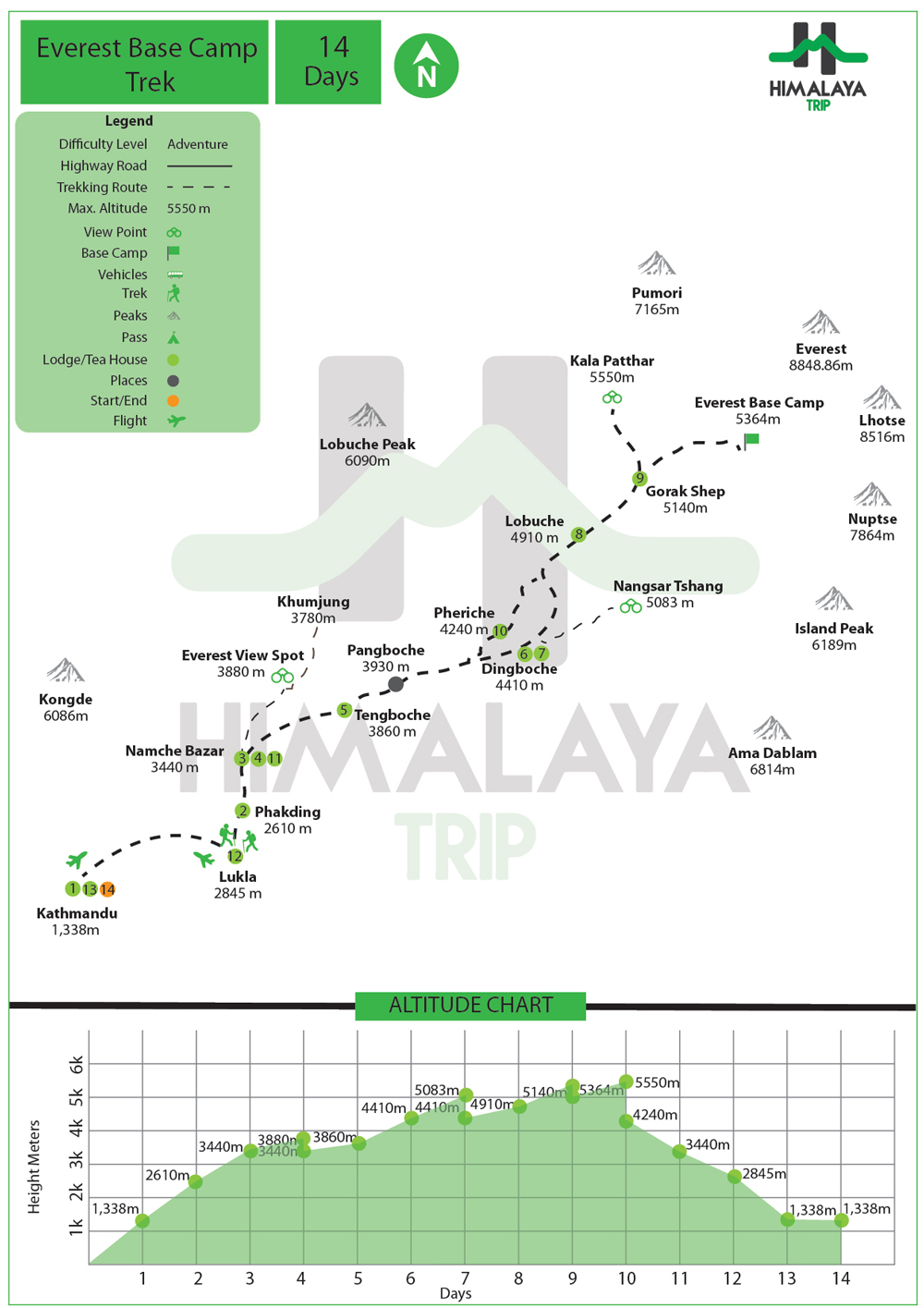
Everest Base Camp Trek Map
What's Included ?
Everything you need for a safe, comfortable, and memorable trek — packed into one transparent price. Below is a full breakdown of what is covered in your Everest Base Camp Trek package.
Accommodation & Meals
- 2 Nights at Kathmandu Guest House in Kathmandu.
- Lodge : 6 Nights attached bathroom ( 3 Nights Namche, 2 Nights Dingboche, 1 Night Lukla ) and 5 Nights common room (Phakding, Tengboche, Lobuche, Gorak Shep , Pheriche ).
- Hot Shower in Namche and Lukla.
- Meals: 13 Breakfasts, 11 Lunches & 11 Dinners during the trek.
Transportation & Flights
- Transportation : Airport pick-up and drop off at Tribhuwan International Airport and Domestic airport by private vehicle.
- Kathmandu – Ramechhap – Kathmandu transportation if your flight is from Ramechhap.
- Flight: Kathmandu or Ramechhap – Lukla – Ramechhap or Kathmandu flight ticket.
Guide & Porter Services
- Guide: One licensed, English-speaking trekking guide.
- Porter service: one porter per two trekkers. No porter for solo trekkers.
- Guide and Porters: Food, accommodation, salary, equipment and personal insurance etc.
Equipment & Safety
- Fingertip Pulse Oximeter — daily oxygen and pulse monitoring for altitude safety.
- First Aid Kit carried by the guide .
- Duffle Bag: One Duffle bag per trekkers on return.
Permits & Official Fees
- Sagarmatha National Park fee .
- Khumbu Pasang Lhamu Rural Municipality entrance fee.
- 13% Government VAT and all official government charges.
Complimentary Extras
- Seasonal fresh fruit en route — pomegranates & apples.
- Everest Base Camp Trek Map and Himalaya Trip branded T-shirt.
- 24/7 emergency support line available during your entire trek.
Whats not Included?
- International airfare.
- Nepal’s visa fee (15 Days USD 30 and 30 Days USD 50). You fill out a form at the depart of immigration before you leave, pay cash, and get a visa on your arrival at Kathmandu airport.
- All the drinks like tea, coffee, Coke, Fanta, mineral water, boiled water, hot shower, Wifi, battery charge etc.
- Your trekking gears.
- Your travel insurance should include emergency evacuation helicopter rescue.
- Tips for guide and porters.
Available dates & Prices
If you are two or more people, private trip is available any date, providing a fantastic opportunity. If you are solo travellers, our fixed group trips are thoughtfully scheduled and offer specific departure dates.
Group Discount Pricing
Price per person — the more you travel together, the less you pay
No. of Persons
Price per Person
-
1 PersonUSD 1,499
-
2 - 4 PaxSave 10% USD 1,349
-
5 - 9 PaxSave 13% USD 1,299
-
10+ Pax Best ValueSave 17% USD 1,249
Create Your Private Trip With
Your Own Itinerary and Dates
We are more than happy to design an itinerary tailored to your schedule and preferred route. Simply share your preferred travel dates, group size, and contact and travel details, and one of our travel experts will get in touch to help plan your journey.
Once your trip is confirmed, you’ll travel exclusively with your own group, enjoying a more personalized and flexible experience.
Packing List for Everest Base Camp Trek
This trek starts from Lukla 2845 m and highest point at Everest Base Camp 5364 m and Kala Patthar 5545 m. The temperature will be cold. You must prepare warm clothes. Our comprehensive checklist covers everything from base layers to permits — organised by category so nothing gets left behind before your Everest Base Camp Trek begins.
Upper Body
- Quick dry, sweat efficiency, merino wool Trekking T-shirts
- Thermal Tank Top (for winter/high altitude)
- Light weight Long-sleeve t-shirt / light sweater / Jumper hoodie
- Down Jacket or Warm Jacket
- Wind /waterproof light jacket
Undergarments
- Thermal (top and bottom)
- Underwear (merino wool) x 3
- Sports Bra (merino wool) x 2
Lower Body
- Trekking Trousers (preferably with zip-off shorts)
- Windproof trousers
- Trekking Short Pants
- Trekking Socks (merino wool) x 4
- Woollen Long Socks (for the evening)
- Silk Leggings (for winter/high altitude)
- Thermal Leggings (for evening/sleeping)
Headwear
- Hat x 2 (sun hat + warm hat)
Hands
- Gloves x 2 (thin + thick)
Footwear
- Trekking Boots/Shoes (+ insoles)
- Camp Sandal or Shoes
Trekking Gear
- Sleeping bag (- 20C ) with liner
- Flash Light or Headtorch
- Backpack or duffle bag 60-70 Litters with Waterproof Backpack Liner
- Quick Dry Towel
- Rain Coat/ Poncho
- Water bottle with Filter or iodine tablets at least 2 Litters.
- Day Bag + Waterproof Cover
Safety & Climbing
- Trekking Poles
- Micro Spikes
- Gaiters
- Sunscreen 30 to 40+ (face + body + lips)
- Pocket Knife / Multi-tool
- Safety rope
First Aid Kit
- Wet Wipes
- Dettol or Betadine
- Handy Plast
- Cotton and bandage
- Strepsils (or similar)
Medical & Medication
- Diarrhoea Relief + Rehydration Sachets
- Decongestant
- Paracetamol
- Deodorant
- Diamox
- Any Other Personal Medication
Electronics & Power
- Travel Adapter (Two Pin)
- Power Bank + Charging
Toiletries & Hygiene
- Toothbrush + Toothpaste
- Toilet Paper
- Sanitizer, Soap, Facewash, Shampoo etc.
Hydration & Nutrition
- At Least 2 Litter Hydration bladder
- Electrolyte Powders and others
Food & Snacks
- Energy bars Mars, Snackers and others etc.
- Dry fruits (Cashew or Kismis)
Documents & Money
- Original Passport , Flight ticket and copy of passport copy.
- US dollar or Npr cash or other currency.
- Credit Card
Personal Safety
- Travel Insurance with Helicopter Evacuation.
- Emergency family contact Number.
- Embassy contact details for your country
- Agency & guide emergency numbers (offline)
General
- Ear Plug
- Sim Card ( Namaste and Ncell)
Optional
- Card Games
- Notes Books
- Books
- Solar Panel
- Oxygen travel tank.
What Do Travellers Wonder About Everest Base Camp Trek?
General Information
Everest Base Camp is located in the Khumbu region of northeastern Nepal inside Sagarmatha National Park. It is situated at an altitude of 5,364 m on the southern side of Mount Everest and is the main base camp used by climbers attempting to summit the world’s highest mountain.
You will walk approximately 130 km round trip. Depending on the itinerary, you’ll walk between 5 and 8 hours on mountain trails, suspension bridges, forests, and Sherpa villages before returning to Lukla.
Kala Patthar is included because it offers the best view of Mount Everest. While Everest Base Camp itself has limited views of the summit, Kala Patthar provides a full view of the Mahalangur Himalayan range that includes Nuptse, Pumori, Ama Dablam, and many more.
Yes, this package is suitable for first-time trekkers. The itinerary has two acclimatization days to adjust your body to the altitude, while experienced guides monitor your health and provide support throughout the trek.
You’ll see Mount Everest (8,848.86 m), Lhotse (8,516 m), Nuptse (7,861 m), Ama Dablam (6,812 m), Pumori (7,161 m), Thamserku (6,608 m), Kangtega (6,782 m), Cholatse (6,440 m), Taboche (6,495 m), Lobuche East (6,119 m), and Island Peak (6,189 m).
Difficulty & Altitude
No, previous trekking experience is not required for this package. First-time trekkers with good fitness can complete this trek successfully.
Altitude sickness, also called Acute Mountain Sickness (AMS), is a health problem that occurs when your body cannot adjust quickly to high elevations. Common symptoms are headache, nausea, dizziness, loss of appetite, fatigue, and difficulty sleeping.
Follow the itinerary, stay hydrated, walk at a comfortable speed, and avoid rapid ascent to reduce altitude sickness.
Yes, your guide monitors your health and oxygen saturation throughout the trek. Our guides carry a first-aid kit and a fingertip pulse oximeter to check oxygen levels regularly and identify altitude-related issues as early as possible.
Your guide will assess your condition and recommend the safest course of action if you develop altitude sickness. Depending on the severity, this may include resting, descending to a lower altitude, or arranging emergency evacuation if necessary.
Yes, healthy older adults with good fitness can complete this trek. Age alone is not a barrier. Preparing physically, following the acclimatization schedule, and consulting the doctor before the trip are important steps.
No, reaching Everest Base Camp cannot be guaranteed because safety always comes first. Weather conditions, flight disruptions, altitude sickness, or other unforeseen circumstances may need itinerary changes. Your guide will always prioritize your health and safety over reaching the destination.
Weather & Climate
Yes, the Everest Base Camp Trek can be completed during winter, but colder temperatures and snowfall should be expected. Trails are less crowded than in peak seasons, although freezing nights and weather-related flight delays may affect the trekking experience.
Temperatures can range from 18°C to -10°C throughout the trek. Lower elevations have moderate weather, while temperatures near Everest Base Camp and Kala Patthar can fall well below freezing.
Autumn offers the clearest mountain views after the monsoon season. Spring also provides great visibility on most days, although some afternoon clouds can develop as temperatures rise during the day.
Yes, the weather affects the Lukla flight. Poor visibility and low clouds can delay or cancel flights. This package covers ground transportation between Kathmandu and Ramechhap when flights operate from Ramechhap during peak trekking seasons.
Spring and autumn are the busiest trekking seasons in the Everest region. During these months, tea houses, trails, and flights to Lukla are more active due to good weather.
Yes, the itinerary changes if weather conditions make travel unsafe. Flight delays, cancellations, or other unforeseen circumstances can require schedule adjustments. Your guide will arrange the safest available alternative while prioritizing your safety.
Couples, Families & Groups
Yes, couples can book a private Everest Base Camp Trek with Himalaya Trip. The trek can be organized around your preferred travel dates without paying an additional cost for the private arrangement.
Yes, a private Everest Base Camp Trek can be a great choice for a honeymoon. It gives couples more privacy, flexible plans, and plenty of time to enjoy the beautiful Himalayan scenery and create special memories together
Yes, families can book a private Everest Base Camp Trek. A private group arrangement helps family members to trek together on their own schedule while receiving the necessary services and support throughout the Everest Base Camp journey.
Yes, groups of friends can arrange a private Everest Base Camp Trek with Himalaya Trip. Private group arrangements helps friends to travel together without joining an unrelated group, while special group pricing can make the trek more affordable.
Yes, we provides special group pricing for families and groups of friends joining the Everest Base Camp Trek. The exact price depends on the size of your group and the services included in your selected trekking arrangement.
A private Everest Base Camp Trek can be arranged for any group size, from 1 person to a larger group. The group size can be discussed with Himalaya Trip during booking so the we can arrange the appropriate guide, porter, accommodation, and other services.
A private trek gives you more control over your travel dates and trek with your chosen companions. This arrangement is suitable for honeymoon couples, families, and groups of friends who prefer a private experience rather than joining other trekkers.
Permits & Visa
Yes, all required trekking permits are included in the package price. Himalaya Trip arranges the Sagarmatha National Park Entry Permit and the Khumbu Pasang Lhamu Rural Municipality Entrance Permit before your trek.
No, the Nepal entry visa fee is not included in this package. All foreign nationals, except those eligible for visa exemptions, must obtain a Nepal visa before or upon arrival and pay the government visa fee separately.
Yes, you can obtain a Nepal visa on arrival at Tribhuvan International Airport in Kathmandu. Your passport should be valid for at least six months, and you’ll need to pay the applicable visa fee according to the length of your stay.
No, travel insurance is not included in the package price. You should purchase travel insurance before your trip to cover high-altitude trekking, medical emergencies, trip interruptions, and helicopter evacuation if required.
No, helicopter evacuation is not included in the package cost. If emergency evacuation becomes necessary, the expense should be covered by your travel insurance.
Carry your original passport, a valid Nepal visa, travel insurance details, and a few passport-sized photographs if requested. Keep digital and printed copies of important documents as welll in case of emergencies or administrative requirements.
Packing, Equipment & Clothing
Bring broken waterproof trekking boots with good ankle support and a durable sole. Avoid using brand-new boots on the trek, as they can cause blisters and discomfort.
Use a three-layer system consisting of a base layer, an insulating layer, and a waterproof outer layer. This adjusts you easily to changing temperatures, winds, sunny afternoons, and freezing mornings at higher elevations.
Yes, many trekking shops in Kathmandu rent items such as down jackets, sleeping bags, trekking poles, and duffel bags. Renting can be a cost-effective option if you do not own high-altitude trekking equipment or do not plan to use it afterward.
Keep your daypack around 5-7 kg for the most comfortable trekking experience. Carry essentials such as water, snacks, extra layers, sunscreen, a camera, personal documents, and any medications you may need during the day.
Commonly forgotten items are sunscreen, lip balm, sunglasses, gloves, spare batteries, a headlamp, and water purification tablets.
Yes, this package provides a duffel bag, a trekking route map, and a branded T-shirt. The duffel bag is used for the luggage carried by the porter, while you carry your personal essentials in a separate daypack during the trek.
Accommodation
Private rooms are provided where available, but facilities are more limited at higher elevations. During the busy trekking seasons, room availability depends on demand, and tea houses may have limited accommodation options.
Attached bathrooms are available in some tea houses at lower elevations, but most higher-altitude lodges have shared bathroom facilities.
Yes, Wi-Fi is available on the Everest Base Camp route. It is offered for an additional charge, and the connection speed varies depending on the location and weather conditions.
Yes, hot showers are available at many tea houses, but they require an additional payment. According to our package, complimentary hot showers are provided in Namche Bazaar and Lukla, while availability at other locations depends on the individual tea house.
Foods
Yes, vegetarian meals are available at tea houses. Options such as dal bhat, vegetable noodles, fried rice, pasta, potatoes, soups, and porridge are served throughout the trek.
Drinking untreated tap water is not recommended during the trek. Tea houses provide boiled drinking water for a small fee and use water purification tablets or a portable filter for extra safety.
Yes, bottled water is available at every tea house and shop. However, prices increase with altitude.
Yes, snacks such as chocolate bars, biscuits, chips, energy bars, and soft drinks are available on the trekking route. Prices increase as you gain altitude, so many trekkers choose to carry some snacks from Kathmandu.
Transportation & Trek Route
Yes, round-trip domestic flights between Kathmandu (or Ramechhap) and Lukla are included in this package.
If a flight is delayed or canceled, we will reschedule it for the next available day or arrange a flight from Ramechhap. The itinerary will be adjusted to prioritize your safety and complete the trek whenever possible.
No, this standard package follows the return trek from Gorakshep to Lukla and includes a scheduled flight back. If you prefer a helicopter return, you should discuss customization options with Himalaya Trip before booking.
Yes, you can leave unnecessary luggage in Kathmandu before flying to Lukla. Most trekkers store extra belongings at their hotel and carry only the equipment needed for the Everest Base Camp Trek.
Guides & Porters
Yes, our package includes an experienced, government-licensed English-speaking trekking guide. Your guide leads the trek, monitors your health, manages the itinerary, and provides assistance throughout the journey.
Yes, one porter is included for every two trekkers. The porter carries the main duffel bags, while you carry only a daypack containing personal essentials such as water, extra clothing, and valuables.
Yes, tipping guides and porters is a common practice in Nepal’s trekking industry. While not mandatory, it is a meaningful way to recognize their hard work, dedication, and support.
Yes, solo travelers are welcome to join this Everest Base Camp Trek. However, the cost is higher for solo travelers because the expenses for the guide, porter, and other trip services are not shared.
Health, Safety & Emergency
Yes, the Everest Base Camp Trek is safe when you follow the itinerary and your guide’s instructions. We also provide experienced guides, planned acclimatization days, daily health monitoring, and emergency support to reduce the risks associated with high-altitude trekking.
Consult your doctor before traveling if you have any existing medical conditions. It’s also recommended to improve your fitness, carry personal medicines, stay hydrated, and purchase travel insurance that covers emergency helicopter evacuation.
Yes, our guide carries a first-aid kit throughout the trek. They are also equipped with a fingertip pulse oximeter to regularly monitor your oxygen saturation and identify possible altitude-related issues early.
Your guide will assess your condition and recommend the safest course of action. Depending on the situation, this may include resting, descending to a lower altitude, seeking medical treatment, or arranging emergency evacuation.
No, helicopter rescue is not included in the package price. If emergency evacuation becomes necessary, the cost should be covered by your travel insurance.
Basic health posts and medical clinics are available in some villages, such as Namche Bazaar and Pheriche. However, medical facilities become more limited at higher elevations, so it is important to acclimatize properly and have travel insurance.
Inform your guide immediately if you experience a headache, nausea, dizziness, unusual fatigue, or difficulty breathing. Reporting these symptoms early gives your guide time to assess your condition and take appropriate action before they become more serious.
This package provides 24/7 emergency support throughout your Everest Base Camp Trek. Your guide is trained to respond to emergencies, monitor your health, coordinate with the trekking company, and arrange assistance if unexpected situations arise.
Internet & Communication
Yes, you can use a mobile phone in many parts of the Everest region if you have network coverage. Signal strength varies with location, so mobile service may become weaker in some remote areas of the trek.
Yes, buying a local Nepal Telecom (NTC/Namaste) SIM card is recommended if you want better mobile connectivity during the trek. Local SIM cards are more reliable than international roaming and are widely used by trekkers in the Everest region.
You can buy a Nepal Telecom (NTC/Namaste) SIM card after arriving at Tribhuvan International Airport in Kathmandu. SIM cards are also available at telecom outlets in Kathmandu.
Nepal Telecom (NTC) provides the most reliable mobile coverage along the Everest Base Camp route. Coverage is available in many villages, although signal quality changes with terrain, altitude, and weather conditions.
Yes, tea houses have charging facilities for phones, cameras, and other small electronic devices. Charging is available for an additional fee, and availability may depend on the power supply at higher elevations.
Yes, electricity is available on the Everest Base Camp route. However, power sources vary by location, and temporary outages can occur due to weather conditions or local power limitations.
Mobile network coverage is available in many areas of the Everest Base Camp Trek, but it is not guaranteed all the way up to EBC.
No, charging electronic devices is not included in the package price. You will need to pay a separate fee to charge phones, cameras, power banks, and other electronic devices.
No, the Everest Base Camp Trek is not suitable for regular remote work. Although Wi-Fi is available at many tea houses, internet speeds are slow and not always available.
Culture & Responsible Trekking in EBC
The Everest region is home to the Sherpa community, who are known for their mountaineering skills and Buddhist culture.
Yes, you’ll have opportunities to visit several Buddhist monasteries, such as Khumjung and Tengboche Monastery. Visitors are welcome to enter respectfully, follow local guidelines, and avoid disturbing religious ceremonies or worshippers.
Wear appropriate clothes, ask permission before photographing local people, follow your guide’s advice when visiting villages/ monasteries, and walk clockwise around chortens, mani stones, and prayer wheels.
Carry a reusable water bottle and refill it with boiled or filtered water instead of buying single-use plastic bottles. Using water purification tablets or a filter bottle also reduces plastic waste and supports environmental conservation in the Everest region.
This trek benefits local communities by using tea houses, local guides, porters, and other regional services. Tourism provides employment opportunities and supports many families living in the Khumbu region.
Avoid littering, disturbing wildlife, damaging cultural sites, and disrespecting local customs. Stay on designated trails, minimize plastic waste, and follow your guide’s instructions.
Miscellaneous & Planning
Booking at least one to three months in advance is recommended. Early booking secures Lukla flights, tea house accommodation, and guide availability during the busiest trekking seasons of Nepal
Yes, families with physically fit members can join this trek. Children and older adults should be in good health and capable of walking several hours each day. A slower itinerary may be more suitable for some families.
There is no fixed minimum age for this package, but participants should be physically fit and able to complete the daily walking distances safely. Parents should consider their child’s fitness, health, and ability to adapt to high altitude before booking.
Yes, the Everest region offers several trekking extensions such as Gokyo Lakes, Cho La Pass, Island Peak Climbing, and Everest Three Passes. If you’re interested in combining itineraries, Himalaya Trip can help you plan a customized trekking package.
Yes, spring is the main Everest climbing season, and trekkers see mountaineering expeditions at Everest Base Camp. During this period, colorful expedition tents occupy the base camp.
You’ll find a variety of locally made souvenirs in villages such as Namche Bazaar and Lukla. Popular items are prayer flags, handcrafted jewelry, singing bowls, woolen clothing, local artwork, and trekking memorabilia made by local artisans.
Everest Base Camp Trek Reviews


Good Experience of Himalaya trip’s EBC trek – 14 days
It is amazing and good experience to join Himalaya trip’s EBC trek - 14 days. The tour guard - Jay and the porters are well arrangement and caring. They skillfully managed our changing circumstances and ensured our safety. And, really appreciate their efforts in making the trip a success.


Unforgettable Everest Base Camp Trek with Jay and His Amazing Team!
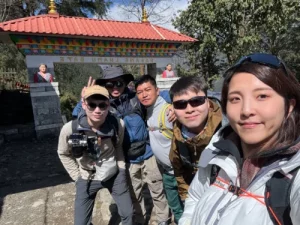
I recently completed a 14-day Everest Base Camp trek that left me speechless, thanks to the exceptional guidance and care provided by Jay, our guide, and his remarkable porter team. Jay's thoughtfulness, professionalism, and adaptability were evident throughout the journey as he went above and beyond to ensure our safety and enjoyment. His extensive knowledge of the region and ability to provide alternative options based on different scenarios were invaluable. The porters were incredible too, carrying our loads with diligence and always greeting us with warmth. Together, Jay and the porters formed a fantastic team that made the entire experience seamless and joyous. I highly recommend Jay and his team to anyone planning an Everest Base Camp trek. Their expertise, care, and positive energy will make your adventure truly unforgettable. Thank you, Jay, and the incredible porter team, for an incredible journey!

Unforgettable EBC Trek with Jay
I recently completed a 14-day Everest Base Camp trek that left me speechless, thanks to the exceptional guidance and care provided by Jay, our guide, and his remarkable porter team. Jay's thoughtfulness, professionalism, and adaptability were evident throughout the journey as he went above and beyond to ensure our safety and enjoyment. His extensive knowledge of the region and ability to provide alternative options based on different scenarios were invaluable. The porters were incredible too, carrying our loads with diligence and always greeting us with warmth. Together, Jay and the porters formed a fantastic team that made the entire experience seamless and joyous. I highly recommend Jay and his team to anyone planning an Everest Base Camp trek. Their expertise, care, and positive energy will make your adventure truly unforgettable. Thank you, Jay, and the incredible porter team, for an incredible journey!
Hong Kong, 2024

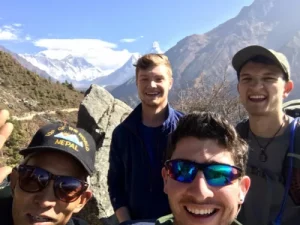
Everest Base Camp Trekking – 14 Days
Was referred to Harka by a friend who had done the 14 Days EBC Trek a few months before, and he was very easy to contact and quick to respond. We were a bit uneasy about booking with someone from the other side of the world, but Harka proved himself to be honest, professional, and reputable while organising our trip for us. Once we were in Kathmandu, he was easy to meet up with and was quick to help us out with anything we needed. Our guide, Mr. Dil, who met us in Lukla, was what really made our trip as amazing as it was. He was extremely knowledgable on the mountains and mountain passes, as well as getting us into tea houses and our flight home. He was very professional, friendly, and easy to work with, even though his English was a bit broken. Overall, it was an incredible trip, and I wouldn't hesitate to book with Harka again. If you do the EBC, ask for Dil, he's the man.
Canada, November 2018

Private trek to Everest Base Camp
I booked a private trek to Everest Base Camp so it was just myself and my guide / porter trekking together for 14 days. As a solo traveller I always invest a lot of time in to researching the company I book with, it was important to me to do this with a Nepalese tour company and the previous reviews were so encouraging and positive I decided to contact Himalaya Trip to see what they had to offer.
Harka responded almost immediately despite the time difference and sent me detailed information on the Everest Base Camp trek. He answered all my questions and always replied quickly which continued to give me confidence. They were also very competitively priced compared to other local companies and along with the great reviews I had a good feeling that Harka and his team would be the ones to get me to EBC.
Harka met me at the airport, took me to my hotel and helped get me any last minute bits I needed for the trek in Kathmandu. He made everything very easy and I felt safe and reassured the whole time which is important to me as a solo female traveller.
My guide / porter was called Dil and he was the man I was spending 14 days with trekking to EBC. Dil was fantastic, he looked out for me every step of the way, regularly checking in to ensure I was ok and did everything to make my experience on the trek as comfortable and as safe as possible. Dil was so knowledgable about the area and the mountains he would point out everything along the way. Despite him speaking broken English we could quite easily chat and communicate without any problems.
The trek was an incredible experience and one of the toughest yet most amazing things I’ve ever done and part of that was down to the efficiency and professionalism of Harka and his team. I didn’t have to worry or think about a thing, just getting to EBC.
UK, Nov 2018
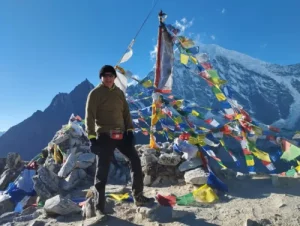
Great time on my walk to Everest Base Camp
I had a great time on my walk to Everest Base Camp from Himalaya Trip Team.
I have many positive comments and the main ones are:
– You were very efficient and helpful before I arrived, answering all my questions promptly and effectively so I knew what to expect when I arrived.
– I was met at the airport as planned, had a good briefing from you at the hotel and the hotel was comfortable.
– Everything happened as planned and it was a good timetable enabling me to to walk at my own pace and to properly acclimatise to altitude on the way up.
– My guide, Om Gurung, was excellent and very attentive. He obtained single accommodation for me every night and always checked that I had everything I needed before he looked after himself. When I was unwell on the way down he carefully monitored me, gave me throat tablets and did everything he could to ensure I was comfortable.
– My porter, Bikas, also did a very good job and was always helpful and pleasant.
– The standard of the lodges was good. The only comment is that often the washing facilities were sometimes very limited and at some lodges only consisted of a tap low down beside the toilet! This is not a comment about your company as I think it applies whichever company one uses. It is just difficult to understand why the washing facilities are often so limited and in short supply when all other features of the lodges are very comfortable!
– The price of the trek was competitive compared to some companies but the standard of care was equally good.
Uk, November 8, 2019

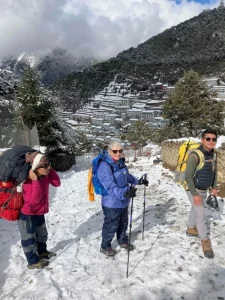
Trek to Everest Base Camp Experience
We had used Harka and his team previously in 2014 so knew to expect great service! Jay as guide and vicus as porter we had a private trek on EBC trek ! We had extreme weather conditions and jay made sure we stayed safe at all times !
Australia, March 2023

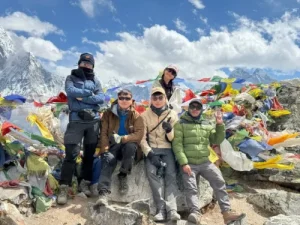
Good Experience of Himalaya trip’s EBC trek
It is amazing and good experience to join Himalaya trip’s EBC trek - 14 days. The tour guard - Jay and the porters are well arrangement and caring. They skillfully managed our changing circumstances and ensured our safety. And, really appreciate their efforts in making the trip a success.
Hong Kong, 04/2024

Cassandra & Cedric
Three Passes & Everest Base Camp

Pippa Jephcott
Pikey Peak Trek
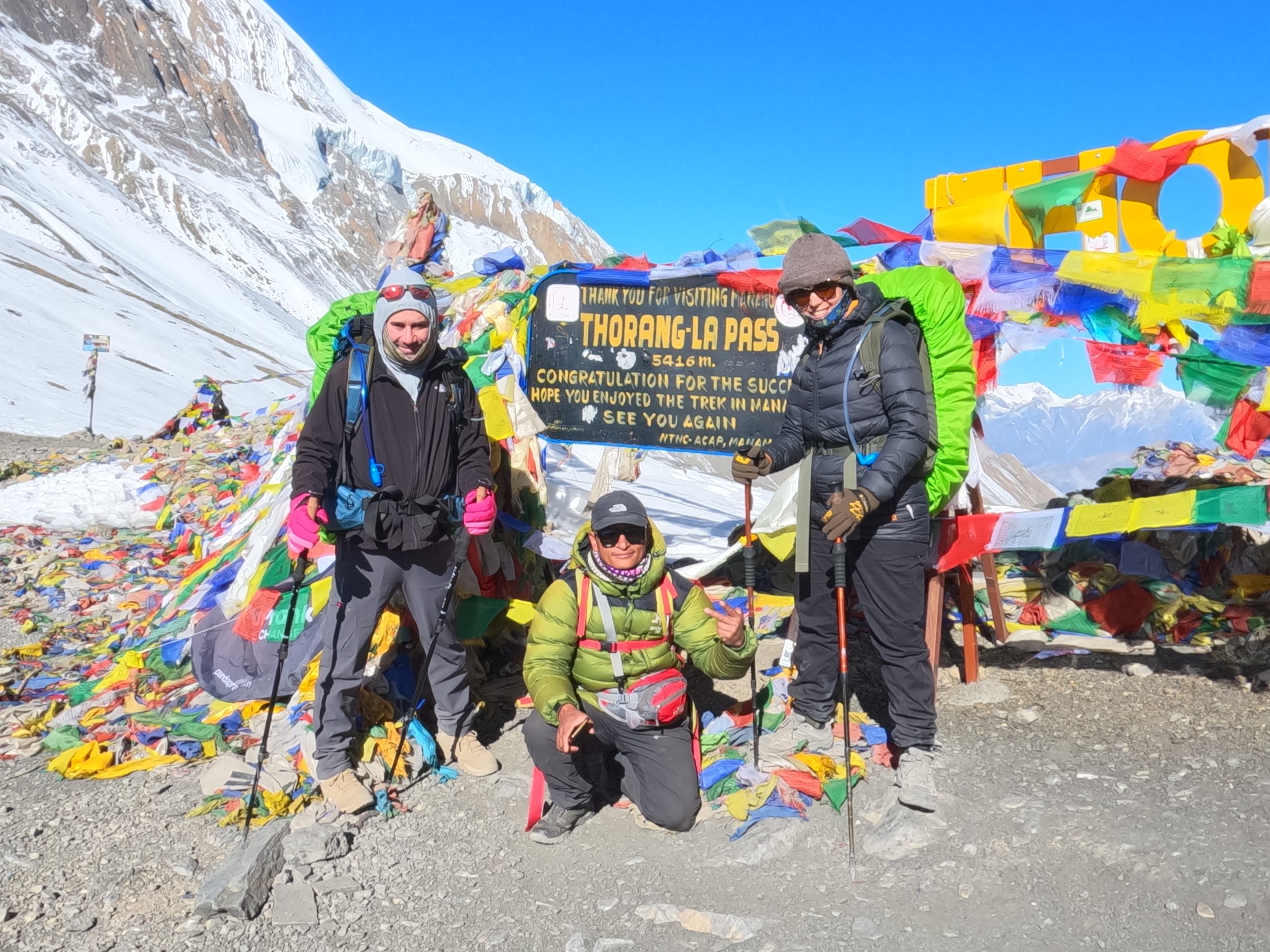
Majid, Sara and Shane
Annapurna Circuit Trek
Reviews from the globe

Hi! Im Sara, from Spain! Good morning! Yesterday we arrived from our 11-day trekking in Gokyo. There were 3 people from Spain, and I don’t know how to express how happy I felt. From the beginning, Himalaya Trip has been attentive to us, with a welcome at the hotel and...

Incredible!
Hi! Im Sara, from Spain!
Good morning!
Yesterday we arrived from our 11-day trekking in Gokyo.
There were 3 people from Spain, and I don’t know how to express how happy I felt.
From the beginning, Himalaya Trip has been attentive to us, with a welcome at the hotel and explanation of the route, rental of necessary equipment, etc.
The most important thing for us has been the ease and comfort with which Ramesh (our precious guide) has taken care of us at all time.
Attentive to the food, to make sure we didn’t get cold, adapting the route day by day according to the needs of the team.
I only have words of gratitude for Ramesh, who I would recommend for any trekking in the world.
In addition to being a great guide and knowing all the mountains of Nepal perfectly, he is a great person, with a big heart.
We hope to repeat in the not too distant future and hopefully it can be with him, since he is already part of our family.
Thank you for everything, from the bottom of my heart.
Thanks!!!!


Had an incredible experience doing the Mardi Himal trek with Himalaya Trip. Our guide Jay and our two porters Umesh and Masak were all simply incredible people. I’m a photographer so always have odd requests for weird areas to access for better angles or even simply just extending time in...
Couldn’t recommend enough
Had an incredible experience doing the Mardi Himal trek with Himalaya Trip. Our guide Jay and our two porters Umesh and Masak were all simply incredible people.
I’m a photographer so always have odd requests for weird areas to access for better angles or even simply just extending time in certain areas and all requests were met with so much help from the team. Highly recommend

I had an amazing time trekking with Surpa, particularly as this was my first solo trek. Beautiful views doing the Mardi Himal trek over 4 days, Surpa was a great guide who organised everything so well for me, kept me well fed, supported a good pace the whole way and...
Mardi Himal: fantastic trek & wonderful guide
I had an amazing time trekking with Surpa, particularly as this was my first solo trek. Beautiful views doing the Mardi Himal trek over 4 days, Surpa was a great guide who organised everything so well for me, kept me well fed, supported a good pace the whole way and always cheerful. Would recommend, and I would happily have him as my guide again in the future. The organisation and booking with Himalaya Trip was great, really responsive on emails and Harka was so helpful in organising everything and meeting me in Kathmandu for a briefing before the trip. Thanks so much!
Our 4 day Mardi Himal Trek with guide Milan and porter Plekta was a wonderful experience. The manager Harka Gurung met with us over coffee in Kathmandu and briefed us about expectations as this was our first trek. After that our guide met us at our hotel in Pokhara, helped...
Once in a lifetime experience in the Himalayas
Our 4 day Mardi Himal Trek with guide Milan and porter Plekta was a wonderful experience. The manager Harka Gurung met with us over coffee in Kathmandu and briefed us about expectations as this was our first trek. After that our guide met us at our hotel in Pokhara, helped us rent equipment, and handled all logistics in between. Our first time in the Himalayas was unforgettable between all the unbelievable landscapes and scenery, and we were lucky to have MIlan and Plekta with us to experience it all. I can’t begin to describe how ethereal sunrise is over the base camp, but hopefully you’ll be able to experience it soon!
Everest Base Camp Trek vs Annapurna Base Camp Trek
The Everest Base Camp and the Annapurna Base Camp are two of Nepal’s most popular trek destinations. However, they are very different from one another. Here is the comparison between these two iconic treks:
| Features | Everest Base Camp Trek | Annapurna Base Camp Trek |
| Region | Everest region | Annapurna region |
| Duration | 12-15 days | 5-12 days |
| Distance | ~130 km (80 miles) | ~110 km (68 miles) |
| Highest altitude | 5,545 m (Kala Patthar) | 4,130 m (Annapurna Base Camp) |
| Difficulty | Moderately to challenging | Moderate |
| Altitude sickness risk | High | Moderate |
| Access | Flight from Kathmandu/ Ramechhap to Lukla | Flight or drive from Kathmandu to Pokhara |
| Best time | Spring (March to May) and autumn (September to November) | Spring (March to May) and autumn (September to November) |
| Scenery | Mount Everest, Lhotse, Nuptse, Ama Dablam, Khumbu Glacier, and alpine terrain | Annapurna massif, Machhapuchhre (Fishtail), Hiunchuli, and lush rhododendron forests |
| Accomodation | Teahouses and lodges | Teahouses, lodges, and guesthouses |
| Culture | Mostly Sherpa culture | Gurung and Magar culture |
| Cost | US$ 1249 to 1,499 per person | US$ 399 to 699 per person |
Is Solo Trekking to Everest Base Camp Possible?
Yes, solo trekking to Everest Base Camp is possible. The standard route from Lukla to Everest Base Camp is well constructed and has many teahouses on the way. You can find food, rooms, drinking water, electricity, and basic services at regular stops. The trail is also easy to follow in most places because many trekkers, porters, guides, and local workers use the same route each day. During the main trekking seasons, you are rarely far from other people.
The Everest region also has health posts and emergency services at major places such as Namche Bazaar and Pheriche. However, solo trekking still needs planning because the trail reaches 5,364 m at Everest Base Camp. You need to allow enough time for your body to adjust to the altitude and know when to stop or turn back if you feel unwell.
What Is Kala Patthar, Why Is It the EBC Trek’s Highlight?
Kala Patthar is a 5,545 m rocky hill above Gorak Shep. Its name means “Black Rock” in Nepali and Hindi. The climb to the top adds about 181 m above Everest Base Camp, making it the highest point reached on the standard EBC trekking route. You do not need climbing ropes or special climbing skills to reach the summit.

One of the main reasons trekkers climb Kala Patthar is for the clear view of Mount Everest. From Everest Base Camp itself, the summit of Everest is partly hidden by Nuptse and the small mountain peaks. Kala Patthar is situated higher above the valley and gives a much clearer view of Everest’s summit. From the top, you can also see Lhotse, Nuptse, Ama Dablam, Pumori, Khumbu Glacier, and the exact South Col climbing route used by mountaineers.
The most popular time to climb Kala Patthar is before sunrise. As the sun rises, the light changes on Everest and the surrounding mountains. This early climb also makes Kala Patthar a fitting end to the journey after reaching Base Camp.
Everything You Need to Know About Lukla Flights
The common way of accessing the scenic trail of the Everest Base Camp is via the Lukla Airport flight from Kathmandu or Ramechhap. Usually, you will fly from the domestic terminal of Kathmandu Airport to Tenzing-Hillary Airport in Lukla. But during peak seasons, air traffic is heavy, and flights are diverted to Manthali Airport in Ramechhap. The flight to Lukla from the capital city takes around 30 minutes, while it only takes about 20 minutes from Ramechhap. However, you will have to take a 5-hour drive to Ramechhap first.
Lukla is located at an elevation of 2,845 m and is a main airport for trekking and shipping activities in the region. The Tenzing-Hillary Airport was built in 1964 with the help of Sir Edmund Hillary himself. Due to its short and sloping runway, spanning 527 m it is one of the world’s most adventurous airports. The flights operating here are mainly small aircraft, such as Twin Otters and Dornier 228s, and helicopters. These aircraft have seating for only 15 to 18, and the cabin is narrow with limited seating. There are also strict backpack weight limits, and passengers are only allowed 15 kg in total (10 kg for luggage + 5 kg hand carry). Lukla Airport serves as the major gateway to trekking and provides essential supplies in the Everest region.
As the weather in the Himalayas is unpredictable, the Lukla flights take place in the mornings. You can see challenging overland travel routes of Nepal while flying over forests, valleys, and terraced landscapes. Likewise, as you get closer to the Khumbu region, the white Himalayas will also become visible. During the peak season, 40 to 50 airplanes land in Lukla daily, and over 30,000 tourists visit the region through Lukla airport each year. Our EBC Trek package includes flights to and from Lukla for a seamless travel experience.
Where To Stay During the Everest Base Camp Trek?
Accommodation on the Everest Base Camp Trek is based around teahouses and mountain lodges. You can find these stays in Phakding, Namche Bazaar, Tengboche, Dingboche, Lobuche, Gorak Shep, Pheriche, and Lukla. In Phakding, Sherpa Guide Lodge provides rooms with toilet bathroom sharing. In Namche Bazaar, Khumbu Lodge is another option with rooms that can include an attached bathroom and a hot shower.
As you move higher toward Base Camp, accommodation becomes more basic, and room prices can increase. Tashi Delek Lodge in Tengboche has private rooms with shared bathroom facilities, while Hotel Stupa Inn in Dingboche provides rooms with attached bathrooms. At Lobuche, you can stay at New EBC Lodge, while Hotel Snow Land in Gorak Shep provides private rooms with shared bathroom facilities.
On the return journey, Everest Trekkers Lodge in Pheriche provides another place to rest before continuing toward Namche and Lukla. In Lukla, Everest Mountain Home has rooms with attached bathrooms and hot showers. Basic teahouse rooms can cost around US$ 5–10 per night at lower elevations and about US$ 15–30 or more at higher villages such as Lobuche and Gorak Shep. Hot showers, Wi-Fi, and device charging may cost extra.
Note: We can arrange private rooms with attached bathrooms at Namche, Dingboche, Lukla and Phakding, Tengboche, Pheriche , Lobuche, and Gorak Shep have common rooms with shared toilets, bathrooms, and hot showers provide (Lukla, and Namche).
Facilities and Services During the Everest Base Camp Trek
- Wi-Fi and Mobile Phone Network: There are mobile phone networks in all areas except Lobuche and Dingboche. Wi-Fi is available at all the Lodges at an extra charge.
- Charging device: The charging ports are mostly in the dining halls. The accommodations will charge extra fees per device. The private room with the attached bathroom also has a charging facility.
- Hot Shower: Accommodations in Namche and Lukla offer complimentary hot showers. If you want to take a hot shower at other stops, you may have to pay extra. Please note that they do not provide shampoo, soap, or a quick-dry towel. You have to carry them yourself.
- Blankets: The lodges have beds with blankets at the higher elevation. But it is not enough as the night temperature can get cold. You need to bring your own sleeping bag or buy or rent one in Kathmandu.
- Toilets: Most places have western toilets, except Gorak Shep and Lobuche. There are Asian toilets on the higher route because the water source will be ice, not running water. Toilet paper is not provided, so you must bring your own.
- Menu Foods and Local Foods: Nepali, Western, and Sherpa local foods are available along the EBC route. The locals believe in no animal sacrifice. Hence, to respect their religion, the foods are mostly vegetarian and vegan.
- Drinking water: You can use iodine tablets or environmentally friendly filters. You can fill up a water bottle every 2 or 3 hours while walking.
- Bakery and Coffee: If you are a coffee lover, most of the places offer you a coffee machine to serve you organic bean coffee and fresh bakery.
Popular Everest Region Festivals and Events
Mani Rimdu
One of the most important Buddhist festivals of the Khumbu region is the Mani Rimdu. Sherpa communities celebrate the sacred three-day festival at the Tengboche Monastery. The Mani Rimdu represents the victory of good over negative forces. During the three days of the festival, monks wearing colorful costumes perform various rituals. Each day of Mani Rimdu has its own significance:
- Day 1: The first day of the festival is called Wong, the empowerment. It falls on the full moon day of the tenth month in the Tibetan lunar calendar. On this day, the head Rinpoche gives out Mani Rilwu (blessed pills) and Tshereel (pills for long life) to attendees.
- Day 2: On this day, Chham, or the masked dances, are performed by the monks. When the monks are performing the dance, they are believed to become divine beings. The dances symbolize the victory of wisdom, compassion, and enlightenment over negative forces. It is also believed to cleanse the environment of negative energy. The dance also represents the Buddhist teachings.
- Day 03: The final day of Mani Rimdu is Jinsak or the Fire Puja. On this day, the monks perform the masked dances and special puja to Agni (the god of fire), and the gods of the mandala. These are followed by blessings for peace, health, and protection of all beings. Then the sand mandala is destroyed, symbolizing Buddha’s teaching that all things are temporary and constantly changing.
Mani Rimdu will be celebrated at Tengboche Monastery on 26th, 27th, and 28th October 2026.
Gyalpo Losar
Gyalpo Losar is the Sherpa New Year, celebrated on the first day of the Tibetan calendar. It is also the Tibetan New Year, and its calendar follows a 12-year cycle. The cycles are named after the mouse, cow, tiger, rabbit, dragon, snake, horse, sheep, monkey, bird, dog, and boar. On the day of Gyalpo Losar, the monks perform special prayers at monasteries in the Everest region. The Sherpa families clean their houses, visit the monasteries, and light butter lamps. They also prepare traditional food and drinks, which they enjoy together with dance and music. Gyaplo Losar is not only a new year but also the time for spiritual renewal for a fresh start.
The Gyalpo Losar or Sherpa New Year is on 7 February, 2027.
International Everest (Sagarmatha) Day or Everest Marathon
The International Everest (Sagarmatha Day) or Everest Marathon is held every year to honor the historic first ascent of Mount Everest by Sir Edmund Hillary and Tenzing Norgay Sherpa. The duo made history on 29 May 1953. The marathon is also the highest in the world. Every year, many runners worldwide participate in the event. It starts at Everest Base Camp and finishes at Namche Bazaar. The race has several categories:
- Half Marathon: 21 km
- Full Marathon: 42 km
- Extreme Ultra: 60-70 km
The Everest Marathon is one of the most challenging marathons in the world. It is a test of endurance in which runners push themselves to extreme altitudes and rugged terrain. The Sagarmatha Day, or Everest Marathon, is a day of celebration and pride that honors the spirit of mountaineering and Himalayan heritage.
Meet Everest Expedition Teams
If you want to see the Everest Expedition team, April and May are the perfect time to do the Everest Base Camp Trek. These months are the peak climbing seasons. Mountaineers from around the world visit the Everest region to attempt a summit climb to Mount Everest. You can meet expedition teams along the EBC Trekking route and teahouses. Likewise, you can also see expedition tents spread over the base camp. Meeting and talking with them provides incredible insights into the world of Everest mountaineering. It even allows trekkers to experience the exciting atmosphere of a Himalayan expedition.
Everest Base Camp From Tibet
The Everest Base Camp from Lukla is the southern base camp and the most popular among trekkers looking to reach the foothill of the world’s tallest mountain. However, there is a lesser-known North Everest Base Camp located in Tibet, China. Unlike the base camp from Nepal’s side, the northern base camp is accessible by vehicle. It allows the visitors to witness the north face of Mount Everest without a multi-day hike.
Our Tibet Lhasa Tour with EBC is the perfect tour for exploring the remote, less-traveled north Everest Base Camp. The tour begins with a drive from Kathmandu to the Nepal border, Kyirung. You will drive along a thrilling, scenic mountain road. From Kyirung, you will drive to Tingri and Ronbuk. You will take a short hike from Ronbuk to the north Everest Base Camp (5,150 m). Then, you will drive to Shigatse and to Lhasa via Gyantse. You will have two full days of sightseeing in Lhasa before flying back to Kathmandu.
Cost Breakdown for the Everest Base Camp Trek
The standard Everest Base Camp Trek costs around US$ 1,249–1,499 per person, while a luxury EBC trek can range from US$ 2,000 to US$ 5,000 or more. The costs depend on factors such as group size, trekking season, and the type of hotel chosen in Kathmandu and during the trek. Larger groups may receive lower per-person rates, while premium hotels and extra services can increase the total cost.
| Variable | Approximate Price (US$) | Notes |
| Permits: | US$ 50 – US$ 70 | Includes Sagarmatha National Park Permit, Khumbu Pasang Lhamu Rural Municipality. |
| Domestic Flights (Kathmandu – Lukla – Kathmandu): | US$ 400 – US$ 500 | Round-trip flights. Prices may vary by season and airline. |
| Accommodation (Tea Houses): | US$ 20 – US$ 30 per night | Budget-friendly tea houses offer basic accommodation, while more upscale lodges offer more amenities. |
| Meals (Breakfast, Lunch, Dinner): | US$ 30 – US$ 40 per day | Food costs can vary depending on your dietary preferences and whether you choose to eat at local restaurants or tea houses. |
| Guide and Porter Fees: | US$ 20 – US$ 30 per day | Hiring a guide and porter is recommended for safety and convenience. Prices may vary depending on the number of people in your group. |
| Travel Insurance: | US$ 50 – US$ 100 | Essential for covering medical emergencies and trip cancellations. |
| Gear and Equipment: | US$ 100 – US$ 500 | Costs can vary depending on whether you rent or buy gear. |
| Personal Expenses: | US$ 100 – US$ 200 | Includes souvenirs, snacks, drinks, and other personal expenses. |
Everest Base Camp Trek for Kids and Senior Citizens
Age has never been a real barrier on the Everest Base Camp trail. At Himalaya Trip, we provide private and fully customized Everest Base Camp Trek packages for families, kids, senior citizens, and travelers of different ages and fitness levels. If you’re trekking with kids or a senior citizen, we recommend building in 1–2 extra days.
Record Holder: Lucy Brown, at just 18 months old, reached EBC in January 2024. Oldest Known Trekker: David McClung reached Everest Base Camp at 82 years old in October 2025. These examples show that people of all ages can complete the trek with proper preparation and support.
Trekking to Everest Base Camp with Kids
Trekking with kids needs extra care and attention. At Himalaya Trip, we can customize the itinerary to make the trek smoother and manageable for young travelers.
- Add extra acclimatization and rest days
- Keep daily walking distances shorter
- Bring books, games, or other entertainment for rest stops and evenings
- Pack comfortable, kid-specific clothing and trekking gear
- Keep the schedule flexible and allow children enough time to rest
- Always have an exit plan, as children can be more vulnerable to altitude sickness and may not clearly communicate their symptoms
Trekking to Everest Base Camp with Senior Citizens
Senior travelers can also enjoy the Everest Base Camp Trek with a comfortable itinerary. We recommend taking things slowly and giving your body enough time to adjust to the altitude. Here’s what our packages include for senior travelers:
- Get a medical check-up before departure
- Extend the itinerary instead of rushing the trek
- Consider using trekking poles for additional stability
- Discuss the use of Diamox with your doctor before the trip
- Build in one or two extra buffer days
- Take regular breaks and maintain a comfortable walking speed
- Monitor altitude sickness symptoms carefully
Note: Himalaya Trip provides customized trekking services for kids, senior citizens, families, and travelers with different needs. Our team can adjust the itinerary, walking hours, rest days, transportation, and overall trekking arrangements.
What Permits Do You Need for the Everest Base Camp Trek
You will need a Khumbu Pasang Lhamu Municipality Entrance Permit and a Sagarmatha National Park Entry Permit. To explore the EBC trek, trekkers must obtain the necessary permits.
| Permit | Who Needs It | Fee |
| Sagarmatha National Park Entry Permit |
|
|
| Khumbu Pasang Lhamu Rural Municipality Permit |
|
|
Optional Permit: Gaurishankar Conservation Area Permit
If you plan to travel to Everest Base Camp from Jiri, you will need a Gaurishankar Conservation Area Permit. First, take a bus or drive to Jiri. The trip takes 7 to 8 hours from Kathmandu. Once you arrive in Shivalaya (at the Nepal Tourism Board in Kathmandu) , get your permit, and then you can start your hike to Everest Base Camp. The cost of the Gaurishankar Conservation Area permit is NPR 1,500 (~US$ 10) per person for SAARC Nationals and NPR 3,000 (~US$ 25) per person for non-SAARC Nationals.
Note: You can obtain these permits from the Nepal Tourism Board Office in Kathmandu or at the Monjo and Lukla checkpoints. If you’re traveling with us, we’ll arrange the permits for you.
Essential Information for Your Arrival in Nepal
Nepal Visa on Arrival
You have to fill out an online form before you leave your home country and bring it with you. Your passport must also have at least 6 months of validity remaining before expiry. Once you arrive at Tribhuvan International Airport in Kathmandu, you must submit the form, pay the visa fee, and proceed to the immigration counter for visa processing. Please bring the visa fee in cash (US dollars). You can also apply for a visa in advance through a Nepalese embassy or consulate.
Please note that citizens from Nigeria, Ghana, Zimbabwe, Swaziland, Cameroon, Somalia, Liberia, Ethiopia, Iraq, Palestine, Afghanistan, Syria, and Refugees with travel documents are not eligible for an on-arrival visa.
Buying a Local SIM Card
If you want to buy a local SIM card, you can do so at Tribhuvan International Airport in Kathmandu upon arrival. There are Namaste and Ncell service counters in the arrival area. You can also buy the SIM at mobile service centers and authorized retailers. All travelers must provide a copy of their valid passport and a passport-sized photograph to obtain the SIM card.
There are various plans you can choose as per your data and calling needs. Mobile internet in the Everest region can get weak and slow as you ascend to higher altitudes. You will mostly get the data of 2G or 3G only.
Money Exchange
Most of the trekkers do not want to carry cash for safety reasons. However, cash is king, especially in remote areas of Nepal. Additionally, using a credit card will always incur extra fees. Sometimes there is the problem of withdrawal limitation, and you can’t withdraw enough money. Bringing cash is easier. You can easily exchange at Tribhuvan International Airport in Kathmandu or at an exchange center near your Hotel.
Airport Pickup & Trek Briefing
Our representative will pick you up at Tribhuvan International Airport in Kathmandu. They will be holding a placard with Himalaya Trip written on it. They will welcome you and help with the transfer to your Hotel. Our team leader will meet at your appropriate time for a briefing and collect the balance payment in US dollars.
Recommended Hotels in Kathmandu
There are a variety of Hotel options available in Kathmandu. Budget Hostel, Nepali typical, luxury, etc. We understand that trekkers like to stay in comfortable hotels before and after the trek. We provide Kathmandu Guest House on this package which is middle class Hotel.
Challenges of the Everest Base Camp Trek
While most hikers are well-aware of the steep climbs and the risk of altitude sickness, the Everest Base Camp Trek also comes with physical and mental challenges that are overlooked in standard travel guides. Let’s have a look at some of the major challenges you may face if you’re not properly prepared:
- The trail reaches 5,364 m at Everest Base Camp, where lower oxygen levels can cause headaches, tiredness, dizziness, and breathing difficulty.
- Temperatures can fall at higher villages such as Lobuche and Gorak Shep, where basic teahouse rooms may have little or no heating.Cold and dry mountain air can irritate your throat, while dust from the trail can make coughing and throat discomfort worse.
- Hot showers are less available at higher elevations, while drinking water becomes more expensive, so trekkers need to plan their water supply carefully.
- Weather can change quickly in the mountains with fog, snow, strong winds, and poor visibility that may affect walking plans and flights.
- Some trekkers lose their appetite at high altitude, which can make it harder to get enough energy from meals during long walking days.
- The sun feels stronger at high altitude. Snow and ice can reflect sunlight toward your eyes, so UV-protection sunglasses, sunscreen, and a hat are important.
Choosing the Right Season for Everest Base Camp
The best times to do the Everest Base Camp Trek are spring (March to May) and autumn (September to November), because these months bring consistent weather and comfortable trekking conditions. However, the EBC Trek is possible throughout the year with suitable preparation. Here is a brief on each season so that you can decide on the best time for this trek:
| Season | Months | Lukla (2,860 m) | Namche Bazaar (3,440 m) | Dingboche (4,360 m) | Everest Base Camp (5,364 m) | Best For |
|---|---|---|---|---|---|---|
| Spring | Mar–May | 5°C – 18°C (41°F – 64°F) | 0°C – 15°C (32°F – 59°F) | -5°C – 10°C (23°F – 50°F) | -10°C – 2°C (14°F – 36°F) | Best overall conditions, clear mountain views, and Everest climbing-season atmosphere |
| Summer | Jun–Aug | 12°C – 22°C (54°F – 72°F) | 7°C – 18°C (45°F – 64°F) | 2°C – 14°C (36°F – 57°F) | -2°C – 8°C (28°F – 46°F) | Trekkers who prefer fewer crowds and do not mind rain |
| Autumn | Sept–Nov | 7°C – 20°C (45°F – 68°F) | 2°C – 16°C (36°F – 61°F) | -4°C – 12°C (25°F – 54°F) | -8°C – 5°C (18°F – 41°F) | Best overall season for clear views, stable weather, and comfortable trekking |
| Winter | Dec–Feb | -2°C – 10°C (28°F – 50°F) | -8°C – 6°C (18°F – 43°F) | -15°C – -2°C (5°F – 28°F) | -20°C – -5°C (-4°F – 23°F) | Experienced trekkers who want fewer crowds and can handle extreme cold |

Everest Base Camp Trek Safety
Safety is the top priority in how we organize your trek. Every itinerary includes two acclimatization days, one in Namche Bazaar and one in Dingboche. Your guide is first-aid trained and carries a first-aid kit along with a fingertip pulse oximeter to check your oxygen saturation and pulse daily. Beyond what we build into the itinerary, a few things are on you as a trekker:
- Stay hydrated
- Ascend slowly above 3,000m
- Follow the “climb high, sleep low” rule
- Protect yourself from the sun and cold, as temperatures can change quickly.
- Never ignore your body’s warning signs
- Know when to turn back
- Buy travel insurance with helicopter evacuation coverage
- Talk to a doctor about Diamox before you go
Altitude Sickness on EBC Trek: Safety Guide
Altitude sickness can occur at elevations above 3,500 m and becomes a major concern on the Everest Base Camp Trek as the route reaches 5,364 m. Acute Mountain Sickness (AMS) is the most common form and can cause headache, nausea, dizziness, tiredness, and difficulty sleeping. In severe cases, it can develop into HAPE or HACE, which require immediate medical attention and descent. Around 10–20% of trekkers may fail to reach Everest Base Camp due to altitude-related problems.
Even before going on the Everest trek, it is essential to understand its symptoms and take proper precautions. Some of the best ways of preventing or minimizing it are as follows:
- Acclimatization is the best way to prevent altitude sickness.
- Maintain a slow speed and listen to your body. Do not over-exert yourself or ignore the symptoms of altitude sickness.
- Take rest days as planned and avoid rushing to higher elevations.
- Eat a proper diet, rich in protein and carbohydrates during the trek to maintain your energy levels and reduce the risk of AMS.
- Maintain hydration by drinking 3 to 5 liters of water daily. Dehydration often worsens the symptoms of altitude sickness.
- Be mentally and physically fit for the long distance and duration of the EBC trek.
- Bring medication such as Diamox (Acetazolamide) to prevent symptoms if needed.
- Travel with a licensed and experienced guide and porter. They are trained to recognize symptoms and respond early.
- Tell your guide immediately if symptoms appear or become worse.
Alternative Ways to Experience Everest Base Camp
Everest Base Camp Trek – Cho La Pass with Gokyo Lake
If you want a more challenging adventure in the heart of the Khumbu region, the Everest Base Camp Trek with Gokyo Lake is the perfect option. The trip combines two of the best trekking routes: the classic Everest Base Camp and the remote and quieter Gokyo Lakes via Cho La Pass. You will follow the main trail to the base camp and Kala Patthar, then diverge onto the remote trail.
It gives you an opportunity to witness the turquoise Gokyo Lakes and pass one of the most challenging passes, the Cho La Pass. The trek is an excellent choice for trekkers with a flexible schedule who want to experience the best of the region.
Everest Base Camp Trek with Lobuche East or Island Peak Climbing
For those who want the best of the trekking and mountaineering world, they can customize the EBC Trek with Lobuche East or Island Peak Climbing. The Lobuche East (6,119 m) and Island Peak (6,189 m) are two popular trekking peaks in the Everest region. These peaks are perfect as an introductory mountaineering journey for beginners or a training ground for 7,000 or 8,000 m expeditioners.
The Lobuche East Peak is popular for its moderately challenging ridge climb and mesmerizing panoramic mountain views. Meanwhile, Island Peak is famous for its challenging “Summit Headwall” and spectacular summit views. Combining the EBC Trek with peak climbing changes the trip into a true Himalayan climbing experience.
Phaplu Everest Base Camp Trek
The Phaplu Everest Base Camp Trek is a great alternative for trekkers who want to try a drive-in-fly-out approach. It adds an extra 3 days to the standard 14 Days EBC Trek. You will drive from Kathmandu to Phaplu and start your trek from here onwards. The trail from Phaplu takes you through the lower Everest region and lesser-visited villages like Nunthala and Bupsa before joining the main trail.
You will end the trek with a flight from Lukla to Kathmandu. Choosing to start from Phaplu gives you more time to acclimate and offers a more enriching cultural experience.
Jiri Everest Base Camp Trek
If you truly want to follow the historic route that follows the original footsteps of Sir Edmund Hillary, Tenzing Norgay, and the early expedition team, the Jiri Everest Base Camp Trek is for you. It is the “real” route to approach the base camp. You will drive from Kathmandu to Shivalaya. From Shivalaya, you will trek through the lower Everest region and join the main Everest trail at Lukla. Although starting from Jiri adds extra days to the trek itinerary, the trek offers a deeper, more authentic EBC experience.
Everest Three Passes Trek
The Everest Three Passes Trek is a more challenging and adventurous trip. It is ideal for adventurers and trek enthusiasts who want to explore the very best of the Everest region. You will trek on the main trail to Everest Base Camp and Kala Patthar. Then, you will take the side trail and cross the high mountain passes of Kongma La, Cho La, and Renjo La. You will also get to explore the remote Gokyo Valley and the turquoise Gokyo Lakes. The Three Passes or Everest Circuit Trek is a demanding but rewarding adventure worth the effort.
Gokyo Lake Trek
For those seeking a quieter alternative to the Everest Base Camp, the Gokyo Lake Trek is an ideal choice. Compared to the busy, crowded main trail, the Gokyo Lake Trekking trail offers peaceful solitude. You will start trekking from Lukla to Namche. From here, you will start through traditional Sherpa villages like Mong La, Dhole, Maccherma, Lungdhen, Thame, and more.
Similarly, you will cross the Ngozumpa Glacier, the largest glacier of Nepal, to reach the hidden Gokyo Valley. The Gokyo Lake Trek is a rewarding high-altitude adventure with spectacular views and rich cultural experiences.
Everest View Trek
Not all trekkers may have time for a long, multi-day trek. For such trekkers, we have the Everest View Trek. The trek starts from Lukla and takes you past the Sherpa villages of Phakding and Namche Bazaar. From Namche, you will hike up to the Everest View Hotel and Khumjung village.
You will not trek to Everest Base Camp, but you will still have the opportunity to get a close-up view of Mount Everest and the surrounding giants. The short Everest View Trek is perfect for first-time trekkers, families, and trekkers with limited time.
Everest Base Camp Helicopter tour
The Everest Base Camp Helicopter Tour makes the dream of reaching base camp a reality for all travelers who do not have the physical ability or preparation to trek. It allows them to witness the grandeur of the world’s highest mountain and other giants from up close and unique aerial views.
The helicopter tour is also a luxurious and convenient way of reaching the mountains. You will fly over villages, forests, valleys, rivers, and glaciers. Aside from travelers with limited time, the helicopter tour is an excellent way to celebrate anniversaries, birthdays, and family time.
Can We Book a Helicopter Flight From Kathmandu to EBC?
Yes, you can book a helicopter flight from Kathmandu to EBC. For those with limited time or who prefer not to take a physically strenuous trek, the one-day Everest Base Camp Helicopter Tour is an option. It is a unique and convenient method to get to this iconic destination.
The EBC Helicopter Tour offers an opportunity to fly over the scenic Khumbu region and witness the snow-capped vistas in an aerial view. You can see the gorgeous Everest massif and marvel at the Mahalangur Himalayan range in a bird’s-eye view. Soaring over the green forests, streams, rivers, valleys, and glacial moraines is a thrilling experience that you cannot experience otherwise. You will fly from Kathmandu and land at Lukla for a short refueling stop. Then, you will fly to Pheriche from where you will soar over the Everest Base Camp and Kala Patthar. You will also have the opportunity to dine at one of the world’s highest luxury hotels, the Everest View Hotel, before returning to Kathmandu.

A helicopter flight from Kathmandu to EBC is a once-in-a-lifetime experience. You can also personalize the trip as per your requirements and preferences. A standard shared flight can cost US$ 1,175 to 1,450 per person, while a private charter can cost from USD 5,500 to 7,500 per person. If you want to combine both trekking and a helicopter tour, you can take an EBC Trek with a helicopter return. You can enjoy adventurous trekking on the classic trail to the Everest Base Camp, and then, instead of a downhill hike, you will take a heli back to Kathmandu.
Do You Need a Guide for the Everest Base Camp Trek?
Yes, practically, operationally, and from a safety perspective, you absolutely need a guide for the Everest Base Camp Trek. A local guide assist you with route planning, permits, accommodation, and changing trail conditions. They can also communicate with lodge owners and local authorities in Lukla, Monjo, Namche Bazaar, and other checkpoints, which can make the journey much easier for trekkers who do not speak Nepali.
A guide becomes even more valuable at higher elevations, where Base Camp is situated at 5,364 m. They can recognize early signs of altitude sickness, such as headache, dizziness, nausea, and unusual tiredness, and can arrange a descent or medical support when necessary. During busy seasons, guides can also arrange rooms at teahouses before you arrive. For these reasons, hiring an experienced and licensed guide adds an important level of safety, local knowledge, and practical support to the trek.
Food Menu During the Everest Base Camp Trek
The teahouses and lodges along the Everest Base Camp Trek provide meals and have their own meal. The menu includes dishes that range from local to international, so you will have your own choice. Almost all ingredients are locally sourced, and the food is hygienic. However, manage your expectations as it is not like city food. Non-veg foods are not recommended, as they may not be hygienic or disrespectful in Sherpa culture. The menu at lower altitudes offers more variety compared to higher altitudes. Do not forget to try some Sherpa foods like Shyakpa (Sherpa Stew), Tsampa porridge, Su-chya (butter/Salt Tea), Thukla (Riki Kur), Potato pancake, momo, Kur (Tibetan Bread), etc.

- Breakfast: Simple Breakfast (Eggs, any item with hashbrown potato, toast, Tibetan Bread, Pancake, Muesli, Oat Porridge, etc.)
- Lunch and Dinner : Nepali Thali (Plain Rice, Lentil soup, Potato Curry, Green Vegetable, Papadam, Tomato Hot spicy, Chicken curry optional), Macaroni, Spaghetti, Potato item, Mo.Mo or dumplings, Pizza, fried rice, Fried Noodles, French fries, etc.
- Dessert: Fresh Fruit (Apple, orange, pomegranates, Banana with any seasonal fruit) served as a sweet dessert. It cost extra.
Note: Soft, hot, and alcoholic drinks are not included in the package.
Responsible Trekking & Sustainability
Carbon pollution and global warming are major issues in Nepal and worldwide. The impact of global warming has also impacted the mountains. It has resulted in irregular rainfall, glacier melting, and changes in the snowfall cycle. Hence, it is more necessary than ever to practice responsible trekking and sustainability.
We urge our clients to follow responsible trekking to reduce their carbon footprint during the Everest Base Camp Trek. Here are some ways you can contribute:
- Avoid using wet tissue: Many trekkers use wet tissue to wash their bodies and faces. It creates unnecessary waste in high-altitude areas where waste management is very difficult.
- Drive Iodine purification or filter water instead of a bottle of mineral water. It helps to reduce waste and protect mountain ecosystems.
- Avoid canned or packaged foods. These also create unnecessary waste that you must carry back.
Walk in and out and avoid using helicopters except in emergencies. It helps to reduce the carbon footprint and preserve the natural beauty of the Everest region.
Budget-Friendly Everest Base Camp Trek with Himalaya Trip
Himalaya Trip is one of the best company for Everest Base Camp Trek and most renowned trekking agencies in Nepal. There are many benefits to choosing our 14-day EBC trek. So let’s get into more detail.
- Multiple trekking packages: The Himalaya trip offers multiple types of trekking packages to EBC. The standard 14-day package includes accommodation, meals, guidance, airfare, and permits, which is the basic package.
- Luxury accommodation: We offer the Luxury Everest Base Camp Trek that provides comfortable teahouses (Yeti Mountain Homes) during your trek.
- Helicopter return option: You can add a helicopter return to Kathmandu after your trek is completed to the EBC Trek package. It reduces the itinerary to 10 days since your return journey to Lukla will only take 20 minutes from Gorak Shep.
- Customizable itinerary: The Everest Base Camp Hike offers customizable packages tailored to your preferences. Whether you’re seeking a luxury experience or a budget-friendly option, you can easily book them as part of a Himalayan trip.
Trips You May Like
Everest Base Camp Trek With Helicopter Return
12 Days
Trekking
USD 1,949 per person
Phaplu to Everest Base Camp Trek
15 Days
Trekking
USD 1,299 per person
Everest Base Camp and Gokyo Lakes Trek
15 Days
Adventure Treks
USD 1,449 per person