Winter and Monsoon Special Offer! Get 5% off on all trekking packages in Nepal . Visit during June , July, August, December , January and February and take advantage of this limited-time deal.


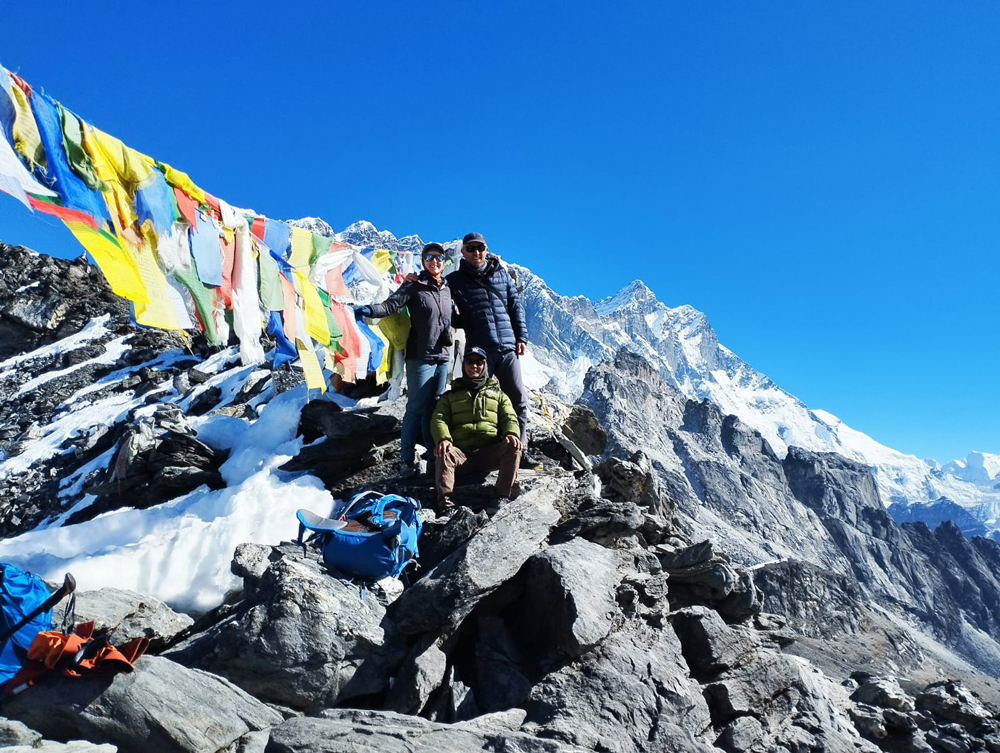
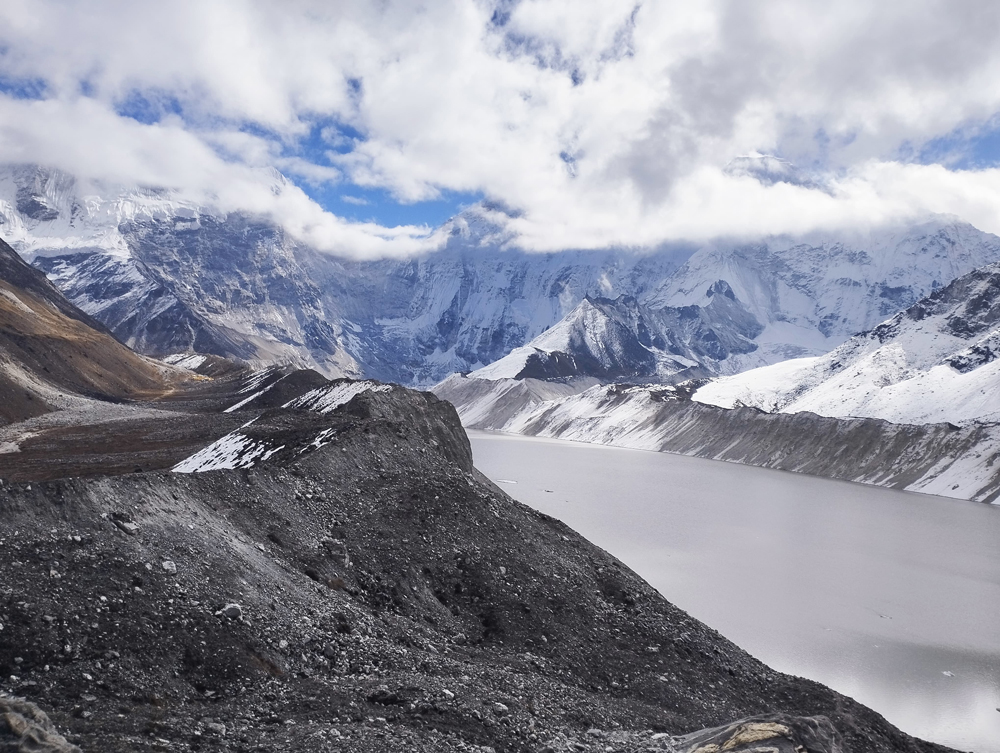


Why You'll Love the Island Peak Climbing
- An opportunity to experience real Himalayan mountaineering without extreme altitude risk.
- Feel the adventurous trekking trail transform into a thrilling peak-climbing experience in a single journey.
- A scenic flight to the adventurous Tenzing-Hillary Airport, Lukla, to kick-start the expedition in the heart of the Everest region.
- Trek on the classic Everest trail before joining the quieter and off-route trail to Imja Valley.
- Walk on diverse terrain from dense subtropical forests to alpine meadows, then navigate glaciers, crevasses, and climb ice walls.
- Trek to Everest Base Camp (5,364 m), Kala Patthar (5,550 m), and Kongma La pass (5,535 m) offer the view, extra achievement, and better acclimatization.
- Challenge the famous “Summit Headwall,” and stand on top of Island Peak at 6,189 m.
- Enjoy the views of the towering Himalayan giants, including Mount Everest, Lhotse, Makalu, and more, from the summit.
- Get to experience a true Himalayan summit and gain high-altitude climbing experience above 6,000 m.
- Traverse age-old monasteries, mani walls, and trails decorated with colorful prayer flags, experiencing the region’s deep spirituality.
- Take a closer look at Sherpa culture and their Himalayan lifestyle as you pass through traditional villages.
Activity
Adventure Treks
Altitude
6,189 m / 20,305 ft (Island Peak summit)
Best Season
Spring (March to May) and Autumn (September to November)
Meals Included
17 breakfasts, 16 lunches, and 16 dinners
Transportation
Flight / Drive (if flights are directed to Ramechhap)
Accommodation
Hotel, lodges, and 1 night at a tented camp
Duration
18 Days
Region
Everest Region Treks
Start / End Point
Kathmandu/ Kathmandu
Group Size
2
Nature Of Trek
Teahouse trekking, trekking peak climb
Difficulty
Moderate to Challenging
Overview of Island Peak Climbing
The Island Peak Climbing is one of the most popular trekking peaks in the heart of the Everest (Khumbu) region. Locally known as Imja Tse, it is a perfect Himalayan adventure that combines trekking with Alpine PD+ mountaineering. The peak stands tall at 6,189 m (20,305 ft) and is famous as one of the practice peaks of the Himalayas. It follows the classic Everest trail, then to a quieter route within the Sagarmatha National Park, before you actually climb the peak.
Starting with a thrilling flight to Lukla, the initial Island Peak Climbing trail winds along the Dudh Koshi River in Dudh Koshi Valley. It takes you through lush forests of rhododendron and pines. As altitude increases, the landscape and vegetation also change. It shifts from alpine meadows to glacier terrain. Similarly, the route takes you through the traditional Sherpa villages, ancient monasteries, mani walls, and chortens.
Along the way, you will also acclimate to help your body adjust to the high altitude. You will go to Lobuche, Gorak Shep, Everest Base Camp, Kala Patthar, and Kongma La Pass first to Chhukung. Then, you will enter the Imja Valley towards Island Peak. The trail occasionally goes alongside the Imja River through the valley. Climbing higher, you will ascend through rocky terrain towards Island Peak Base Camp. Island Peak is located on top of the Chhukung glacier between Mount Ama Dablam (6,812 m) and Lhotse (8,516 m). To reach the summit, one can start from a base camp at 5,087 m (16,690 ft) called Pareshaya Gyab. Another popular option is to ascend to High Camp at around 5,600 m (18,400 ft) to reduce the effort and time necessary on the summit day.
However, many climbers start from base camp because of better water access and a lower sleeping altitude. Base camp to high camp is basically a hike, but above high camp, it becomes more demanding. Some rocky steps require moderate scrambling and lead up through a broad, open gully. At the top of the gully, glacier travel begins and proceeds up to a steep snow and ice slope. From here, fixed ropes may be set up by the guides for the strenuous ascent of nearly 100 m (330 ft) to the summit ridge.
Why Choose Island Peak Climbing?
Island Peak Climbing offers a rare combination of trekking, alpine climbing, and cultural immersion in a single trip. The accessibility, diverse landscapes, and mesmerizing mountain scenery also make it a popular choice among climbers and adventurers. There are many other reasons for choosing Island Peak Climbing, which are as follows:
Dual adventure in a single trip
Island Peak Climbing is not just a trek or just a climb, but a combination of both. It is rare for a single trip to have both experiences. You will start by trekking the classic Everest Base Camp route from Lukla to Dingboche. Then, the route branches to Chhukung via Kongma La Pass and the Island Peak Base Camp. From the base camp, the expedition phase begins. The adventurous high-altitude trek and thrilling alpine climb are a rare balance. Hence, the journey is ideal for those seeking more than walking trails but without committing to a full-scale expedition.
A full expedition experience
One of the top reasons to choose Island Peak is for a complete, raw Himalayan expedition experience. Although it is classified as a trekking peak, you will need basic mountaineering and moderate technical skills. From glacial travel to crevasse crossings and steep ice-climbing, the adventure will test one’s fitness, endurance, and skills. Similarly, you will also experience expedition-style planning, base camp stay, climbing preparation, and a summit push. It is challenging, but reaching the summit is a rewarding and life-changing achievement.
True Himalayan climb without extreme altitude exposure
Another reason to choose Island Peak is that you can experience mountaineering without the extreme altitude risk. It is challenging but more accessible for well-prepared climbers. Compared to 7,000 or 8,000-m peaks, the physical demands are relatively lower. Likewise, the risk of exposure to high altitude and low oxygen levels for a longer period is also lower. It makes Island Peak ideal for climbers seeking a serious mountain challenge without the complications of high-altitude expeditions. As a result, the peak is a popular entry-level peak and training ground for higher Himalayan expeditions.
Flexible climbing strategy and acclimatization
When it comes to summit planning and acclimatization, Island Peak offers more flexibility than others. You take strategic acclimatization at Namche Bazaar (3,440 m) and Dingboche (4,410 m). Then, you will hike to Everest Base Camp, Kala Patthar, and Kongma La. It gives you adequate time to adapt to the high altitude, minimizing the risk of altitude sickness. Similarly, depending on one’s fitness, weather conditions, and preference, the climbing strategy can also be customized. You can choose to make the summit push from Island Peak Base Camp (5,087 m) or High Camp (5,500 m). Guides can make a plan according to the individual’s needs and weather conditions. It is a massive advantage in the Himalayas, where the weather is unpredictable.
Diverse terrain and Himalayan Panorama
Among the reasons to choose Island Peak is the opportunity to trek through the diverse terrain of the Khumbu region and enjoy spectacular Himalayan views. You will start in lush, dense rhododendron forests. With the elevation gain, the vegetation and landscape change as well. The lush forest changes to conifers and alpine meadows, then to glacial valleys and rocky moraines. Similarly, from the Island Peak Base Camp, the landscape changes to high-altitude snowfields. The constant scenery change keeps each day immersive and enjoyable. The highlight of the journey is undoubtedly the gorgeous mountain views. Throughout the trail, you can enjoy the panoramas. Then, from the top of the Island Peak, you can get panoramic views of the Himalayas.
Rich cultural immersion in the Sherpa’s land
Beyond the mountains and changing landscapes, the Island Peak Climbing also offers a rich Sherpa culture. The Everest region is often called the homeland of the Sherpa people. They have always been an integral part of guiding, mountaineering, and expedition support. During the trip, you will trek through traditional Sherpa villages and age-old monasteries. You will pass by stone houses adorned with prayer flags. Similarly, you will stay in locally run teahouses that offer a chance to closely glimpse their culture and lifestyle, which is deeply connected to Tibetan Buddhism and the mountains. It makes the climb richer and more rewarding.
Climb Island Peak and Conquer the Everest Region
Island Peak (6189 m) is one of the most popular climbing peaks in Nepal. This trek combines a thrilling climb with stunning views of Everest, Makalu, and Lhotse. If you’re looking for an adventure beyond trekking, Island Peak offers the challenge you’re seeking, all while enjoying the beautiful Everest region.

18 Days Island Peak Climbing Outline Itinerary
Day 01:
Arriving in Kathmandu (1,340 m), transfer to the hotel.
Day 02:
Kathmandu - Lukla by flight, trek to Phakding (2,610 m / 8,563 ft, 8 km or 3 hours walk).
Day 03:
Phakding - Monjo - Jorsalle - Namche (3,440 m / 11,290 ft, 11 km or 5-6 hours walk).
Day 04:
Hike to Everest View Hotel to see the world’s highest peak, Mt. Everest, and the other Himalayas views, visit Khumjung village, and back to Namche (6.6 km or 3-4 hours walk).
Day 05:
Namche - Kyangjuma - Phunki Tenka - Tengboche (3,860 m / 12,664 ft, 9 km or 5-6 hours walk).
Day 06:
Tengboche - Pangboche - Somare - Dingboche (4,410 m / 14,465 ft, 11 km or 4-5 hours walk).
Day 07:
Hike to Nangkar Tshang Peak (5,083 m / 16,676 ft) for acclimatization, then back to Dingboche.
Day 08:
Dingboche - Thukla - Lobuche (4,940 m / 16,207 ft, 8 km or 5-6 hours walk).
Day 09:
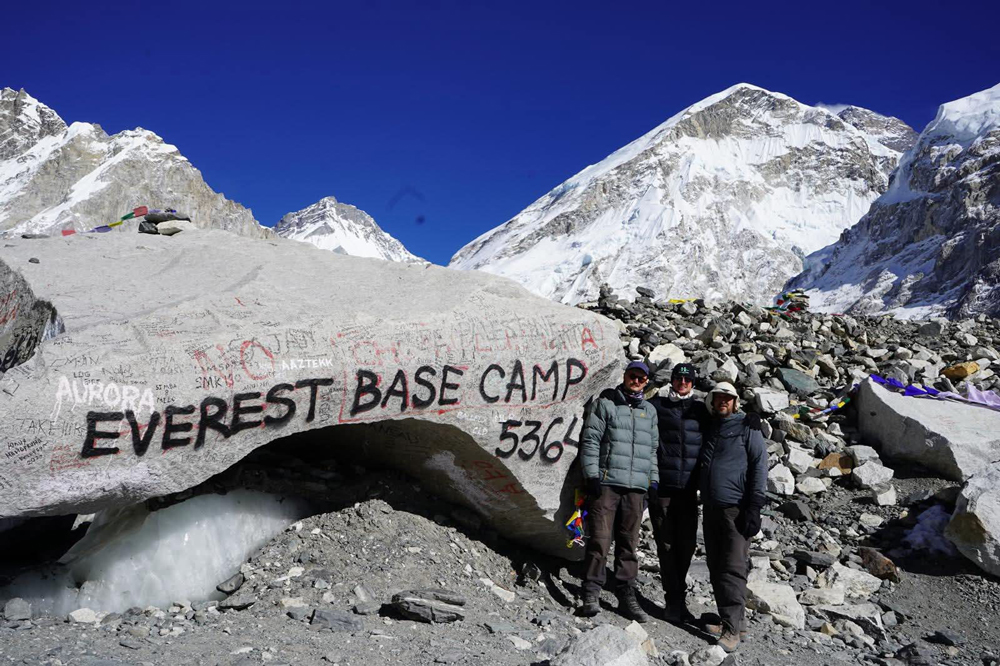
Trek to Gorak Shep (5,146 m / 16,942 ft, 11 km or 7-8 hours walk), Hike to Everest Base Camp (5,364 m / 17,598 ft).
Day 10:
Hike to Kala Patthar (5,550 m / 18,209 ft), trek to Lobuche (4,910 m / 16,207 ft, 8.4 km or 5-6 hours walk).
Day 11:
Cross to Kongma La Pass (5,535 m / 18,159 ft), trek to Chhukung (4730 m / 15,518 ft, 9.8 km or 8-9 hours walk).
Day 12:
Trek from Chhukung (4730 m / 15,518 ft) to Island Peak Base Camp (5,100 m / 16,732 ft, 6.7 km, 4-5 hours walk), overnight at Tent Camp.
Day 13:
Climb to Island Peak (6,189 m / 20,305 ft), trek down to Chhukung (4,730 m / 15,518 ft, 8.4 km or 12-13 hours walk).
Day 14:
Contingency day in case of bad weather or not ready to climb the peak.
Day 15:
Chhukung – Tengboche - Namche (3,440 m / 11,290 ft, 24 km or 7-8 hours walk).
Day 16:
Namche - Monjo - Phakding - Lukla (2,860 m/ 9,383 ft, 19 km or 6-7 hours walk).
Day 17:
Fly from Lukla to Kathmandu, then drive to your Hotel.
Day 18:
Departure from Kathmandu (1,350 m).
Island Peak Climbing Itinerary
Arriving in Kathmandu (1,340 m / 4,396 ft), transfer to the hotel.
Activity
Airport Pick Up
Highest Altitude
1,345 m / 4,396 ft, Kathmandu
Accommodations
Kathmandu Guest House or similar
Your Island Peak Climbing journey begins the moment you arrive at the Tribhuvan International Airport in Kathmandu. You will go through immigration and visa formalities before heading to the exit terminal. Our representative will be waiting for you at the exit, holding a name board. They will help you transfer to your hotel.
After checking in at your hotel, you will have time to freshen up and rest. In the evening, we will hold a short trip briefing about the Island Peak Climb. If you have any queries, you can ask us. With the spare time, you can explore around the hotel or do last-minute shopping. You will stay overnight in Kathmandu.
Kathmandu-Lukla flight and trek to Phakding
Activity
8 km or 3 hours walk
Highest Altitude
2,610 m / 8,563 ft, Phakding
Accommodations
Lodge
Meals
Breakfast, Lunch, and Dinner
Day 2 begins early in the morning. Our guide will pick you up from your hotel, and you will take a flight to Lukla. You will drive from your hotel to the domestic terminal of Tribhuvan International Airport. It is a scenic mountain flight that offers your first glimpse of Nepal’s rural landscapes and mountain views. The scenic aerial view of the Himalayas, hills, and valleys will build anticipation for the coming adventure ahead. The flight is short and takes 25 to 30 minutes. You will land at the famous Tenzing-Hillary Airport. From here, you will start your trekking journey.
Upon landing at Lukla, you will meet with your trekking porter and support crew. Since today is the first day of the Island Peak Climbing, the trek duration is relatively short. You will descend along the Dudh Koshi River valley, through pine forests. The trail takes you through small Sherpa settlements, prayer flags, mani walls, and suspension bridges. You will pass by villages such as Chheplung and Ghat. You will get your first introduction to the Sherpa people and their culture. Following the trail, you will arrive in Phakding, located along the Dudh Koshi. You will rest overnight at Phakding.
Important Note: All flights operate from Ramechhap to Lukla and back to Ramechhap in April, May, October, and November. In such a case, trekkers must first drive from Kathmandu to Ramechhap, a 4- to 5-hour drive. The flight from Ramechhap to Lukla takes around 20 minutes.
Phakding - Monjo - Jorsalle - Namche Bazaar trek
Activity
11 km or 5-6 hours walk
Highest Altitude
3,440 m / 11,290 ft, Namche Bazaar
Accommodations
Lodge
Meals
Breakfast, Lunch and Dinner
After breakfast at Phakding, you will start your journey. The trekking trail of the Island Peak Climbing follows the Dudh Koshi River. It takes you through a forest of rhododendrons and pine. Along the way, you will cross several suspension bridges decorated with colorful prayer flags. The route heads north, passing through settlements such as Toktok, Benkar, and Monjo. You will also come across age-old mani walls, prayer wheels, and chortens. At Monjo, you will come across the entrance of Sagarmatha National Park. You have to show your permit to enter the national park.
From Monjo, you will trek towards Jorsalle. It is the last settlement before the long ascent to Namche Bazaar. At the start, the trail descends to the river. You will cross the famous Hillary Suspension Bridge. It is one of the iconic bridges spanning a deep gorge above the Dudh Koshi River. The route begins to ascend steeply from here onwards. It is a demanding yet rewarding uphill trek. As you get closer to Namche, you can get a first distant view of Mount Everest on a clear day. You will continue to trek until you reach a natural amphitheater where Namche Bazaar is located. It will be the first acclimatization stop for the Island Peak Climbing.
Acclimatization day
Activity
6.6 km or 3-4 hours walk
Highest Altitude
3,880 m / 12,730 ft, Everest View Hotel
Accommodations
Lodge
Meals
Breakfast, Lunch, and Dinner
Today, you will take an acclimatization day at Namche Bazaar and follow the “climb high, sleep low” principle. It is important to stay active to help your body adapt to the thinning air of high elevation. You will have breakfast, then take a side excursion to the Everest View Hotel (3,880 m) and Khumjung village (3,780 m).
The trail to the Everest View Hotel from Namche Bazaar is a steep, uphill climb. You will climb the stone steps, passing by colorful flags and chortens. It gradually ascends through pine forests to Syangboche airstrip. Along the way, you can see beautiful views of the surrounding mountains. The view becomes more incredible when you reach the Everest View Hotel. It is one of the highest luxury hotels in the world. The hotel’s terrace is an excellent viewpoint. You can enjoy your first clear, sweeping view of Mount Everest, Lhotse, Nuptse, Ama Dablam, Kangtega, and Thamserku. You can spend some time enjoying the view while sipping tea or coffee.
From the Everest View Hotel, you will hike towards the Khumjung village. It is a traditional Sherpa village that sits beneath Khumbila peak. You can see stone-built houses and green terrace farms that offer a glimpse into traditional Sherpa culture. There is also the famous Khumjung Monastery that is believed to hold a mysterious Yeti scalp. Similarly, there is also the Hillary School established by Sir Edmund Hillary. The visit to Khumjung offers a rich cultural experience after the incredible visual feast from the Everest View Hotel.
You will descend to Namche Bazaar and spend the rest of the evening exploring the town. You can visit the local cafes and bakeries, narrow alleyways, and shops. You will spend the night in Namche Bazaar.
Namche - Kyangjuma - Phunki Tenka - Tengboche trek
Activity
9 km or 5-6 hours walk
Highest Altitude
3,860 m / 12,664 ft, Tengboche
Accommodations
Lodge
Meals
Breakfast, Lunch, and Dinner
Today, you will leave Namche Bazaar after breakfast and resume your Island Peak Climbing adventure. You will follow the gentle trail to Kyangjuma, a small Sherpa settlement. As you move forward, the beautiful vistas of Mount Everest, Lhotse, Nuptse, Ama Dablam, and Thamserku will follow you. The Island Peak trekking trail gradually rises above the Dudh Koshi Valley. The trail from Kyangjuma begins to descend through a forest of rhododendron, pine, and juniper. After trekking for a while, you will reach Phunki Tenga (3,250 m).
Phunki Tenga is a small riverside settlement located beside the Dudh Koshi River. It is a popular rest stop for trekkers. You will cross a suspension bridge at Phunki Tenga and begin a gradual ascent. It winds through dense rhododendron forest, which is in full bloom in spring. Occasionally, you can see surrounding snow-capped peaks. After ascending for some time, the forest path opens up, and you will reach Tengboche. The village sits right under the iconic Mount Ama Dablam. It is also home to the ancient Tengboche Monastery, a spiritual center for the Sherpa people. You will stay overnight at Tengboche, enjoying the mountain views and spiritual atmosphere.
Tengboche - Pangboche - Somare - Dingboche trek
Activity
11 km or 4-5 hours walk
Highest Altitude
4,410 m / 14,465 ft, Dingboche
Accommodations
Lodge
Meals
Breakfast, Lunch, and Dinner
After breakfast at Tengboche, you will trek into the upper Khumbu Valley today. You will start by descending through the forest of rhododendron, pine, and juniper. The Island Peak trail moves toward Imja Khola. Then, you will cross a suspension bridge over a river and climb towards Pangboche (3,985 m). It is one of the oldest Sherpa settlements in the Everest region. While passing through Pangboche, you can see traditional stone houses, an age-old monastery, and vibrant Sherpa culture. Similarly, you can see magnificent views of Mount Ama Dablam. You will leave Pangboche village and follow the wide Imja Valley.
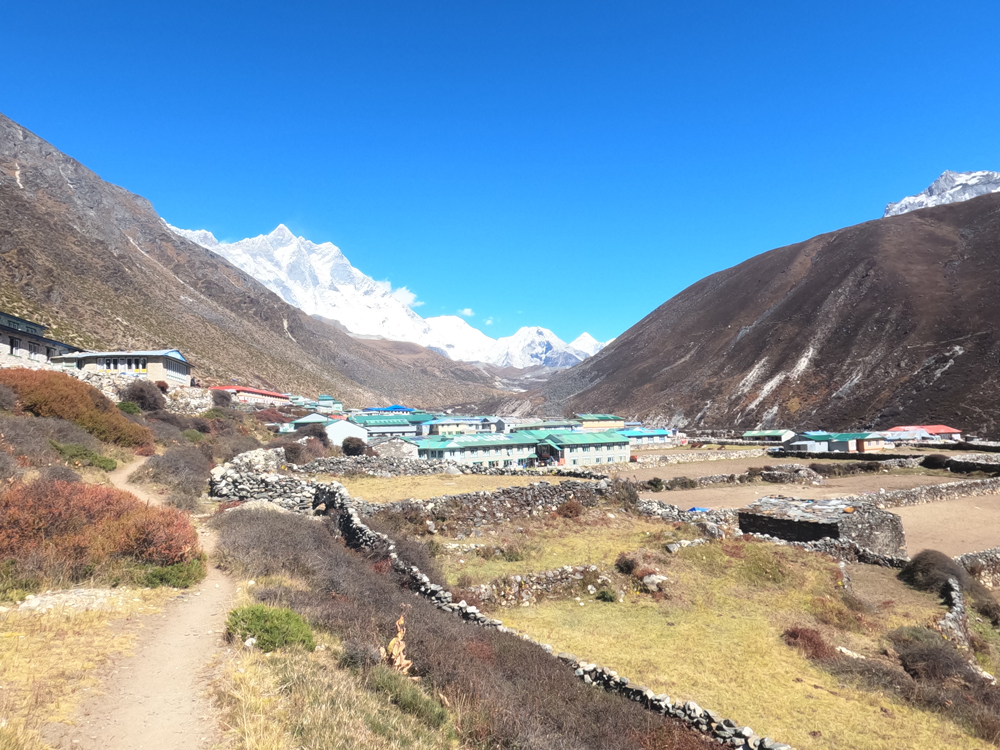
The trekking trail goes through alpine meadows and green pastures. You may catch sight of yaks grazing leisurely in the pastures. Along the way, you will pass by small settlements while enjoying stunning views of Mount Ama Dablam, Lhotse, Nuptse, Cholatse, and Taboche. Following the route, you will reach a small seasonal settlement of Somare. As you ascend above 4,000 m, the landscape becomes more barren, and trees start to disappear. The vegetation becomes low, hardy alpine shrubs. The trail will continue to ascend as you reach Dingboche. It is a beautiful Sherpa village well-known for its stone-walled fields. Dingboche will be the next acclimatization stop on the Island Peak Climbing itinerary.
Acclimatization day
Activity
6 km or 4-5 hours walk
Highest Altitude
5,083 m / 16,677 ft
Accommodations
Lodge
Meals
Breakfast, Lunch, and Dinner
You will wake up in the peaceful atmosphere of Dingboche. The village offers incredible views of Mount Ama Dablam, Lhotse, Island Peak, and other surrounding peaks. After breakfast, you will again follow the “climb high, sleep low” principle and take a side hike to Nangkartshang Peak (5,083 m).
The trail starts with a gradual ascent, but it gets steeper as you move forward. You will be surrounded by dry alpine terrain and snow-capped mountains. Similarly, you can see massive glacial valleys below. The higher you go, the more spectacular the scenery becomes. Then, you will reach the Nangkartshang Peak, a huge ridge above Dingboche. From the top of the ridge, you can enjoy spectacular views of Himalayan giants like Ama Dablam, Lhotse, Nuptse, Makalu, and Island Peak.
Enjoy the view and the tranquil atmosphere before descending to Dingboche. You can spend the remaining day resting at the teahouse or exploring around the village.
Dingboche - Thukla - Lobuche trek
Activity
8 km or 5-6 hours walk
Highest Altitude
5,140 m / 16,863 ft, Lobuche
Accommodations
Lodge
Meals
Breakfast, Lunch, and Dinner
After an acclimatization day at Dingboche, you will once again resume the Island Peak Climbing journey. You will continue to trek on the main EBC trail that ascends along the lateral moraine of the Khumbu Valley. As the altitude increases, the ascent becomes more demanding. However, the distant view of the Everest massif, Ama Dablam, Taboche, and Cholatse will make the trek rewarding. It takes you to Thukla, also known as Dughla (4,620 m), a small settlement that is located at the base of a steep hill.
From Thukla, you will ascend to the Thukla Pass memorial hill (4,830 m). It is one of the most notable landmarks in the Everest region. The memorial hill is covered with rows of stone memorials with prayer flags. These are dedicated to climbers who lost their lives on Mount Everest and other high Himalayan peaks. The atmosphere around the memorial hill is emotional and powerful. It is a reminder of how cruel the Himalayas can be. After crossing the Thukla Pass, the trail begins to follow the Khumbu Glacier’s glacial moraine.
While trekking on the alpine and rocky terrain, you can enjoy the views of Lobuche East, Mount Pumori, Nuptse, and other peaks. After trekking for some time, you will finally arrive at Lobuche. It is a small high-altitude settlement and a key stop in the Everest region. You will stay here overnight and allow your body to adapt to the decreasing oxygen level.
Lobuche to Everest Base Camp, and Gorak Shep trek
Activity
11 km or 7-8 hours walk
Highest Altitude
5,364 m / 17,598 ft, Everest Base Camp
Accommodations
Lodge
Meals
Breakfast, Lunch, and Dinner
Today is one of the most thrilling and rewarding days of the Island Peak Climbing. You will follow the classic trail to the Everest Base Camp (5,364 m). Ascending to the base camp before climbing Island Peak helps with acclimatization and builds confidence. First, you will trek towards Gork Shep, the last permanent settlement on the EBC route. The trekking route follows the rugged lateral moraine of the Khumbu Glacier. You will slowly ascend over the icy, rocky terrain. Similarly, you can enjoy the view of Mount Nuptse, Pumori, and Lingtren. Upon reaching Gorak Shep, you will take a short break.
The trail to Everest Base Camp becomes challenging, especially due to the high altitude and the rocky terrain. You will navigate rocky moraine, glacial debris, and uneven terrain. Finally, you will reach the base camp at the foot of the world’s highest mountain. The moment is deeply emotional and offers a deep sense of achievement. Although you cannot see the summit of Mount Everest directly, you can see the surrounding Himalayan giants, including Lhotse, Nuptse, Pumori, and Khumbutse. Likewise, you can also see the massive Khumbu Glacier. During expedition season, colorful tents are scattered throughout the base camp.
You will retrace your steps back to Gorak Shep after enjoying the views to your heart’s content. Tonight, you will rest at a teahouse here.
Hike to Kala Patthar, trek to Lobuche
Activity
8.4 km or 5-6 hours walk
Highest Altitude
5,550 m / 18,209 ft, Kala Patthar
Accommodations
Lodge
Meals
Breakfast, Lunch, and Dinner
Day 10 begins early, before sunrise. Another demanding but memorable moment awaits you as you hike to Kala Patthar. You will leave Gorak Shep and begin ascending a steep, rocky trail. It will still be dark, so you need to use a headlamp. The early morning weather is cold, even for the season, so make sure to layer up. After a 1.5 to 2 hours of ascent, you will reach the iconic viewpoint of Kala Patthar. It is the favorite vantage point in the Khumbu region, offering sweeping views of the Himalayan giants, including Mount Everest. The sunrise view over the towering vistas is mesmerizing and unforgettable.
You will return to Gorak Shep for breakfast. Then, you will return the same route to Lobuche. The trail takes you through a familiar high-altitude glacial valley route. Compared to ascending, descending is slightly easier. You will also descend slightly, which makes breathing more comfortable. Tonight, you will rest in Lobuche.
Cross Kongma La Pass, trek to Chhukung
Activity
9.8 km or 8-9 hours walk
Highest Altitude
5,535 m / 18,159 ft, Kongma La Pass
Accommodations
Lodge
Meals
Breakfast, Lunch, and Dinner
Today is an important day on the Island Peak expedition. You will leave the main EBC Trekking trail and cross the high mountain pass of Kongma La Pass (5,535 m). Leaving Lobuche, you will begin trekking on a quieter, more remote trail. Then, you will begin your uphill climb to the top of the pass. The trail ascends through glacial moraine and rocky terrain. Along the way, you can see beautiful and interesting ice formations, frozen lakes, and mountain views. Once you reach the top of Kongma La Pass, a sweeping mountain view unfolds before you. From Lhotse to Nuptse, Island Peak, Makalu, and Baruntse, you can also see glacial valleys below.
You will spend very little time at the top and begin descending toward the Imja Valley. Descending from the pass is more demanding than climbing. The loose rocks, scree, and steep slopes add to the difficulty. It requires careful footing, pace, and focus. You will continue descending toward the Khumbu Glacier basin. During the descent, you can enjoy the view of Lhotse, Nuptse, and Ama Dablam. Once you reach the lower basin, the trail becomes more defined. There are only a few trekkers on the route, so it feels quiet and isolated. For the final section of today’s trek, the trail becomes easier. Then, you will enter the Chhukung valley to reach Chhukung. You will stay at this small village for the night.
Trek from Chhukung to Island Peak Base Camp
Activity
6.7 km, 4-5 hours walk
Highest Altitude
5,080 m / 16,667 ft, Island Peak Base Camp
Accommodations
Tented Camp
Meals
Breakfast, Lunch and Dinner
You will leave Chhukung after breakfast and begin your expedition phase of the Island Peak Climbing journey. It marks the shift from trekking to mountaineering adventure. The trail takes you deep into the Imja Valley, over rocky, rugged terrain. The path becomes more off-beaten as you ascend higher. Views of Mount Lhotse, Ama Dablam, and Island Peak become closer and dominate the horizon. Meanwhile, the surrounding landscape changes to glacial moraine and becomes more alpine desert-like. The air also becomes thinner, so you have to maintain a steady pace to avoid overexertion and fatigue.
The surroundings become more isolated and rugged as you get closer to the Island Peak Base Camp. Likewise, the terrain is uneven and exposed to strong winds. There are a few small streams and icy sections along the trail. Finally, you will reach the base camp. Massive mountain walls and glacial formations surround it. You will stay here overnight in a tented camp. After arriving at the base camp, your guide will provide a climbing briefing. You and your guide will check the equipment, review the climbing route and safety procedures, and prepare for the summit push.
Note: You can customize your itinerary and stay overnight at High Camp.
Climb to Island Peak, trek down to Chhukung
Activity
8.4 km or 12-13 hours walk
Highest Altitude
6,189 m / 20,305 ft, Island Peak summit
Accommodations
Lodge
Meals
Breakfast, Lunch, and Dinner
Finally, today is the day when you will climb to the summit of the Island Peak. You will start the journey very early in the morning, from midnight to 2:00 AM. Before leaving the base camp, you will have a light meal and make a final gear check. The temperature can drop below freezing, so dress warmly. With the help of a headlamp, you will gradually start to climb to the high camp first. The route follows rocky slopes before turning into steep, icy terrain. You will come across glacier sections, which you have to cross using gear like crampons, harnesses, and ropes.
Your guide will lead you and fix ropes on steep sections. So make sure to follow them and their instructions closely. It is crucial for your safety. After traversing the glacier, you will cross the crevasses and ice fields. Next, you will come across a steep ice slope or the “Summit Headwall.” You have to carefully move through the snowfields, use fixed ropes, and use gear. Then, you will carefully navigate the narrow trail to the summit ridge of Island Peak.
From the top of the Island Peak, you will be greeted by the massive Himalayas and silence. Standing on the summit, you will get a real sense of the sheer scale of the mountains. Sweeping views of Everest, Lhotse, Nuptse, Makalu, Ama Dablam, Baruntse, and other surrounding peaks will leave an unforgettable visual impression. Likewise, the tranquil atmosphere and the huge sense of achievement make the moment emotional and deeply personal. After spending a short time celebrating the success, you will begin your descent.
You will carefully descend the same route using the fixed rope and gear to Island Peak Base Camp. Then, you will descend further toward Chhukung. Since you will be descending to a lower altitude, breathing becomes easier. Upon reaching Chhukung, you can finally rest and relax. You will stay overnight at a teahouse here.
Contingency day in case of bad weather or not ready to climb the peak.
Meals
Breakfast, Lunch, and Dinner
This day is designated as a contingency or buffer day. The weather conditions can change quickly in the mountains. So, there may be weather-related delays or changes in plans to ensure climbers’ safety. Sometimes climbers may not be physically ready for the climb and require an extra rest day. This day provides a strategic safety buffer for climbers in the event of such events.
Chhukung – Tengboche - Namche trek
Activity
24 km or 7-8 hours walk
Highest Altitude
4,730 m / 15,518 ft, Chhukung
Accommodations
Lodge
Meals
Breakfast, Lunch, and Dinner
You will leave Chhukung after breakfast and follow the familiar trail down the Imja Valley. Compared to the ascent, descending is relatively easier, and breathing is also more comfortable. The landscape also changes from alpine terrain to yak pastures. During the downhill trek, you can enjoy gorgeous views of Mount Lhotse, Ama Dablam, Island Peak, and more. It takes you to Pangboche and then to Tengboche.
From Tengboche, you will start descending into the forest of rhododendron and pine. Upon reaching Phunki Tenga, you will cross the Dudh Koshi River over a suspension bridge. The trail then gradually ascends to Kyangjuma. After a while, it begins to descend towards Namche Bazaar. Although the day is long, it is enjoyable and scenic. You will rest overnight in Namche Bazaar.
Namche - Monjo - Phakding - Lukla
Activity
19 km or 6-7 hours walk
Highest Altitude
3,440 m / 11,290 ft, Namche Bazaar
Accommodations
Lodge
Meals
Breakfast, Lunch, and Dinner
Today is the final trekking day on our Island Peak Climbing journey. After breakfast at Namche Bazaar, you will begin your steep downhill descent. The winding route goes through pine forests toward the Dudh Koshi Valley. You will pass through Monjo and exit the Sagarmatha National Park. The route follows the Dudh Koshi River, passing by familiar scenery and traditional villages. Similarly, you will cross several suspension bridges along the way.
As you continue descending the mountain, the views start to become more distant. Then, you will pass by Phakding village. The trail becomes easier, and the temperature rises. From Phakding, you will descend to Lukla, where you will stay your final night in the Everest region.
Fly from Lukla to Kathmandu, then drive to your Hotel
Activity
30 minutes flight
Highest Altitude
2,860 m/ 9,383 ft, Lukla
Accommodations
Kathmandu Guest House or similar
Meals
Breakfast, Lunch, and Dinner
You will take a morning flight from Lukla to Kathmandu. From the flight, you can get one final aerial view of the Himalayas and the diverse landscape of the Everest region. If you take a flight from Lukla to Ramechhap, you will drive back to Kathmandu. The drive duration is 4 to 5 hours.
Upon arrival in Kathmandu, our representative will help transfer you to your hotel. With the remaining time, you can explore around the capital city, go sightseeing, or shop around for souvenirs. You can also taste Nepalese cuisine and drinks, and enjoy Kathmandu’s nightlife.
Important Note: All flights operate from Ramechhap to Lukla and back to Ramechhap in April, May, October, and November.
Departure from Kathmandu (1,350 m)
Activity
Airport drop off
Today is the final day of the Island Peak Climbing. Our representative will drop you off at the Tribhuvan International Airport at least 2 hours before your scheduled departure. We wish you a safe flight back home. Thank you for choosing the Himalaya Trip for your adventure in Nepal. We hope to see you back soon!
Island Peak Climbing: 1 Night / 2 Days from Chhukung (Optional)
If you want to trek to Chhukung on your own or with other trekkers, and join Island Peak Climbing with us, we have a package for 1 Night / 2 Days from the village. Our team will meet you in Chhukung. From here, you will trek to Base Camp, climb to High Camp and the Summit, and return to Chhukung the next day.
Day 01: Chhukhung – Island Base Camp
After the breakfast, our team will come to pick you up at your Lodge in Chhukhung, trek to Base Camp (5080 m, 4-5 hours walk). Our climbing guide will teach you some ideas to use climbing gears in the afternoon. overnight at Tent Camp (Lunch, Dinner included ) .
Day 02: Island Base Camp – High Camp – Summit, back to Chhukhung.
You will wake up early and get ready at 2:00 AM. From Base Camp – High Camp, you will trek. You will climb from High Camp to the Summit with all equipment, enjoy the achievement at the top, take some photos and videos, and return to Chhukung.
Optional: 1 or 2 additional days are recommended in case of flight cancellation and bad weather on the Island Peak Summit day.
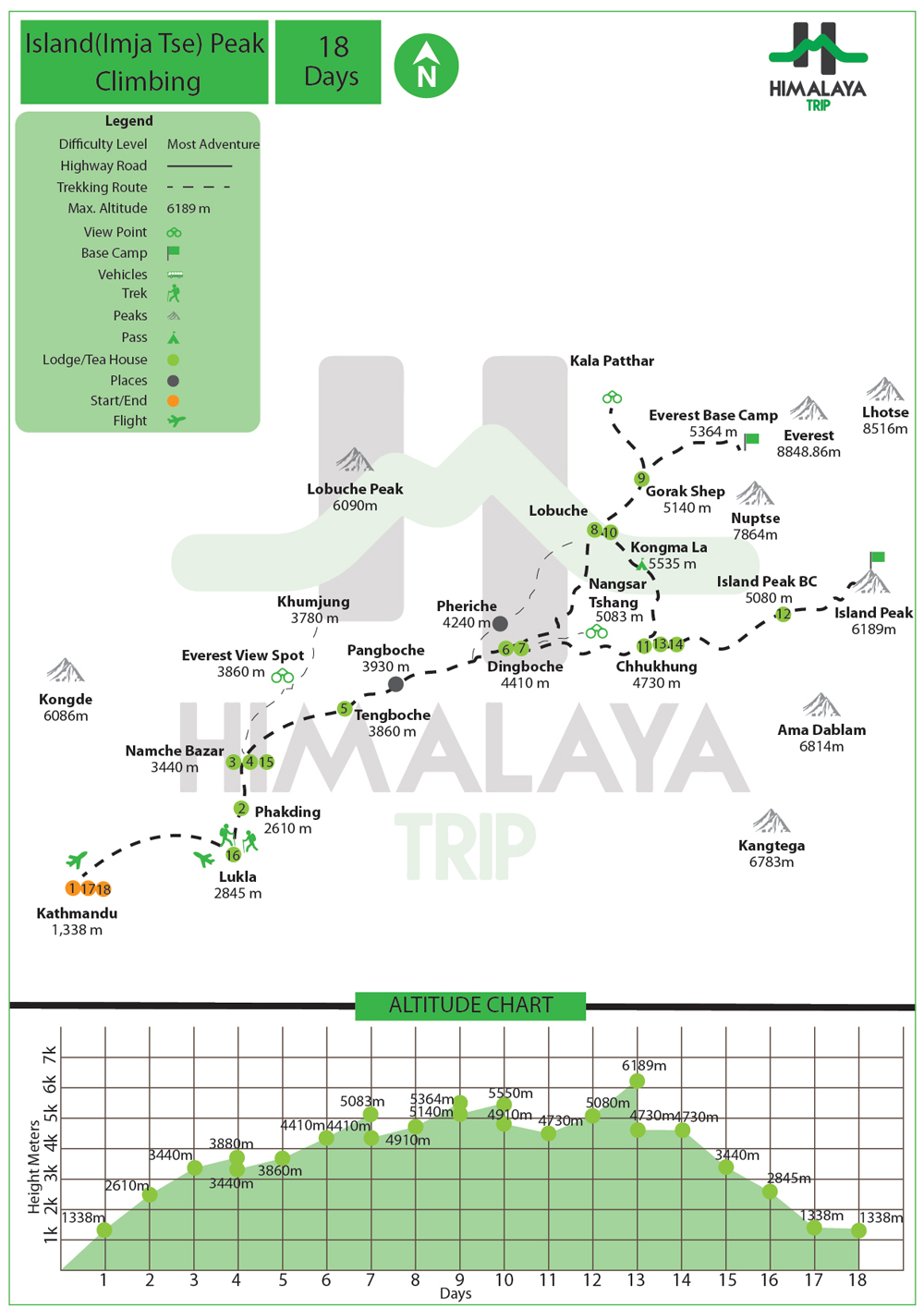
Island Peak Climbing Map
Whats Included?
Everything you need for a safe, comfortable, and memorable trek — packed into one transparent price. Below is a full breakdown of what is covered in your Island Peak Climbing package.
Accommodation & Meals
- Lodge : Twin or triple sharing room ( 3 Nights Namche, 2 Nights Dingboche, 1 Night Lukla have attached bathroom and Phakding, Tengboche, Lobuche, Gorak Shep , Chhukhung have common room. Island Peak Base Camp at Tent Camp. Hot Shower in Namche and Lukla.
- 2 Nights at Kathmandu Guest House in Kathmandu.
- Meals: 17 Breakfasts, 15 Lunches & 15 Dinners during the trek.
Transportation & Flights
- Transportation : Airport pick-up and drop off at Tribhuwan International Airport and Domestic airport by private vehicle.
- Kathmandu – Ramechhap – Kathmandu transportation if your flight is from Ramechhap.
- Flight: Kathmandu or Ramechhap – Lukla – Ramechhap or Kathmandu flight ticket.
Guide & Porter Services
- Trekking Guide: One licensed, English-speaking trekking guide whole trek and climbing sherpa from Chhukhung to Island Peak summit and back.
- Porter service: one porter per two trekkers.
- Trekking/ Climbing Guide and Porters: Food, accommodation, salary, equipment and personal insurance etc.
Equipment & Safety
- Fingertip Pulse Oximeter — daily oxygen and pulse monitoring for altitude safety.
- First Aid Kit carried by the guide .
- Duffle Bag: One Duffle bag per trekkers on return.
Permits & Official Fees
- Island Peak Climbing Permit and Garbage deposit.
- Sagarmatha National Park fee and Khumbu Pasang Lhamu Rural Municipality entrance fee.
- 13% Government VAT and all official government charges.
Complimentary Extras
- Seasonal fresh fruit en route — pomegranates & apples.
- Island Peak Climbing Map and Himalaya Trip branded T-shirt.
- 24/7 emergency support line available during your entire trek.
Whats not Included?
- International airfare.
- Nepal’s visa fee (15 days for USD 30 and 30 days for USD 50). You fill out a form at the Department of Immigration before you leave, pay cash, and get a visa on your arrival at Kathmandu airport.
- Lunch and Dinner in Kathmandu.
- All drinks (tea, coffee, Coke, beer, mineral water), battery charge, hot shower, wifi, etc.
- Personal climbing gear & clothing (also available for hire).
- Your travel insurance should include emergency Rescue.
- Tips for staff.
Available dates & Prices
If you are two or more people, private trip is available any date, providing a fantastic opportunity. If you are solo travellers, our fixed group trips are thoughtfully scheduled and offer specific departure dates.
Group Discount Pricing
Price per person — the more you travel together, the less you pay
No. of Persons
Price per Person
-
1 PersonUSD 2,499
-
2 - 4 PaxSave 12% USD 2,199
-
5 - 9 PaxSave 14% USD 2,149
-
10+ Pax Best ValueSave 16% USD 2,099
Create Your Private Trip With
Your Own Itinerary and Dates
We are more than happy to design an itinerary tailored to your schedule and preferred route. Simply share your preferred travel dates, group size, and contact and travel details, and one of our travel experts will get in touch to help plan your journey.
Once your trip is confirmed, you’ll travel exclusively with your own group, enjoying a more personalized and flexible experience.
Altitude and Acclimatization for Island Peak
Island Peak Climbing is a high-altitude adventure that takes you to an altitude of 6,189 m. Although it is lower than a 7,000 or 8,000-m expedition, there is still the risk of altitude sickness. It is not only a physical but also an altitude challenge. The oxygen level at the summit is half that at sea level. Even physically strong climbers can fail to adapt to altitude, forcing them to descend. As a result, acclimatization for Island Peak is crucial.
The oxygen level in the atmosphere begins to decrease gradually above 3,500 m. Trekkers will start to experience altitude-related sickness. Based on the symptoms and their severity, altitude sickness has three types. They are as follows:
- Acute Mountain Sickness (AMS): It is the mildest form of altitude sickness that begins a few hours after ascending to a higher altitude. The AMS symptoms include nausea, headache, fatigue, dizziness, shortness of breath, insomnia, and reduced physical performance.
- High Altitude Pulmonary Edema (HAPE): It is a serious form of altitude sickness that develops after rapid ascension. HAPE is a condition in which a lack of oxygen leads to fluid buildup in the lungs. It is a life-threatening condition. Some of its symptoms include shortness of breath that worsens progressively, a persistent cough, rapid breathing, chest tightness, and a rapid heartbeat.
- High Altitude Cerebral Edema (HACE): It is a severe form of altitude sickness when a lack of oxygen leads to swelling of the brain. HACE usually develops with rapid ascent above 3,500-4,000 m. Some of its symptoms include extreme fatigue, nausea, severe and persistent headache, difficulty concentrating, and poor coordination.
Here are some tips for altitude and acclimatization during the Island Peak Climbing:
- Choose an itinerary with proper acclimatization days and gradual ascent. It helps your body adapt to the higher elevation and reduces the risk of altitude sickness.
- Follow the “climb high, sleep low” principle. During the day, hike to a higher elevation and return to a slightly lower altitude to sleep at night.
- Avoid rapid ascension and maintain a steady pace. Walking too fast can increase fatigue and put additional strain on your body.
- Do not skip the acclimatization hike, as it is essential for altitude adaptation. Also, get adequate rest and sleep to help your body recover after long days of hiking.
- Drink plenty of water even when you are not feeling thirsty. You have to drink at least 3 to 4 liters of water, as dehydration can worsen the symptoms of altitude sickness.
- Eat carbohydrate and protein-rich meals such as Dal Bhat. Avoid caffeine, alcoholic beverages, and smoking during high altitude climbs.
- Recognize early symptoms of altitude sickness. If you feel any symptoms or feel uncomfortable, let your guide know immediately. If the symptoms worsen, you must descend to a lower altitude.
- Carry medication such as acetazolamide (Diamox) that can help with altitude sickness symptoms. However, consult with health professionals before taking them.
Island Peak Climbing Cost
The cost of Island Peak Climbing ranges from US$ 2099 to US$ 2,499 per person, depending on the duration and services. It also depends on the itinerary, group size, and preferences. The cost variation also reflects the difference in high-altitude logistics and guide support.
Short itineraries usually cost less, but they may skip acclimatization days or Everest Base Camp, Kala Patthar, and Kongma La pass. However, shorter itineraries are recommended only for experienced climbers or those already well acclimatized to high altitude. Longer itineraries, including the Everest Three Passes, are more expensive due to additional logistics such as accommodation, food, guides, and porter services. Similarly, packages that include full equipment and logistics may cost more. It is important to consider your fitness and review all the inclusions and exclusions of the packages before booking.
Price of Island Peak Climbing for Spring and Autumn:
The price of Island Peak varies between the Autumn and Spring seasons. Please kindly check it before you book the trip.
The price of Island Peak in the spring season:
The permit price for Island Peak is US$ 350 per person in the spring season (March, April, May). It will increase the overall cost of this climb. The Island Peak Climbing price ranges from US$ 2,275 to US$ 2,675 per person, depending on the group size.
The price of Island Peak in the Autumn/ Winter/ Summer Season :
The price of Island Peak is US$ 175 per person in the Autumn season (September, October, and November), the Winter season (December, January, and February), and the Summer season (June, July, and August). This permit price will help reduce the US$ 175 from the overall package price. The Island Peak Climbing price in autumn is US$ 2,099 to US$ 2,499 per person, depending on group size.
Technical Sections of Island Peak Climb
The Island Peak, or Imja Tse, is a trekking peak, but the final ascent requires some technical mountaineering skills. Here is a detailed explanation of the technical sections during the climb:
Glacier Crossing
Once you leave the Island Peak Base Camp, the trail starts to become technical. You have to cross the glacier instead of walking on the solid ground. It requires careful navigation to cross the uneven ice and snow. Similarly, you may need mountaineering gear, such as crampons and climbing boots, for grip. What makes the crossing more difficult is that the glaciers shift constantly, depending on the temperature and human movement. Hence, the route is not fixed, and guides will lead you on a safer path. It provides you with the first real introduction to alpine climbing.
Crevasses
In addition to the shifting glaciers, climbers must also be aware of the crevasses. They are deep cracks in the glacier that are often hidden under thin snow bridges. While some are easily visible, others require careful navigation because they can be tens of meters deep. Guides will navigate the safest route across. Similarly, climbers are roped together in teams for safety. A simple misstep can be dangerous to say the least. You have to move quickly and steadily. Likewise, you may need to use crampons and an ice axe to cross these icy surfaces.
Fixed Rope Climbing
After you cross the glacier and crevasses, you will tackle the headwall next. It is a steep ice wall located just below the summit ridge. Additionally, it is the most technical part of the Island Peak Climbing. To overcome this section, you have to use fixed ropes. You have to use jumars or ascenders to climb on the fixed rope set by the guides. The climb requires coordination, strength, and some skills to use the rope systems. Your guide will assist with the climb, but you will need to manage your own safety equipment from Chhukhung.
Summit Ridge
The next section is the narrow summit ridge of the Island Peak. You have to move carefully, especially because it is also exposed to strong winds. The terrain is a mix of snow and ice. Similarly, these sections have steep drop-offs on either side of the route. You will be roped with other climbers or a guide for safety reasons. The narrow path, high altitude, and building fatigue will test you in every way possible. More than technical, this section requires balance and a steady walk. As a result, although the distance to the summit is short, it feels very challenging.
Ice and Snow Conditions
It is important to note that the conditions on Island Peak are highly influenced by season and weather. This, in turn, impacts ice and snow conditions that will affect your climb. The spring and autumn seasons offer the most stable conditions for the climb. On cold mornings or in winter, the ice is often hard and compact. Mostly, you will come across mixed ice and snow patches in steep sections. Due to these highly variable conditions, one has to adapt their techniques accordingly. Climbers cannot rely solely on a fixed trail and must have real mountain awareness.
Island Peak Climbing Permits and Regulations
Island Peak Climbing requires multiple permits. Climbers must obtain a Sagarmatha National Park Entry Permit, Khumbu Pasang Lhamu Rural Municipality, and Nepal Mountaineering Association (NMA) Climbing Permit.
Sagarmatha National Park Entry Permit:
The Island Peak lies within the Sagarmatha National Park, a UNESCO World Heritage Site. It falls under the government-protected area. Similarly, the park is inhabited by numerous endangered flora and fauna. All trekkers and climbers entering the Everest region must obtain the Sagarmatha National Park Entry Permit. The fees obtained from the permit are used for trail maintenance, biodiversity conservation, and environmental protection. The Sagarmatha National Park Entry Permit is a one-time entry permit. Department of National Parks and Wildlife Conservation issues it. The permit costs around USD 25 per person.
Khumbu Pasang Lhamu Rural Municipality Permit:
It is the local permit that replaced the TIMS (Trekker’s Information Management System) Card in the Everest region. The Khumbu Pasang Lhamu Rural Municipality Permit helps the local government to regulate tourism. Similarly, the fee collected from the permit is used to support trail development and local communities. The Khumbu Pasang Lhamu Rural Municipality Permit costs around USD 25 per person.
Nepal Mountaineering Association (NMA) Climbing Permit:
All climbers seeking to climb Island Peak must obtain the climbing permit. It is issued by the Nepal Mountaineering Association (NMA) and obtained through a local licensed trekking/climbing agency. After obtaining the climbing permit, it is only valid for the specific season and expedition period.
The cost of an NMA Climbing Permit varies depending on the season. They are as follows:
- Spring (March to May): US$ 350 per person
- Autumn (September to November)/ Summer (June to August)/ Winter (December to February): US$ 175 per person
Note: Solo climbing on Island Peak is not allowed. It is mandatory to hire a licensed climbing guide registered with NMA. The guide must be trained in high-altitude climbing, glacial travel, and rope and safety systems. It also requires a high-altitude mountaineering travel insurance. The insurance must cover altitude up to 6,189 m and helicopter evacuation. Climbers must also pay a refundable garbage deposit of USD 500 per group to obtain the NMA Permit. It will be refunded after completing the climb, and all waste has been properly collected.
Summit Success Rate of Island Peak
The success rate of Island Peak is moderately high and ranges from 70% to 85%. It is at a moderately high rate, and most guided expeditions to the summit succeed. In addition to the climber’s fitness and skill, the climb’s success rate also depends on weather conditions, acclimatization, and route conditions. It is important to choose the right itinerary, with adequate acclimatization, and the right timing for a higher success rate. The help of an experienced guide is also crucial during the journey.
It is important to note that factors such as poor weather, altitude sickness, or lack of preparation are common reasons behind climbers’ failure. Physical preparation is one of the key factors that influence the summit’s success. You have to trek for long hours each day, which requires reasonable strength, stamina, and endurance. Cardiovascular fitness and mental endurance go hand in hand. Poor physical preparation is one of the common reasons why climbers fail to reach the summit.
Similarly, weather conditions also hugely affect the success of Island Peak. Stable weather offers safer conditions for the climb, and the success rate is higher. It is one of the reasons summit attempts are planned for early morning. Despite proper preparation, if the weather becomes unfavorable, climbers have to turn back. Proper acclimatization and guide support also increase the success rate on the summit. Acclimatization helps to minimize the risk of altitude sickness. Meanwhile, climbers with strong guide support have a higher chance of success. With the right preparation and a well-planned itinerary, Island Peak is an achievable 6,000-meter summit.
Island Peak vs Mera Peak
The Island Peak and the Mera Peak are two popular trekking peaks in Nepal. However, they are completely different from one another. Mera Peak is the highest trekking peak in Nepal. Meanwhile, Island Peak is more popular and technical. To provide you with a clearer picture, here is a comparison between the two:
| Features | Island Peak | Mera Peak |
| Location | Upper Imja Valley in the Khumbu or Everest region | Hinku Valley in the Makalu region |
| Elevation | 6,189 m | 6,476 m |
| Difficulty | Moderate to challenging | Moderate |
| Alpine grading | PD+ (Peu Difficile Plus) | PD (Peu Difficile Plus) |
| Technicality | More technical (Glacier, crevasses, fixed ropes, steep headwall, and ice walls) | Less technical (Long glacier walks, minimal rope work, and gentle snow slopes) |
| Fitness requirement | High fitness with basic climbing skills | Reasonable fitness and high endurance |
| Success rate | Moderate to high | High |
| Crowd level | More popular and busier | More remote and less crowded |
| Scenic highlights | Spectacular views of Mount Everest, Lhotse, Ama Dablam, and Imja Glacier | Panoramic views of Mount Everest, Makalu, and Kanchenjunga |
| Suitable climber profile | Climbers looking for a technical introductory Himalayan climb | Climbers looking for a non-technical and high-altitude endurance climb |
Perfect time for Island Peak Climbing
The season is one of the key factors that directly influence the success of the Island Peak summit. It influences the weather and route conditions. Hence, choosing the right time for the climb is crucial. Spring (March to May) and autumn (September to November) are ideal times for the adventure.
Spring (March to May)
The spring season is one of the perfect times for Island Peak Climbing. During this time, the weather is stable, and the temperature is warmer. Likewise, the visibility is brilliant. In the lower area, the rhododendron forests are in full bloom. What makes spring ideal for climbing is its more predictable weather. The snow is softer and more stable for rope climbing. Additionally, the glacier routes are also well-defined. The disadvantage of climbing in spring is the higher crowd levels and warm temperatures, which can cause snow to melt.
The average daytime temperature of Island Peak in spring is as follows:
- Base Camp (5,200m): 5°C to 10°C
- High Camp (5,600m): 0°C to 5°C
- Above 6,000m (climbing zone): -5°C to 0°C
Autumn (September to November)
The most popular climbing season for Island Peak is autumn. It offers one of the most favorable and stable weather conditions. As it comes after the monsoon, the skies are clear, and visibility is excellent. The stable weather makes glacial travel to the summit more predictable. The snow and ice are also firmer. Therefore, the rope sections are safer. The autumn season offers the highest success probability. However, there is a high number of trekkers and climbers. The temperature around High Camp and the summit is especially cold during nighttime.
The average daytime temperature of Island Peak in autumn is as follows:
- Base Camp (5,200m): 0°C to 8°C
- High Camp (5,600m): -3°C to 3°C
- Above 6,000m (climbing zone): -8°C to -2°C
What Views Can You Expect from the Summit?
The summit of Island Peak offers one of the best panoramic views of the Himalayan vistas in the Everest region. It is surrounded by some of the highest mountains in the world. Here are some views you can expect from the summit:
- Everest (8,848.86 m): It is the highest peak in the world that is visible from the top of the Island Peak. You can see the mountain as part of a massive Himalayan wall. Although Everest is often partially hidden behind surrounding ridges, you can get an idea of its huge scale.
- Lhotse (8,516 m): You can get one of the most spectacular and panoramic views of Lhotse. From the summit, you can see the massive south face rise above the Khumbu Glacier. The view is even more beautiful than Everest.
- Makalu (8,485 m): The summit of the Island Peak also offers one of the best views of the world’s fifth-highest mountain. You can see Makalu stand out among other mountains with its sharp, pyramid-like shape. The mountain stretches beyond the Everest region, giving you a glimpse at its massive size.
- Nuptse (7,861 m): It is another towering giant that you will see from the top of the Island Peak. Nuptse connects with the Everest massif. You can see its massive southwestern wall rise just beside the world’s tallest mountain. You can clearly see Mount Nuptse’s long, jagged ridge of ice and black rock.
- Baruntse (7,129 m): On the far eastern side of the Island Peak’s summit, you can see Mount Baruntse. Although distant, you can make out the snow-covered pyramid shape of the mountain on clear days. The view blends with the surrounding Himalayan skyline, adding to the unforgettable experience.
- Ama Dablam (6,812 m): You can also see Ama Dablam from the Island Peak top. It is one of the most visually stunning mountains in the Everest region, with its elegant, pyramid-shaped ridges. You can also clearly see the long hanging glacier on its southwest face.
Essential Gear for Island Peak Climbing
Clothing
- Moisture-wicking thermal layers (top & bottom)
- Fleece jacket or insulated jacket
- Softshell jacket
- Heavy down jacket (suitable for high camp & summit)
- Waterproof/ windproof jacket
- Waterproof/ windproof pants
- Lightweight inner gloves
- Insulated mountaineering gloves
- Sun hat or cap
- Warm beanie
- Neck gaiter or buff
Footwear
- Warm trekking socks
- Summit socks
- Gaiter
- Trekking boots with good ankle support (broken-in)
- Mountaineering boots
Equipment
- 60-70 L Duffel bag (carried by porter)
- 40-50 L Backpack
- Rain cover
- Trekking pole
- Mountaineering harness
- Crampons
- Helmet
- Ice axe
- Ascender & descender
- Carabiners
- Climbing ropes
- Prusik loops or safety slings
- Sleeping bag (rated -15°C to -20°C or higher)
- Sleeping bag liner
Miscellaneous
- Headlamp with extra batteries
- Power bank
- Camera
- Trekking map
- Personal toiletries
- First aid kit
- Water purification tablets or a portable filter
- Trekking maps
Renting climbing gear in Chhukhung:
Climbing gear can be rented in Chhukhung. This is convenient for climbers, as they do not have to deal with the hassle of carrying gear from Kathmandu. Lukla flight weight limit is 15 kg (5 kg hand luggage + 10 kg baggage). Carrying all the equipment & gear from Kathmandu can often cause baggage overweight. This results in an extra fee of USD 1 per additional kg. It also causes extra weight for the porter to carry all the way to EBC and Kongma La pass. Hence, it is recommended to rent from Chhukung rather than carrying from Kathmandu. It is a practical, cost-effective, and hassle-free solution for climbers.
Trip Reviews
We haven't found any particular reviews for this trip. If you'd like to view all our reviews, please view All Reviews.


Cassandra & Cedric
Three Passes & Everest Base Camp

Pippa Jephcott
Pikey Peak Trek
Majid, Sara and Shane
Annapurna Circuit Trek
Reviews from the globe

Hi! Im Sara, from Spain! Good morning! Yesterday we arrived from our 11-day trekking in Gokyo. There were 3 people from Spain, and I don’t know how to express how happy I felt. From the beginning, Himalaya Trip has been attentive to us, with a welcome at the hotel and...

Incredible!
Hi! Im Sara, from Spain!
Good morning!
Yesterday we arrived from our 11-day trekking in Gokyo.
There were 3 people from Spain, and I don’t know how to express how happy I felt.
From the beginning, Himalaya Trip has been attentive to us, with a welcome at the hotel and explanation of the route, rental of necessary equipment, etc.
The most important thing for us has been the ease and comfort with which Ramesh (our precious guide) has taken care of us at all time.
Attentive to the food, to make sure we didn’t get cold, adapting the route day by day according to the needs of the team.
I only have words of gratitude for Ramesh, who I would recommend for any trekking in the world.
In addition to being a great guide and knowing all the mountains of Nepal perfectly, he is a great person, with a big heart.
We hope to repeat in the not too distant future and hopefully it can be with him, since he is already part of our family.
Thank you for everything, from the bottom of my heart.
Thanks!!!!


Had an incredible experience doing the Mardi Himal trek with Himalaya Trip. Our guide Jay and our two porters Umesh and Masak were all simply incredible people. I’m a photographer so always have odd requests for weird areas to access for better angles or even simply just extending time in...
Couldn’t recommend enough
Had an incredible experience doing the Mardi Himal trek with Himalaya Trip. Our guide Jay and our two porters Umesh and Masak were all simply incredible people.
I’m a photographer so always have odd requests for weird areas to access for better angles or even simply just extending time in certain areas and all requests were met with so much help from the team. Highly recommend

I had an amazing time trekking with Surpa, particularly as this was my first solo trek. Beautiful views doing the Mardi Himal trek over 4 days, Surpa was a great guide who organised everything so well for me, kept me well fed, supported a good pace the whole way and...
Mardi Himal: fantastic trek & wonderful guide
I had an amazing time trekking with Surpa, particularly as this was my first solo trek. Beautiful views doing the Mardi Himal trek over 4 days, Surpa was a great guide who organised everything so well for me, kept me well fed, supported a good pace the whole way and always cheerful. Would recommend, and I would happily have him as my guide again in the future. The organisation and booking with Himalaya Trip was great, really responsive on emails and Harka was so helpful in organising everything and meeting me in Kathmandu for a briefing before the trip. Thanks so much!
Our 4 day Mardi Himal Trek with guide Milan and porter Plekta was a wonderful experience. The manager Harka Gurung met with us over coffee in Kathmandu and briefed us about expectations as this was our first trek. After that our guide met us at our hotel in Pokhara, helped...
Once in a lifetime experience in the Himalayas
Our 4 day Mardi Himal Trek with guide Milan and porter Plekta was a wonderful experience. The manager Harka Gurung met with us over coffee in Kathmandu and briefed us about expectations as this was our first trek. After that our guide met us at our hotel in Pokhara, helped us rent equipment, and handled all logistics in between. Our first time in the Himalayas was unforgettable between all the unbelievable landscapes and scenery, and we were lucky to have MIlan and Plekta with us to experience it all. I can’t begin to describe how ethereal sunrise is over the base camp, but hopefully you’ll be able to experience it soon!