Winter and Monsoon Special Offer! Get 5% off on all trekking packages in Nepal . Visit during June , July, August, December , January and February and take advantage of this limited-time deal… Read the full flood notice.



What Makes Annapurna Circuit Trek Beautiful
- Begin the journey with a scenic drive on a mountain road from Kathmandu to Syange.
- Trek through the changing landscapes from subtropical forests to the Trans-Himalayan trails of the Annapurna region.
- Traverse and explore the beautiful Marshyangdi River valley.
- Pass by windswept valleys, rocky cliffs, colorful rock formations, and cross many suspension bridges over streams.
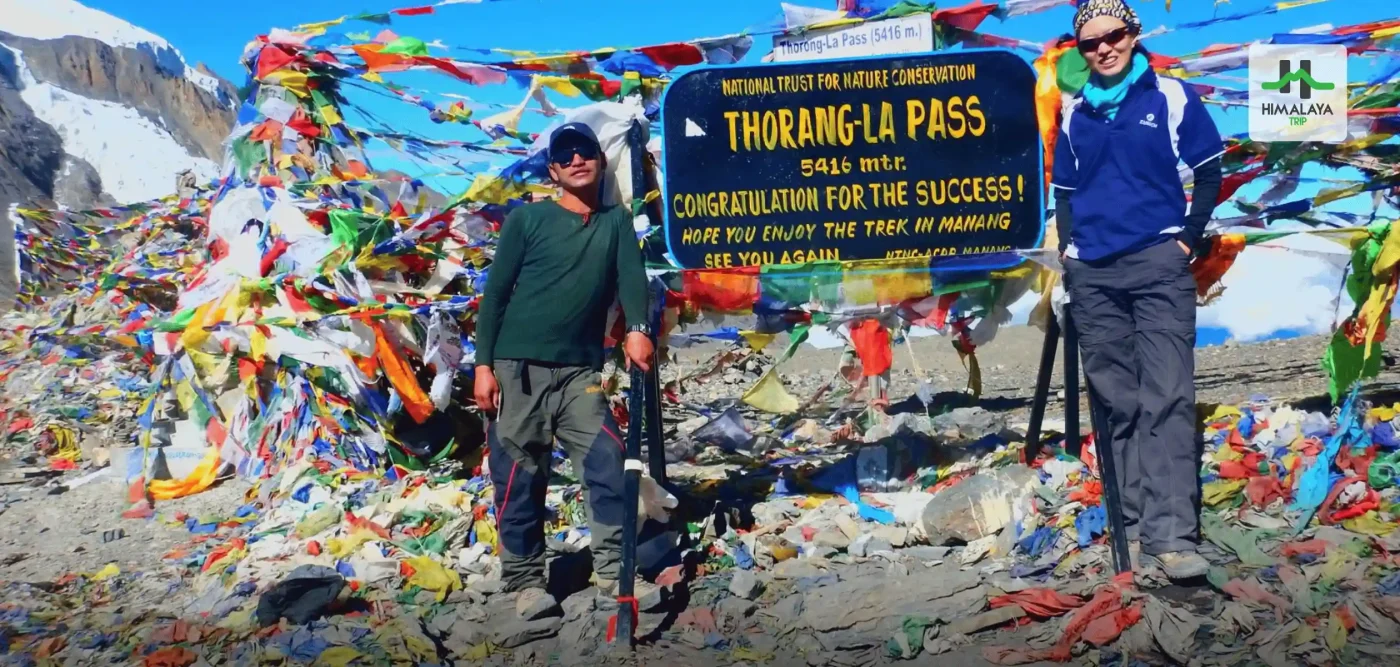
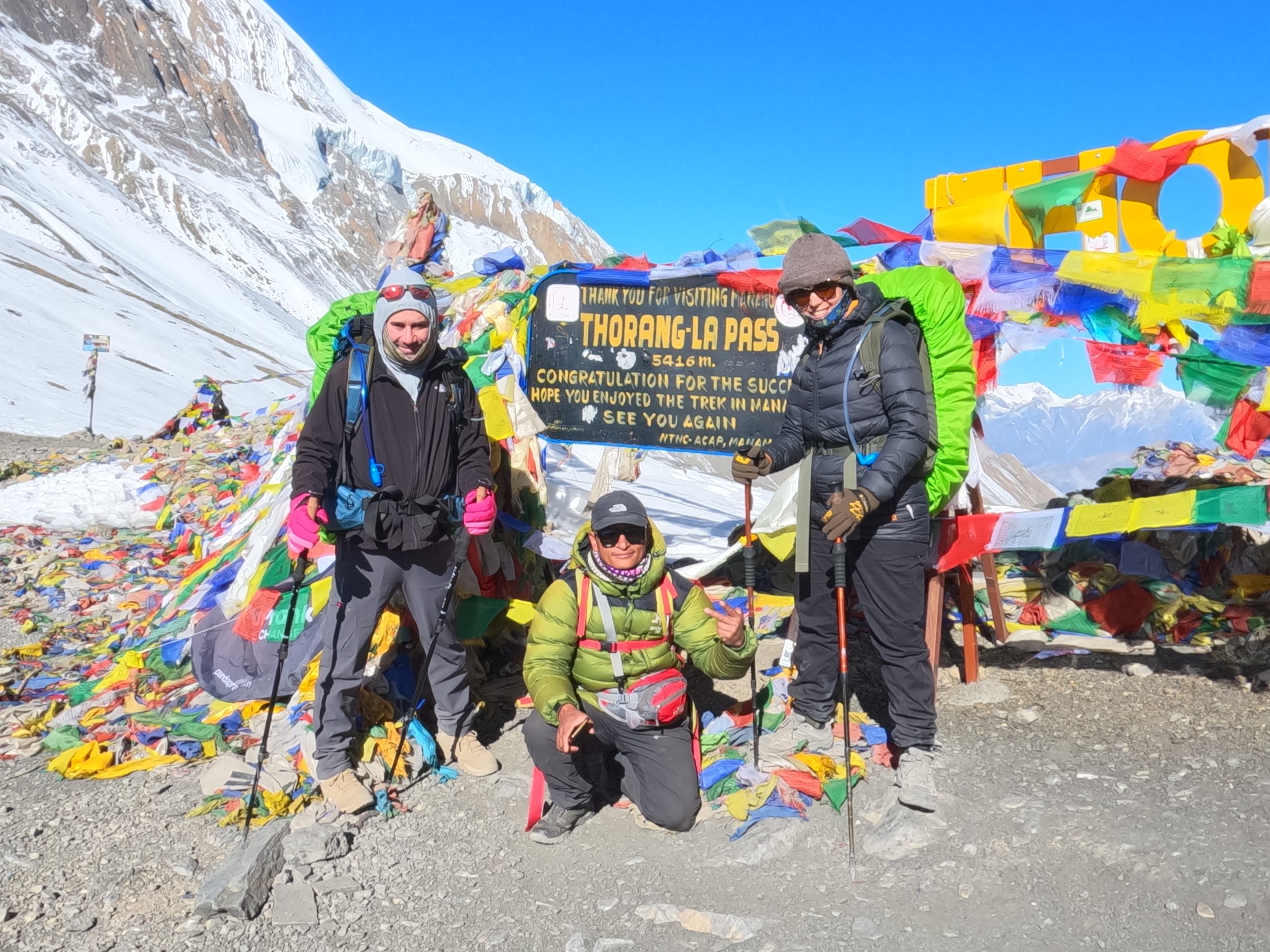
- Cross one of the world’s highest mountain passes, the Thorong La Pass (5,416 meters).
- Drive through the world’s deepest gorge and the Kaligandaki valley.
- Witness the mesmerizing views of Annapurna II, III, IV, Gangapurna, Glacier Dom, Dhaulagiri Range, Manaslu Range, Nilgiri, Tilicho, Chulu, Thorong, and Pisang Peak.
- Trek past age-old Buddhist mani walls, stupas, and monasteries.
- Experience Tatopani’s natural hot springs.
- Observe and immerse in the culture and lifestyle of Gurung, Thakali, and Manangi communities.
- Immerse in the warm hospitality of the locals in the heart of the Himalayas.
Activity
Adventure Treks
Altitude
5416 m, Thorong La pass
Best Season
Mar-May Sep-Nov
Meals Included
10 Breakfast 10 Lunch 8 Dinner
Transportation
Flight/Car/Jeep/Bus
Destination
Most Popular Treks
Accommodation
1 Night Hotel in Pokhara 8 Nights at Lodge
Duration
10 Days
Region
Annapurna Region Treks
Start / End Point
Kathmandu / Kathmandu
Group Size
2
Difficulty
Adventure
Activities
3 Days drive 7 Days Trekking
Annapurna Circuit Trek Overview
The Annapurna Circuit Trek is one of Nepal’s classic and iconic trekking destinations. It’s an adventurous and scenic trail that encircles the Annapurna massif in Western Nepal. For trek enthusiasts and adventure seekers, the Annapurna Circuit is a perfect venture. The journey isn’t just about crossing the high mountain pass. It takes you to the heart of the Annapurna region and within the Annapurna Conservation Area.
You will begin the journey with a drive from Kathmandu to Dharapani. From here, you will start your trek to Chame, Upper Pisang, Manang, Ledar, Thorung Phedi or High Camp, Thorong La Pass, and Muktinath. To conclude the journey, you will drive back to Pokhara and then to Kathmandu. During the trek, you will stay at locally run teahouses and lodges, where you can enjoy warm Nepalese hospitality.
The Annapurna Circuit trekking trail goes alongside the Marsyangdi River at the beginning. Then, you will hike through diverse landscapes and terrain while passing through traditional Gurung and Magar villages. Explore the diverse landscapes, from dense subtropical forests to alpine meadows, desert-like areas, dramatic cliffs, and apple orchards. Throughout the journey, you can enjoy a spectacular view of the snow-capped Annapurna ranges. Similarly, the striking view of the Tibetan plateau will leave you speechless.
During the journey, you will traverse cultural and natural diversity unique to the Annapurna Circuit route. As you move towards the higher elevations, you can see trails adorned with colorful prayer flags, chortens, mani walls, and prayer wheels. You will also have the opportunity to visit ancient monasteries in Manang, which offer a glimpse into the influence of Tibetan Buddhism. The highlight of the Annapurna Circuit Trek is crossing the Thorong La Pass (5416 m). It is also the highest point of the trip.
The Annapurna Circuit Trek route links the districts of Manang and Mustang in the Himalayas. It combines the adventure of crossing the high pass in the Manang region with a descent towards the sacred Hindu site of Muktinath. Cleanse your sins at the 108 water spouts inside the temple and gain spiritual enlightenment. You will encounter a blend of history, culture, biodiversity, geology, flora, fauna, and water bodies throughout most of your trekking adventure. If you want an unforgettable, thrilling trek experience, join our 10 Days Annapurna Circuit Trek in 2026!
Is the Annapurna Circuit Trek Still Worth It in 2026/2027?
Absolutely yes! The Annapurna Circuit Trek is a classic trekking route with unmatched beauty, challenges, and diversity that make it worth doing in 2026 and 2027. It is among those few destinations that offer an authentic Himalayan trekking experience without feeling overly commercialized.
Every day of the Annapurna Circuit Trek offers different scenery and cultural experiences. You will trek through various climate zones with beautiful views of subtropical forests, alpine landscapes, and barren mountain passes. The steep trails, narrow pathways, exposed ridges, and shifting Himalayan weather add to the thrill of the journey. So, do not just take them as challenges. They make the trek a more rewarding and unforgettable experience and are all worth it. Furthermore, the sense of accomplishment after crossing the Thorong La Pass, one of the highest trekking passes in the world, is indescribable.
Throughout the trek, you will also get views of towering snow-capped peaks, such as Annapurna, Dhaulagari, Machhapuchhre, and many other surrounding vistas. You will pass by highland valleys, deep gorges, rocky cliffs, glacial lakes, and sometimes even yak caravans. The Annapurna Circuit Trek route also traverses traditional villages of Gurung, Thakali, and Manangi. They have their own unique culture and follow the Nepali-Tibetan culture, which adds a cultural dimension to your journey.
Due to recent road construction, the Annapurna Circuit trail is now more accessible than ever. However, many trekkers may doubt whether the trek is still worth it in 2026/2027. Do not worry, the classic trail still retains its authenticity. It will be one of the most extraordinary treks you will ever take, and it will remain with you for life.
Annapurna Circuit Trek Outline Itinerary
Day 01:
Drive Kathmandu - Besishahar by public van, Besishahar - Dharapani by public Jeep (1860 m, 222 km or 9-10 hours drive).
Day 02:
Trek Dharapani - Chame (2670 m, 17 km or 5-6 hours walk).
Day 03:
Trek Chame - Pisang (3200 m, 14 km or 5-6 hours walk).
Day 04:
Trek Pisang - Gyaru - Ngawal - Manang (20 km, 7-8 hours walk).
Day 05:
Rest day in Manang.
Day 06:
Trek Manang - Yak Kharka - Chauri Leddar (4200 m, 12 km or 4-5 hours walk).
Day 07:
Trek Chauri Leddar - Thorong Phedi or High Camp (4450 m, 5.1 km or 3 hours walk).
Day 08:
Trek Thorong Phedi or High camp - One of the hardest days and the highest altitude Thorong La Pass 5416 m - Muktinath (3760 m, 15 km or 8-9 hours walk).
Day 09:
Drive Muktinath - Jomsom - Tatopani - Pokhara by public Bus (179 km, 9-10 hours drive).
Day 10:
Drive Pokhara - Kathmandu by tourist bus (200 km or 8-9 hours drive).
10 Days Annapurna Circuit Trek Itinerary
Kathmandu - Besishahar - Dharapani
Activity
222 km or 10 Hours drive
Highest Altitude
1860 m, Dharapani
Accommodations
Dharapani Cottage or similar
Meals
Breakfast, Lunch and Dinner
On the first day, you will start our Annapurna Circuit Trek journey from Kathmandu to Besisahar by public Van at 6 am from Lhotse Mall. Besishahar is the headquarters of Lamjung District. Similarly, Lamjung is the gateway to Manang district, which lies to its south. The route takes you out of the Kathmandu valley through Nagdhunga, Malekhu, Mugling. Following the course of the Trishuli River via the Prithvi Highway, we cover a distance of 130 kilometers. You will pass by charming countryside with riverside settlements, villages, terrace farms, and rolling hills. Then, you will eventually arrive at Dumre in the Tanahun district. From Dumre, the road heads north towards the Lamjung district.
After traveling 40 kilometers, you reach Besisahar, a suburban town situated directly beside the Marsyangdi River. You will continue driving from Besishahar to Dharapani by public Jeep. The drive will continue along the Marsyangdi River, which originates in the high Annapurna ranges. From here on, the road transitions from a smooth, paved surface to mountainous terrain. It is a dirt path carved along the high rocky cliffs of the Manang region. For most of your drive today, you will navigate through the road paved beside the Marsyangdi River.
You will drive past rural landscapes and traditional Nepalese villages. Along the way, you will come across paddy fields, terraced farms, rural hamlets, and lush forests. As you approach Khudi, Bhulbhule, Syange, Jagat and Chamje, you will notice changes in the landscape and geology. The muddy road suddenly becomes rocky and full of boulders. It will be a unique Himalayan roadway experience. Following this roadway, you will traverse through Tal , Karte and Dharapani at the end. The public van from Kathmandu to Besishahar and public Jeep from Besishahar to Dharapani have Nepali size seats which is smaller and shorter legroom. They play load Nepali music to entertain passengers and driver not felt to sleep. I recommend to bring earplugs to avoid the music. You will spend the night at the Dharapani Cottage in Dharapani.
Optional: It is also possible to take a private Jeep from Kathmandu to Dharapani via Besishahar.


Dharapani - Timang - Chame
Activity
17 km or 5-6 Hours walk
Highest Altitude
2670 m, Chame
Accommodations
Hotel New Shangri La or similar
Meals
Breakfast, Lunch and Dinner
Today, your trek journey will begin from Dharapani. The trail enters dense forests of rhododendrons, oaks, pine, and fir. You will also hike alongside the Marsyangdi River. There are a few small suspension bridges over streams. Along the route, you will come across Tibetan settlements like Bagarchhap, Danakyu, Timang for Lunch, and Thanchowk . The stunning view of Lamjung and Annapurna peaks is visible throughout the journey.
After crossing the settlement of Koto, you will come across a path that connects Nar-Phu with the adventure. You will pass by open fields, prayer wheels, and mani walls. Finally, you will arrive at your overnight stop in Chame. At the gate of the village is a large mani wall with prayer wheels. Chame is a dense Manangi village with modern amenities. It is the district headquarters of Manang district. You will stay overnight at Hotel New Shangri La or similar in Chame.
Note: The Jeep is available from Besishahar to Manang. To avoid altitude sickness. You will only go to Chame and trek from there.


Chame - Bhratang - Dhukur Pokhari - Upper Pisang
Activity
14 km or 5-6 Hours walk
Highest Altitude
3200 m, Uppe Pisang
Accommodations
New Trekkers Hotel and Restaurant
Meals
Breakfast, Lunch and Dinner
After breakfast, you will leave Chame and head toward the charming Manang Valley. A beautiful landscape unfolds before you. The initial part of the trail guides you through narrow, winding pathways alongside the river. Similarly, you have to make multiple crossings of the turbulent Marsyangdi River. As you approach Talekhu, Bhratang, the valley opens up, offering a spectacular view of the Paungda Danda Rock. It is a massive, curved rock located 1,500 meters above the Marsyangdi River. The rock is one of the amazing geological features, also called the “Great Wall of Pisang.”
The Paungda Danda Rock is one of the most photographed landmarks. You can also take pictures before resuming the journey. Approximately one hour from Chame lies the quiet village of Bhratang, famous for its expansive apple orchards. The succulent apples harvested here not only contribute significantly to Manang’s economy but also offer a delightful treat. From here, you will continue trekking through the riverside hamlets. A broader valley comes into view upon reaching Dhukure Pokhari for Lunch. The grandeur of the Himalayan mountains, with shimmering peaks, surrounds you from every angle. Finally, you will conclude your day’s journey in the riverside village of Upper Pisang. You will spend the night at New Trekkers Hotel and Restaurant or similar Upper Pisang.


Pisang - Ghyaru - Ngawal - Manang
Activity
20 km or 7-8 Hours walk
Highest Altitude
3540 m, Manang
Accommodations
Tilicho Hotel
Meals
Breakfast, Lunch and Dinner
You will resume your Annapurna Circuit Trekking with departure from Pisang after breakfast. The trail treats you to the majestic views of Chulu Himal (6,584 m), Gangapurna (7,454 m), Annapurna II (7,939 m), Himlung Himal (7,125 m), and several other towering mountains. Sitting just above the Pisang village is Pisang Peak (6,091 m), a popular climbing peak in Nepal. From here, you will take the route that circles the base of Pisang Peak. You will stroll through the river basin, where you will come across the Mring Tso Lake. After 2 hours of hiking from Pisang, you will reach Ghyaru. It is a small hamlet sitting beside the Marsyangdi River. This village sits on a sloped landmass, with its mud-and-wooden-built ethnic houses.
Moving further along the hiking trail, you will reach Ngawal for Lunch. It serves as a crossroads for the Kangla Pass (5,320 m), the Nar Phu Valley, and Manang village. Then you will head further west along the riverbank trail. From Ngawal, the trail passes through several pasturelands and semi-arid surfaces. The Annapurna Circuit Trek trail then diverges from the road path at Mugje, Braka village. From here, Manang village is 1 hour further. Manang stands as the commercial hub of the district. You can see typical Manangi homes with unique mud-built structures stacked one on top of another. You will get to experience a wonderful rural ambiance as you spend the night at Tilicho Hotel in Manang, private room with attached bathroom, hot shower, wifi, batter charge etc.
Optional: If you do not like the crowd, you may stay Braga village instead of Manang Village which is more peaceful.


Rest day in the same place for acclimatization
Activity
Rest day
Highest Altitude
3540m, Manang
Accommodations
Tilicho Hotel
Meals
Breakfast, Lunch and Dinner
Today is set as an acclimatization day. Hence, you will have the opportunity to engage in various activities within Manang village. Manang village is home to the Manangi people who follow Tibetan Buddhism. It is a notable settlement where you can see a blend of traditional charm with modern amenities in a beautiful valley beneath the Himalayas.
You can take a hike to the renowned Cave of 100 Monks. Here, you can get blessings from the holy monks for a successful journey. There is also the village of Brabal nearby. It is home to several Buddhist monasteries, where you can participate in prayer ceremonies. Alternatively, you can take a hike to Ice Lake, Milarepa Cave, or Khangsar village.
Another popular side hike is the Gangapurna Glacier Lake, also known as the Ice Lake. The lake lies at a short distance from the Manang village. It is a milky-blue glacial lake that sits under the Annapurna III and Gangapurna peaks. Taking a side trip to Ice Lake at 4,600 meters is more demanding and takes half a day. The hike to the lake is steep and physically demanding. However, the gorgeous views of the turquoise alpine lakes and the stunning mountain vistas are well worth it. You can consult your guide for the best alternative. After the side hike, you will return to Manang and spend the night at Tilicho Hotel, a private room with attached bathroom, hot shower, wifi, battery charge etc.


Manang - Chauri Leddar
Activity
12km or 5 Hours walk
Highest Altitude
4200m, Chauri Leddar
Accommodations
Hotel Dhading Laxmi or similar
Meals
Breakfast, Lunch and Dinner
You will leave Manang on the Annapurna Circuit Trekking trail that gradually starts to ascend. The journey towards Chauri Leddar unfolds with captivating mountain views. It also passes by green yak pastures, mani walls, and chortens. From Manang, there are two paths, one leading to the renowned high-altitude lake, Tilicho, and the other toward Thorang La Pass. Opting for the latter, we ascend the trail to the right, gaining 500 meters in elevation from Manang village. The trail today inclines uphill, following the Jar Sang River. This river is a tributary of the Marsyangdi River. As you ascend a series of yak pastures, juniper shrubs will appear before you.
You will pass through Tanki village, a small hamlet, before reaching Gunsang. The Gungsang village is located right by the Jar Sang river and Yak Kharka. After crossing a small wooden bridge, you will reach Yak Kharka. From here, you can enjoy spectacular views of Annapurna III, Gangapurna, and rocky cliffs. Just before reaching Chauri Leddar, you will trek past a series of Mani walls constructed before the village gate. As evening descends, you will check in at a teahouse and settle into the tranquil surroundings of Chauri Leddar (Lunch ) . overnight at Hotel Dhading Laxmi or similar.
Optional: It is also possible to extend this itinerary with a visit to Tilicho Lake, which can be done in just two extra days. You can consult with your trek agency.


Chauri Leddar - Thorong Phedi 4450 m or Thorong High Camp
Activity
5.1 km or 4-5 Hours
Highest Altitude
4450 m, Thorong Phedi
Accommodations
Hotel New Phedi or similar
Meals
Breakfast, Lunch and Dinner
On this day, you will enter the alpine zone of the Annapurna region. The Annapurna Circuit Trek route from Chauri Leddar steadily goes uphill, and you will cross the elevation mark of 4000 meters. Therefore, it is crucial to take the trek slowly and steadily. The area beyond Chauri Leddar is barren, dry, and semi-arid. You will notice the valley begins to narrow, with rocky cliffs on both sides. There is a high risk of landslides, AMS, and other physical risks along this stretch of the journey. Similarly, the path is uneven with loose stones. We advise you to take it slow and listen to your guide. Today’s journey guides you through numerous dry landslides scattered across the landscape.
The Manang region experiences minimal rainfall, even during the monsoon season. Hence, it results in a predominantly dry environment. The occasional storms further increase the risk of landslides across the area. As you move forward, the trail becomes more rocky and narrower. Following the trail cut by the Kona River, you arrive at Thorung Phedi in the evening for our night stopover. From Thorung Phedi, you will be treated to captivating vistas of Purbung Himal (6500m), JinJang (6111m), Chulu (6584m), and other scenic mountain views.
After arriving at Thorung Phedi (Lunch) , if you still have time and energy to move forward, you can trek up to the High Camp. It is a steep uphill trek on a winding trail. This section of the trail is one of the steepest ascents in the entire journey. Upon arriving at the High Camp, you can rest for the day. Since it sits on a rocky plateau, you will get spectacular views of the surrounding mountains. overnight at Hotel New Phedi or similar Thorong Phedi.


Thorong Phedi or Thorong High Camp - Thorong La 5416m - Muktinath
Activity
15 km or 7-9 Hours walk
Highest Altitude
5416m, Thorong La Pass
Accommodations
Hotel Eureka or similar
Meals
Breakfast, Lunch and Dinner
Today is the main highlight of our Annapurna Circuit Trek. You will tackle the toughest stretch after exiting from Thorang Phedi. To cross the high mountain pass before the strong winds or the afternoon, you will start early (around 3 to 4 AM). You will begin slowly, while navigating steep sections and landslide-prone areas. You will make a steady ascent until reaching High Camp 4925m , Tea Shop and finally at Thorong La Pass. It is one of the highest passes in the world. The top of the pass is decorated with colorful Buddhist Prayer flags. The view from the top of the pass is one of the best that you will see during the trip. You will witness a 360-degree panorama of the Himalayas and the arid landscape of Mustang.
From Thorong La Pass, the trail descends towards Muktinath. The trail is rocky and curves along the base of Thorung Peak. Descending from the pass is relatively less challenging, but it still puts pressure on your knees. The alpine landscape also changes into arid terrain as you head towards Muktinath. Along the way, you will pass by alpine shrubs, small shelters, and yak pastures. You will reach Muktinath after a 3-hour descent for an overnight stop, overnight at Hotel Eureka or similar, a private room with attached bathroom, hot shower, wifi, battery charge etc.


Muktinath - Kagbeni - Jomsom - Tatopani - Pokhara
Activity
179 km or 9 -10 Hours drive
Highest Altitude
830 m, Pokhara
Accommodations
Hotel Hidden Kingdom
Meals
Breakfast and Lunch
Muktinath is a sacred temple located amid dry, rocky hills on all sides. It is a revered site for Hindus and Buddhists, renowned for its spiritual energies and supernatural ambiance. Inside the temple, there are 108 water spouts, which are believed to cleanse one’s sins. After visiting the temple, you will board a vehicle from Muktinath Bazaar and start the drive towards Pokhara. Your vehicle will first descend steeply to reach Kagbeni, a village on the banks of the Kaligandaki River.
From here, we head west towards Jomsom. For most of your return journey, you will drive along the bank of the Kaligandaki River. You will drive through the flat plains of Jomsom, Marpha, Lete, and Kalopani before descending steeply into the Myagdi district. The ride is comfortable on a paved road except for a few stretches. You will come across Dana gorge along the way. Dana gorge sits between two gigantic mountains: Dhaulagiri and Annapurna. It is a deep and narrow valley carved by a river and surrounded by steep cliffs. Along the way, you will also pass by Tatopani village. You can dip in the hot spring and relax your body. It offers the perfect way to end your challenging Annapurna Circuit Trek journey. The public bus from Muktinath to Pokhara has Nepali size seats which is smaller and shorter legroom. They play load Nepali music to entertain passengers and driver not felt to sleep. I recommend to bring earplugs to avoid the music. You reach Pokhara in the evening, marking the end of the adventure, overnight at Hotel Hidden Kingdom, Lake side, street no 9, Pokhara.
Note: A private Jeep or Flight from Jomsom to Pokhara , Drive to Ghorepani for Poon Hill sunrise with Dhaulagiri and Annapurna ranges view additional one day , Upper Mustang Jeep tour additional two days is available at an additional cost.


Pokhara - Kathmandu
Activity
200 km or 8-9 Hours drive
Highest Altitude
1340m, Kathmandu
Accommodations
Hotel
Meals
Breakfast
You will take a bus journey from Pokhara to Kathmandu, a 6-7 hour ride via the Prithvi Highway. The scenic drive takes you through lush green forests, hills, and beautiful Nepalese countryside. You will also drive alongside the Seti and Trishuli Rivers. The drive once again provides you with a glimpse of rural life in Nepal.
Upon arrival in Kathmandu, you will check into at your hotel. In the evening, you will have leisure time for any last-minute shopping in the vibrant Thamel area. You can also stroll around or enjoy the nightlife of the capital. You will stay at a hotel in Kathmandu.
Alternative route: There are many flights to Kathmandu from Pokhara every day. You can take a flight to get there. It takes 25 minutes and is a more convenient way to get to Kathmandu. However, the flight costs more than traveling by road.


Annapurna Circuit Trek Map

In the map above, our Annapurna Circuit Trek begins with a drive from Kathmandu to Dharapani. It is a 9 to 10-hour drive that covers 221 km and passes through the notable town of Besishahar. Our trek begins from Dharapani. The trail gradually ascends through forests of conifers and goes alongside the Marsyangdi River. After following the 15 km route for 5 to 6 hours, we will make our first stop at Chame.
The next destination on our map is Pisang. It is 13.7 km from Chame and takes 5 to 6 hours of trekking. We will continue on the diverse and scenic trail of the Annapurna Circuit. It takes us through small traditional villages like Gyaru and Ngawal. Then, we will reach Manang. The trek from Pisang to Manang takes 7 to 8 hours and covers 20 km.
According to our map, our next destination is Chauri Leddar. The trekking distance is 12 km and takes 4 to 5 hours. From Chauri Leddar, the trail takes us through Yak Kharka and to Thorong Phedi or High Camp. The trek distance from Chauri Leddar and Thorong Phedi is 5.1 km. Similarly, the trek duration is around 3 hours.
The trail on the map shows that we will head to Thorong La Pass and then descend to Muktinath. We will cover the longest distance while trekking between these two stops, i.e., 16 km. Likewise, the trek duration is around 8 to 9 hours. It is also the final trekking day. The map shows Muktinath as our overnight stop.
From Muktinath, we will take a public bus to Pokhara via Jomsom and Tatopani. The drive covers 175 km and takes 8 to 9 hours. We will drive back to Kathmandu from Pokhara on the final day.
Whats Included?
Everything you need for a safe, comfortable, and memorable trek — packed into one transparent price. Below is a full breakdown of what is covered in your Annapurna Circuit Trek package.
Accommodation & Meals
- Lodges: 2 Nights Manang and 1 Night Muktinath have private room with attached bathroom and 5 nights have private room with toilet and bathroom sharing accommodation during the trek.Solar Hot shower available.
- Meals : 10 Breakfast, 10 Lunch, 8 Dinner ) during the trek.
- 1 Night Hotel Hidden Kingdom in Pokhara on BB Plan.
Transportation & Flights
- Airport Pick up and drop off at Tribhuwan International airport in Kathmandu.
- Kathmandu – Besishahar by public Van and Besishahar- Dharapani by public Jeep.
- Muktinath – Pokhara by public bus.
- Pokhara – Kathmandu by Sofa Seat tourist bus.
Guide & Porter Services
- One English-speaking government certificate holder trekking guide.
- Porter service: Porter service: one porter per two trekkers. No porter for solo trekkers.
- Guide and Porters: Food, accommodation, salary, equipment and personal insurance etc.
Equipment & Safety
- Fingertip Pulse Oximeter — daily oxygen and pulse monitoring for altitude safety.
- First Aid Kit carried by the guide .
- Duffle Bag: One Duffle bag per trekkers on return.
Permits & Official Fees
- Annapurna Conservation Area Permit (ACAP).
- Himalaya Trip T-shirt.
- 13% Government VAT and all official government charges.
Complimentary Extras
- Seasonal fresh fruit en route — pomegranates & apples.
- Annapurna Circuit Trek Map .
- 24/7 emergency support line available during your entire trek.
Whats not Included?
- International airfare.
- Nepal’s visa fees (15 Days US$25 and 30 Days US$40), you fill up a form depart of immigration before you leave and pay cash and get visa on your arrival in Kathmandu airport.
- Hotel and meals in Kathmandu (Most of our customers like Kathmandu Guest House in Kathmandu ) .
- Dinner in Pokhara.
- Your trekking gear.
- All the drinks, such as tea, coffee, Coke, beer, and mineral water.
- Your travel insurance should include emergency rescue.
- Tips for your guide and porters, etc.
Note: In the case of one person, a guide will lead this trek, you will carry own backpack.
Available dates & Prices
If you are two or more people, private trip is available any date, providing a fantastic opportunity. If you are solo travellers, our fixed group trips are thoughtfully scheduled and offer specific departure dates.
Group Discount Pricing
Price per person — the more you travel together, the less you pay
No. of Persons
Price per Person
-
1 PersonUSD 750
-
2 - 4 PaxSave 10% USD 675
-
5 - 9 PaxSave 13% USD 650
-
10+ Pax Best ValueSave 17% USD 625
Create Your Private Trip With
Your Own Itinerary and Dates
We are more than happy to design an itinerary tailored to your schedule and preferred route. Simply share your preferred travel dates, group size, and contact and travel details, and one of our travel experts will get in touch to help plan your journey.
Once your trip is confirmed, you’ll travel exclusively with your own group, enjoying a more personalized and flexible experience.
Packing List for 10 Days Annapurna Circuit Trek for 2026 / 2027
This trek starts at Dharapani 1860m and highest point at Thorong La 5416m pass. Most of the trek will be average to cold temperature. You need to prepare warm clothes. Our comprehensive checklist covers everything from base layers to permits — organised by category so nothing gets left behind before your Annapurna Circuit Trek begins.
Upper Body
- Thermal Tops and Bottoms
- Trekking Shirts
- Jumper hoodie or Fleece Jacket
- Down Jacket
- Wind or Rain Jacket
Undergarments
- Thermal (top and bottom)
- Underwear
- Sports Bra
- Sando Tanks
Lower Body
- Trekking Pants
- Rain pants
- Trekking Warm Socks
- Trekking Short Pants
Headwear
- Woollen warm hat or monkey hat
- Any Sun Hat
Hands
- Windproof Warm gloves
Footwear
- Camp Sandal or shoes
- Use Trekking Boots instead of brand new to avoid the blisters
Trekking Gear
- Sleeping bag (- 20C ) with liner : Lodges do not have enough blankets at the room.
- Flash Light for evening in case of power cut or early start for Thorong La Pass
- Backpack or duffle bag 60-70 Litters for porter
- Quick Dry Towel is easy to carry
- Rain Coat/ Poncho raining possible any season
- Day back
Safety & Climbing
- Trekking Poles
- Micro Spikes
- Gaiters
- Sunscreen 30 to 40+ (face + body + lips)
- Safety Rope
First Aid Kit
- Wet Wipes
- Dettol or Betadine
- Handy Plast
- Cotton and bandage
- Strepsils (or similar)
Medical & Medication
- Diarrhoea Relief + Rehydration Sachets
- Decongestant
- Paracetamol
- Deodorant
- Any Other Personal Medication
Electronics & Power
- Travel Adapter (two pin recommend)
- Power Bank + Charging
Toiletries & Hygiene
- Toothbrush + Toothpaste
- Toilet Paper
- Sanitizer, Soap, Facewash, Shampoo etc.
Hydration & Nutrition
- Water bottle or plastic bladder at least 2 litters. Drink plenty of water.
- Electrolyte Powders and others
Food & Snacks
- Energy bars Mars, Snackers and others etc.
- Dry fruits (Cashew or Kismis)
Documents & Money
- Original Passport, Flight ticket and copy of passport copy.
- US dollar or Npr cash or other currency or extra expenses and emergency.
- Credit Card
Personal Safety
- Travel Insurance with Helicopter Evacuation.
- Diamox
Ganeral
- Ear Plug (Load Music on Public or Bus for Kathmandu – Besishahar – Dharapani and Muktinath – Pokhara)
- Sim Card (Namaste and Ncell). There is phone signal most of the places except Leddar or Thorung Phedi.
Optional
- Card Games
- Notes Books
- Books
- Solar Panel
- Oxygen travel tank.
- GPS Tracking Satellite Communicators voice call or massager
What Do Trekkers Want to Know About Annapurna Circuit Trek
General Information
The Annapurna Circuit Trek is famous for crossing Thorong La Pass (5,416 m), one of the world’s highest trekking passes, while passing subtropical forests, Tibetan-style villages, Muktinath Temple, and the Kali Gandaki Gorge.
You can see Annapurna II, Annapurna III, Annapurna IV, Gangapurna, Tilicho Peak, Chulu East, Chulu West, Pisang Peak, Dhaulagiri, Manaslu, and Nilgiri in different areas of the trek.
The Annapurna Circuit crosses two major Himalayan river valleys because Thorong La Pass connects them. You will first follow the Marshyangdi Valley to reach the pass and then descend into the Kali Gandaki Valley.
Muktinath is an important pilgrimage site for both Hindus and Buddhists. It is known for its 108 sacred water spouts and eternal natural flame. The temple is visited for blessings before driving to Pokhara after completing the high pass.
No, the modern 10-day Annapurna Circuit does not completely circle Annapurna I. Road construction has shortened many itineraries, and the Himalaya Trip route focuses on the most beautiful trekking route between Dharapani and Muktinath.
Thorong Phedi is the last major settlement before crossing Thorong La Pass. You’ll spend the night there before starting an early morning ascent. Some also stay at High Camp, located higher on the mountain, to shorten the summit day.
The Annapurna Circuit is popular because its highest trekking part is still reached only on foot. Crossing Thorong La Pass, visiting Muktinath, and enjoying Himalayan views make it one of the classic trekking routes of Nepal.
Difficulty
The Annapurna Circuit Trek is a moderately difficult to challenging trek.
A good level of cardiovascular fitness and leg strength is recommended for the Annapurna Circuit Trek. You should be comfortable walking 5–7 hours daily for several days while carrying a light daypack.
Yes, the Annapurna Circuit Trek is harder because it crosses Thorong La Pass (5,416 m). The higher altitude, longer trekking distance, and higher elevation gain make it more challenging than the ABC Trek.
No, Thorong La Pass does not need technical climbing skills or mountaineering equipment. The challenge comes from the high altitude, thinner air, and cold temperatures, rather than rock climbing or ice climbing.
The ascent from Thorong Phedi to Thorong La Pass is the most demanding section.
Yes, many trekkers find the long descent from Thorong La to Muktinath exhausting. Continuous downhill walking puts heavy pressure on the knees, ankles, and thigh muscles.
Transportation & Logistics
The 10-day itinerary includes three main driving days. You drive from Kathmandu to Dharapani before the trek, from Muktinath to Pokhara after completing the trek, and finally from Pokhara back to Kathmandu by tourist bus.
Upper Pisang offers better mountain views and supports altitude gain. The higher trail also provides wider views of Annapurna II, Annapurna III, Annapurna IV, and Pisang Peak compared to the lower route.
Road delays can occur during the monsoon or after landslides on mountain roads. Himalaya Trip adjusts transportation schedules when necessary, but you should keep at least one or two extra buffer days after the trek for international flight planning.
Yes, it is possible to leave the trek from villages with road access, such as Manang or Muktinath. Transportation availability depends on weather and local road conditions, and your guide will arrange the safest option if required.
No, it is better to keep at least one or two extra days after the scheduled itinerary. Road conditions, weather, or delays in the mountains can affect travel times, so keep buffer days to reduce the risk of missing your international departure.
Yes, you can hire a private jeep instead of a shared public jeep, but there will be an additional charge. Public jeeps are included because they are the most practical and cost-effective mode of transportation on this route.
Permits
No, a TIMS Card is not required when trekking with a licensed trekking company. The required permit for this itinerary is the Annapurna Conservation Area Permit (ACAP).
Yes, the Annapurna Conservation Area Permit (ACAP) is included in the Annapurna Circuit Trek cost with Himalaya Trip. The permit is arranged before the trek starts, so you can cross official checkpoints without additional permit arrangements.
No, trekking permits are issued in the individual trekker’s name and cannot be transferred. Each permit is linked to your passport details and is valid only for the person whose information appears on the permit.
You should immediately inform your guide if your permit is lost. Since permit checks are conducted on the route, your guide can assist in coordinating with the appropriate authorities to verify your trekking records and discuss possible solutions.
No, each Annapurna Conservation Area Permit is issued for a specific trekking trip and cannot be reused for future visits. A new permit must be obtained every time you plan to trek inside the Annapurna Conservation Area.
Minor itinerary adjustments within the Annapurna Conservation Area are manageable, but significant route changes should be discussed with Himalaya Trip before departure. Your guide can advise whether any administrative updates are necessary during the trek.
Booking
Book at least 1–2 months before your preferred departure. Early booking gives us enough time to organize logistics, permits, transportation, accommodation, and guide availability.
Yes, you can join one of Himalaya Trip’s fixed departure groups if the dates match your travel schedule.
The trek price includes accommodation during the trek, meals while trekking, required permits, an experienced guide, porter service, ground transportation as listed in the itinerary, and public jeep transportation between Pokhara and Kathmandu.
You should budget separately for Nepal visa fees, travel insurance, international flights, personal trekking equipment, beverages, snacks, charging fees, Wi-Fi, hot showers, laundry, tips, and other personal purchases made during the trek.
The Annapurna Circuit Trek price is the same regardless of season. However, optional services, hotel upgrades, or customized itineraries may affect your final trip cost based on your preferences.
Yes, if you arrive before your trek starts, your booking documents and permit arrangements can be coordinated during the pre-trek briefing.
Yes, additional trekking days may be added if requested before the trek begins and logistics allow.
Clothing & Trekking Gear
A 20–30-liter daypack is sufficient for carrying your daily essentials during the trek. Keep items such as water, snacks, warm clothing, rain gear, sunscreen, personal medication, and important documents with you while your porter carries the main duffel bag.
Wear waterproof, ankle-support hiking boots that are already broken in before arriving in Nepal. Comfortable boots prevent blisters and provide better grip on the rocky trail and occasional snow near Thorong La Pass.
Microspikes are not required during the main spring and autumn trekking seasons. However, they can be useful after snowfall or when icy conditions develop near Thorong La Pass during late autumn, winter, or early spring.
Yes, using waterproof dry bags or packing cubes keeps clothing and electronics dry. They provide extra protection if your duffel bag is exposed to rain, snow, or dust during transportation and trekking.
No, cotton clothing is not recommended because it absorbs sweat and dries slowly. Synthetic or merino wool fabrics keep you warmer and dry more quickly.
Yes, the main trekking equipment can be rented in Kathmandu before the trek starts. Items such as sleeping bags, down jackets, trekking poles, and duffel bags are available for rent.
Weather
Yes, it is possible, but monsoon trekking is more difficult due to rainfall, boggy trails, landslides, and less mountain visibility. But the rain-shadow area near Manang and Muktinath receives less rainfall than the lower parts of the route.
No, Thorong La Pass is not permanently covered with deep snow. During spring and autumn, the trail is clear, although fresh snowfall can occur at any time and temporarily change trekking conditions.
Yes, strong winds are common at Thorong La Pass later in the day. This is why most trekkers start before dawn.
Yes, thin layers of black ice can develop on shaded areas of the trail after freezing nights. Guides monitor trail conditions carefully and provide you with tips where icy patches are present.
December through February have the highest chance of fresh snowfall on Thorong La Pass. Snow can also occur during late autumn and early spring, although trail conditions are more favorable in the main trekking seasons of spring and autumn.
Health
Yes, altitude sickness is one of the biggest challenges on the Annapurna Circuit Trek because the trail reaches Thorong La Pass at 5,416 m.
Altitude sickness can begin above 3,000 m. As the Annapurna Circuit traverses villages like Manang, Yak Kharka, and Thorong Phedi, trekkers should monitor themselves for symptoms and report any concerns to their guide immediately.
Walk slowly, stay well hydrated, avoid alcohol, eat healthy meals, and follow the planned acclimatization schedule in Manang.
Yes, Diamox (Acetazolamide) reduces the risk of altitude sickness when used correctly. It should only be taken after consulting your doctor before traveling, as dosage and suitability vary between individuals.
Yes, dehydration can worsen altitude-related symptoms and reduce your ability to adapt. Drinking sufficient water throughout the day is one of the simplest ways to support acclimatization.
Inform your guide immediately if you develop a cold or respiratory illness. Symptoms such as coughing or breathing difficulty can become hazardous at high altitude, and your guide will determine whether it is safe to continue.
Yes, basic health posts are available in some larger villages such as Manang. However, advanced medical treatment is limited, which is why travel insurance with emergency evacuation coverage is important.
Electricity
Yes, mobile network coverage is available on the Annapurna Circuit Trek. Larger settlements such as Chame, Manang, and Muktinath have more consistent coverage than remote sections of the trail.
Nepal Telecom (NTC) provides better coverage than Ncell on the Annapurna Circuit. You can purchase an NTC SIM card after arriving at Tribhuvan International Airport or from authorized mobile service centers in Kathmandu.
Yes, many teahouses offer Wi-Fi for an additional charge. Internet speed is slower than in cities and is weak at higher elevations due to weather conditions and limited network infrastructure.
Yes, battery charging is available in teahouses for a small fee (around USD 1-2). Charging costs increase with altitude because electricity is more expensive to supply in remote mountain villages.
No, most teahouses and small shops accept cash only, and even where card facilities exist, network interruptions are common.
No, ATMs are not available on the trekking route. Although a few larger towns may have ATM services, they may be out of cash or temporarily unavailable, so withdraw sufficient money.
Electricity is available, but occasional interruptions can occur due to weather or local power supply issues. Carry a fully charged power bank as a backup for phones, cameras, and other small electronic devices.
Guides & Porters
Yes, Himalaya Trip provides experienced, government-licensed trekking guides for the Annapurna Circuit Trek. They are familiar with the route, weather conditions, local culture, and altitude management.
A porter carries up to 20 kg, which is shared between two trekkers. This means each trekker should limit the weight of their duffel bag to about 10 kg for safe load distribution.
Yes, tipping is a common practice in Nepal trekking industry. The amount depends on your satisfaction with their service, group size, and trek duration, and it is given at the end of the trek.
No, a porter and a licensed trekking guide have different responsibilities. A guide leads the trek, manages logistics, and assists with safety, while a porter is responsible for carrying trekking bags.
Yes, if your preferred guide is available, Himalaya Trip can arrange the same guide for your future trekking trips. It is best to mention your request when making your new booking.
Himalaya Trip gives priority to the safety of both trekkers and staff. If a porter becomes ill or injured, appropriate arrangements are made depending on the location and situation.
Yes, they regularly observe you for symptoms of altitude sickness throughout the journey. They monitor your walking speed, overall condition, appetite, breathing, oxygen level, and any health complaints.
Culture & Wildlife
The Annapurna Circuit is inhabited by Gurung, Manangi, Thakali, and Tibetan-influenced communities. As you gain altitude, you will notice changes in architecture, language, food, and clothing.
The Annapurna Conservation Area is home to Himalayan thar, blue sheep, musk deer, Himalayan monal, eagles, and various mountain birds.
Dress appropriately, greet local people politely, ask permission before photographing individuals, and follow your guide’s advice when visiting monasteries or religious sites.
Carry reusable water bottles, avoid littering, minimize plastic waste, don’t pick up plants and herbs, and respect local culture and wildlife.
Move to the uphill side of the trail and let the animals pass. Standing on the downhill edge can be dangerous on narrow paths where pack animals carry heavy loads between villages.
Yes, some villages still use traditional water-powered mills to grind grains such as barley, maize, and millet. These mills are an important part of daily life in rural communities on the Annapurna Circuit.
No, not every monastery is open to visitors at all times. Some monasteries have restricted areas or prayer sessions where visitors should wait or seek permission before entering, and your guide will explain the appropriate etiquette when visiting religious sites.
Unique FAQs
Yes, Tilicho Lake can be added as an extension to the Annapurna Circuit Trek. The detour needs an additional 2–3 trekking days from Manang before rejoining the main trail and continuing toward Thorong La Pass.
No, collecting Shaligram stones is discouraged because they are sacred fossils worshipped by many Hindus. These ancient ammonite fossils are naturally found in the Kali Gandaki River, and visitors should respect local religious beliefs.
Trekkers ring the bell at Thorong La Pass to pray for blessings, give thanks for a safe journey, and celebrate reaching this biggest milestone.
Traditional stone houses of Manang are designed to withstand strong winds, cold temperatures, and winter snowfall. Their flat roofs, thick stone walls, and compact design show centuries of adaptation to the Himalayan environment.
The Kali Gandaki Valley is known for its strong daytime winds caused by temperature differences between the mountains and the lower valleys. This is why many vehicles and trekkers prefer to travel through the area earlier in the day.
Trip Reviews


Annapurna circuit
A fantastic, joyous, adventure. My daughter and I spent 11 days with a porter and guide trekking from Kathmandu to Thorong La Pass 17,700 ft’. We had great food, superb companions, and incredible scenery. The memories are etched very deep and motivates us for more.


our 10-day ACT trekking journey
This late October, I went back to Nepal and once again experienced its wonderful people, things, and the magnificent snow-capped mountains.
Harka and Ramesh picked the three of us up at the hotel early in the morning, and we started our 10-day ACT trekking journey.
From Day 1 to Day 3, we followed the original itinerary, enjoying the beautiful scenery along the way, the kind and friendly Nepali people, and hikers from all over the world.
On Day 4, we were very excited at first to see the snowfall, but because the snow was too heavy, High Camp was closed, so many people could not continue and had to head back down.
The weather was really bad, with strong wind and heavy snow, and the snow on the ground was very deep, so Ramesh was very worried about our safety and was planning to arrange for us to retreat on Day 5, but we did not want to give up.
After many discussions with Ramesh and his team, they tried their best and offered several route options so that we could still try to continue up to High Camp.
On Day 5, we set off for Yak Kharka; it was still snowing heavily, and since most people had already gone down, the 5 of us could enjoy the stove in the tea house and a very quiet night all to ourselves.
On Day 6, we really had to retreat, because the snow still had not stopped, the snow on the ground was extremely thick, and the mountain remained closed, so everyone could only stop at 4,450 m.
Although we were not able to reach the final destination, Thorong Phedi (5,416 m), there were no regrets.
On the contrary, it was amazing to personally experience this heavy snowstorm, the biggest snowfall I have ever seen in my life.
Throughout the 10 days journey, we deeply felt how Ramesh, Markus, and Umesh did everything they could to take care of us and to make sure everyone could complete the trek safely.
So grateful that they were willing to accompany us moving forward in the strong storm and playing in the snow together.
In Nepal, within 10 days, it felt like going from summer to winter, and from lush green mountains to a world of pure white snow; it was truly magical, beautiful, and unforgettable.
Himalaya Trip (Harka / Ramesh / Markus / Umesh), thank you so much for your warm hospitality and thoughtful care.
We will definitely be back—see you again ???????


Annapurna Circuit Tripping
Annapurna Circuit Tripping the book was super easy and explained every step of the way. The staff were always responsive and great at answering questions.
The guides and porters where absolutely fantastic! They were very knowledgeable of the area and trails, always giving bits of knowledge about our surroundings.
They also made us feel very comfortable at every stage and I can't recommend them enough!!!!


Second time with Harka and his team
For the second time we booked a trek with Himalaya Trip (after Langtang in 2024). This time we chose the Annapurna Circuit Trek, again with Ramesh dai as our guide. We also opted for a porter as we knew it was going to be a more difficult and long trek, so Sandeep bai joined us as well which was great. Both Ramesh and Sandeep were amazing, they helped us throughout the whole trek and kept us smiling. Also, despite the monsoon season, we have been blessed with clear views on some mornings. We would definitely recommend the ACT trek (off season) but especially with the guidance and expertise of Ramesh, Sandeep and Harka/Himalaya Trip!


I have just completed ACT with my friends
I have just completed ACT with my friends from Hong Kong. Jay is our guide and he is super experienced. He is calm and we feel so secure with his guidance on trekking, even in such high altitude (over 5000m). Sandip and Masak are our porters, who are so kind and even prepare fruit for us every night. If you are going to Nepal for hiking, Himalya Trip is your only choice .


my second trek with Himalaya Trip
This is my second trek with Himalayan trip. Last year 16 day to Manaslu Circuit with my daughter, and this year 20 day Annapurna Circuit and side trips with my wife and friend. Harka and his amazing team delivered an unbelievably enjoyable product. Many highlights. They include partially: Exposure to the Gurung culture. Most fascinating. Mountain scenery beyond belief. Patient, caring porter/guides-Bassu/Deep on Annapurna/Harry/Soroz on Manaslu, all of whom continually assessed our health and well-being, bent over backwards to make this journey a fantastic experience. Dahl baht! Momos! Yaks! Water buffalo. Chang beer! Super pleasant Nepali people en route. Turning 60 en route. Memorable birthday. Challenging altitudes. A very interesting menagerie of fellow Trekkers. Great villages loved Ghandruck, a special Gurung village.
If you are considering a trekking adventure, this family-run company has the experience and knowledge to make it memorable. This year, our porter/guide, Bassu, was incredible. Totally flexible, patient, never without a smile, totally cognizant of our needs, we felt so fortunate.
Deep our porter also never stopped smiling, most contagious. Many great laughs on the trails, such an awesome rich and rewarding experience with these two gentlemen.
Canada, October 2016

Annapurna trek with Harka
In October 2007 we did the Annapurna trek with Harka, which was a fantastic experience. In 20 days Harka guided us from one magnificent place to the other. During the trek Harka provided us with a lot of information about the region and the people we met. Harka’s experience made it a challenging but safe and feasible trek, by keeping the pace to a level that suited our physical condition. In the evening we rested and played many card games with Harka surrounded by the worlds highest peaks, drinking tea and eating cookies. It was an unforgettable experience, which we will cherish for the rest of our lives.
For any further reference please don’t hesitate to contact us via
Netherlands., August 23, 2016

Outstanding service. It was like having a VIP experience with Jay and Harka. Our porter, Meshak, never stopped smiling!
Jay, Harka, and Meshak were outstanding. My friend and I were treated like VIPs throughout the experience. Everyone was a professional, polite, courteous, organized, patient, and extremely friendly. I would recommend all of them in heartbeat.
USA, November 2023
Cassandra & Cedric
Three Passes & Everest Base Camp

Pippa Jephcott
Pikey Peak Trek
Majid, Sara and Shane
Annapurna Circuit Trek
Annapurna Circuit Route And Distance
The distance of the Annapurna Circuit Trek depends on the itinerary you choose. The total trekking distance beginning from Dharapani and ending at Muktinath is 82 kilometers. The distance from Kathmandu to Dharapani (your starting point) is 215 kilometers. On the other hand, the distance from Muktinath (the endpoint) to Pokhara is 175 kilometers. The distance from Pokhara to Kathmandu is 200 kilometers.
The western Himalayan range includes a series of high mountains, including the Manaslu, Annapurna, and Dhaulagiri Ranges. Between these mountain ranges flows a white-water river, creating flat valleys along its path. In between the towering mountain ranges flows the mighty Marsyangdi River. Manang district is accessed by following the Marsyangdi River basin. The journey is a round-trip that begins in Dharapani and ends in Pokhara, forming a semi-circle circuit.
From Dharapani, you will walk north from Chame, following the riverbank pathway that traverses through the villages of Pisang, Manang, Yak Kharka, and Thorang Phedi, finally reaching the top of Thorang La Pass. The elevation range of the Annapurna Circuit scales from 1860 meters to 5416 meters.
From the top of the Thorang pass, the trail then descends steeply towards the Mustang district. You will first encounter isolated and secluded areas before reaching Muktinath. From Muktinath, you will board a vehicle that will drive you towards Pokhara, marking the trip’s end. The Annapurna Circuit is professionally handled by Himalaya Trip to make sure your experience is comfortable and enjoyable.
Originally, it took 3 weeks to hike the Annapurna Circuit. After the construction of the road, you can complete the journey within 10 days (3 days of driving and 7 days of trekking). Trekkers can customize the duration and its starting and ending points as per their requirements.
Why Start Annapurna Circuit Trek from Dharapani?
To take advantage of the road access and follow a more effective acclimatization strategy, you should start the Annapurna Circuit Trek from Dharapani. It reduces the need for long treks and allows your body to adjust to the higher elevation more effectively. Hence, it makes the journey safer and more enjoyable.
Dharapani is located at an altitude of 1,860 m. So, if you drive from Kathmandu (1,340 m), you will gain 500 m elevation. From here, you will gain altitude step-by-step. From Dharapani, you will ascend to Chame (2,670 m) and then to Upper Pisang (3,300 m). Then, you will ascend to Manang (3,540 m), where you will also take a rest day. The altitude continues to climb from Manang and heads to Yak Kharka (4,000 m) or Ledar (4,200 m). The trail continues uphill to Thorung Phedi (4,450 m) and finally to Thorong La Pass (5,416 m) before descending to Muktinath (3,760 m). You will then drive back to Pokhara and Kathmandu. Hence, the chance of completing the Annapurna Circuit Trek is higher when you choose Dharapani as the trek’s trailhead.
If you start from Kathmandu to Manang, the immediate altitude gain is 2,200 m. Your body may not be able to adapt to the sudden changes. It exposes you to the risk of altitude sickness. Following this itinerary from Dharapani helps minimize the risk of altitude sickness. It also provides a strategic acclimatization at Manang, after starting from Dharapani.

Ending the trek at Muktinath is more practical. You will descend here after crossing the high mountain pass of Thorong La Pass. The pass is the most challenging section of the Annapurna Circuit Trek, and Muktinath serves as a perfect place to rest after crossing it. You can visit the sacred Muktinath Temple and take a spiritual conclusion from the journey. Additionally, there is easy road access from Muktinath to Jomsom and Pokhara. It makes it convenient for you to end the trek and return to Pokhara and then to the capital city of Kathmandu.
Where To Stay Before Crossing Thorong La Pass (5,416 m): Thorung Phedi or High Camp?
Thorung Phedi is located at an altitude of 4,450 m, whereas High Camp sits at 4,925 m. The trail from Thorung Phedi to the High Camp is very steep and takes 1 to 1.5 hours.
Many trekkers wonder where to stay before the thrilling crossing of Thorong La Pass. Well, a few factors can influence the choice. It depends on your health, acclimatization, and how well you slept the previous night. If you slept well at Leddar (4,200 m) and took an acclimatization side hike to Tilicho Lake or another high pass, you can trek to High Camp. However, if you did not sleep well at Leddar, feel unwell, or are unsure about staying at high altitude, it is better to stay at Thorung Phedi.
What if you stay at Thorung Phedi?
If you decide to stay at Thorung Phedi (4,450 m), you need to be prepared for a longer and more demanding ascent on the day of crossing Thorong La Pass. You will need to ascend to around 966 to 1,000 m in elevation. Similarly, you have to walk for around 5 hours and cover 5.1 km to reach the pass.

What if you stay at High Camp?
If you choose to stay at High Camp (4,925 m), crossing the Thorong La Pass is shorter and quicker. From High Camp, you will need to ascend 491 m in elevation. It takes around 3 hours, and the distance covered is 3.9 km. If you stay here, you have already completed the most challenging and steepest part of the previous day. It makes the final push to the pass easier and more manageable.
Transportation Options for the Annapurna Circuit Trek in 2026
Besisahar serves as the gateway for the Annapurna Circuit Trek. So, you first have to get here from Kathmandu or Pokhara. From Besisahar, you will have to drive on a narrow, mountain road. Muktinath serves as the ending point of the Annapurna Circuit Trek. From here, you can take various modes of transportation to return to Pokhara or Kathmandu.
The different transportation options for the Annapurna Circuit Trek are as follows:
|
Kathmandu/Pokhara to Besisahar |
||
| Transportation options | Costs (per person) | Time |
| Local bus | NPR 1,000 to 1,200 | 8 to 9 hours |
| Tourist bus | NPR 1,400 to 2,000 | 6 to 7 hours |
| Private jeep or car | NPR 20,000+ per vehicle | 5 to 6 hours |
| Flight + overland | NPR 8,000 to 12,000+ (flight) NPR 5,000 to 7,000 (Pokhara to Besisahar) |
30 minutes (Flight) 4-5 hours (Private jeep) |
|
Besisahar to Chame or Manang |
||
| Public bus | NPR 750 to 1,000 | 6 to 8 hours |
| Shared Jeep | NPR 3,000 to 4,000 (Besisahar to Chame) NPR 5,200 to 6,500 (Besisahar to Manang) |
5 to 6 hours (Besisahar to Chame) 7 to 9 hours (Besisahar to Manang) |
| Private Jeep | NPR 26,000+ per vehicle (Besisahar to Chame) NPR 30,000+ per vehicle (Besisahar to Manang) |
4 to 5 hours (Besisahar to Chame)
6 to 7 hours (Besisahar to Manang) |
|
Muktinath to Jomsom to Pokhara/ Kathmandu |
||
| Local bus via Jomsom | NPR 2,000 to 4,000 (Muktinath to Jomsom) NPR 1,000 to 1,500 (Jomsom to Pokhara)NPR 1,000 to 1,200 (Pokhara to Kathmandu) |
2 to 3 hours (Muktinath to Jomsom)
8 to 10 hours (Jomsom to Pokhara) 6 to 7 hours (Pokhara to Kathmandu) |
| Shared jeep | NPR 3,000 to 5,000 per person | 7 to 9 hours (to Pokhara) |
| Private jeep | NPR 30,000+ per vehicle | 6 to 7 hours (to Pokhara) |
| Flight + overland | NPR 6,000 to 9,000 (flight from Jomsom to Pokhara) NPR 1,000 to 1,2000 (Local bus from Pokhara to Kathmandu)NPR 20,000+ per vehicle (Private jeep or car) |
25 minutes (flight from Jomsom to Pokhara)
8 to 9 hours (Local bus) 5 to 6 hours (Private jeep or car) |
Features of different transportation modes:
- Public buses: These are the most common mode of transportation for locals. These rides are ideal for those who are looking for a “real local travel” experience. Although they are the cheapest option, the buses can be crowded and slow. The buses also make frequent stops along the way.
- Tourist buses: These are faster and more comfortable than local buses. The tourist buses are more comfortable, with wide seats, and some even have A/C. However, compared to the local buses, they are slightly pricer.
- Shared Jeeps: The most common mode of transportation for the Besisahar to Chame or Manang and Muktinath to Pokhara route is the shared 4WD jeeps. They are more comfortable than taking public buses on bumpy, off-road roads. However, they are pricier. Since they are shared rides, travelers have to share them with fellow travelers or locals.
- Private car/jeep: For small groups of 5 to 7, or for those who do not want to share their car/jeep with strangers, they can hire a private jeep. They are the most comfortable and convenient mode of transportation. Taking a private vehicle is also faster. You can make stops as needed, and the seats are comfy. But, they are pricier than buses and shared jeeps.
- Flight + overland: You can fly from Kathmandu to Pokhara at the start of the Annapurna Circuit Trek and from Jomsom to Pokhara at the end. It significantly reduces the travel time and offers unique aerial views of the Annapurna region. But the flights are expensive and highly weather-dependent. You have to combine the overland transportation. The combination of flight and overland provides more comfort.
Latest road conditions (2026 Update)
The road conditions are safe for traveling. The route from Kathmandu to Besisahar is mostly good with paved roads. From Besisahar to Chame and Manang is rough and unpaved. However, it is managed. Driving from Muktinath to Jomsom is bumpy, but some parts of the road are partly paved. Meanwhile, the road condition from Jomsom to Beni is very rough and off-road.
Due to heavy snow in parts of October and November 2025, sections of the Annapurna Circuit were temporarily closed. However, they have been reopened. Officials have warned of slippery patches along the trail and advised trekkers to proceed with caution. Check the weather forecasts and ask your trek agency about road conditions before starting the journey. Also, include 1 to 2 buffer days in your itinerary for weather-related delays.
Is Annapurna Circuit Trek Suitable for You?
To find out whether or not the Annapurna Circuit Trek is suitable for you, you first need to understand your fitness level. Having said that, you do not need an athlete’s level of fitness and stamina. If you have a decent fitness level and would love to have a new, challenging experience in the Himalayas, the Annapurna Circuit Trek can be for you.
While prior experience is not required, it can be helpful. You have to hike daily for about 5 to 6 hours, with rugged ascents and descents. Similarly, the trail also passes through high-altitude areas over 5,000 meters. It requires strategic acclimatization and planning to deal with these challenges. If you are comfortable with all this and can handle long walks, high altitude, and unpredictable weather, the trek is definitely achievable for you.
If you are a first-time trekker and unsure of your fitness level, you can choose an easy, short-day trail. However, beginners can also join the Annapurna Circuit Trek with proper preparation. It requires both physical and mental preparation. Whether you are a beginner or a seasoned trekker, reasonable fitness and adequate preparation are necessary for the Annapurna Circuit. So, if you have the fitness, determination, and patience, the trek is suitable for you.
Lesser-known Attractions of Annapurna Circuit Trek
There are some hidden spots and lesser-known attractions along the Annapurna Circuit Trek route. Here are some of them:
Side trip to Ice Lake and Milarepa Cave in Manang
During your acclimatization stop at Manang, you can take a side hike to Ice Lake or Milarepa Cave. These are two lesser-explored spots, but they are perfect for acclimatization hikes.
Ice Lake, also known as Kicho Tal, sits at an altitude of 4,600 meters. It is a beautiful high-altitude alpine lake located near Braka village above Manang. Hiking to the lake from Manang takes 6 to 8 hours (round trip). The trail is challenging but nothing too technical. The Ice Lake lies right beneath the icy ridges of Annapurna III and Gangapurana. The hike not only offers views of this stunning turquoise lake but also of the Annapurna range, Tilicho Peak, and Chulu East. You can also see the stunning views of the Marsyangdi Valley far below.
Milarepa Cave is another excellent side hike from Manang. It is situated in the north of Braka village and sits at an altitude of 4,000 m. The cave is a sacred Buddhist site. It is believed that the 11th-century Tibetan saint Milarepa meditated here. There is a small monastery and Milarepa’s statue at the cave’s entrance. It is a perfect spiritual stop and an opportunity to immerse oneself in the surrounding scenery and mountain views. A visit to the care also allows you to witness the harmonious blend of Tibetan Buddhism with local Himalayan traditions. Compared to the Ice Lake side hike, the Milarepa Cave side hike is shorter. It only takes 3 to 4 hours for a round trip.
Honey Hunting at Syange
You must’ve heard about “Wild Honey” or “Mad Honey” of Nepal, but did you know that you can actually participate in the honey hunting at Syange (1,100 m)? A standard Annapurna Circuit Trek package does not include this thrilling experience, but with Himalya Trip, you can join in the fun. Honey hunting is not only about gathering the famous wild honey, but also about being part of the ancient practice of the Gurung and Magar communities.
The honey comes from the giant Himalayan honeybee. These bees make their nest on high-altitude cliffs. During the hunt, you will join the locals. They use handmade bamboo ladders and ropes to climb down sheer cliffs to gather honey. They use smoke to drive the bees away and carefully harvest the honeycombs by cutting. The honey has a distinctive reddish color and aroma. It is made with rhododendron nectar and contains natural hallucinogenic compounds. The honey is highly nutritious and prized, highly valued by locals as well as travelers.
Locals believe that the wild honey helps in healing and energizing. There is also a spiritual connection with nature. You can observe the honey-hunting process and also taste the honey. Since Syange village lies on the lower section of the Annapurna Circuit route, you can add this unique activity to your itinerary. The honey-hunting season typically runs from late spring to early summer. If you would like to be part of this extraordinary experience, please feel free to consult with us directly.
Annapurna Circuit Vs Annapurna Base Camp Trek
Both the Annapurna Circuit and Annapurna Base Camp (ABC) trek are highly regarded trekking adventures in the Nepalese Himalayas. If you are unsure about which one to choose, here are some tips to help you. The ABC trek is an adventure that entails reaching deep into the Annapurna Sanctuary, following Modi Khola to the base of Annapurna I at 4,130 meters. On the flip side, the Circuit Trek circumnavigates the entire Annapurna range, making its way through the two neighboring districts of Manang and Mustang.
In terms of difficulty, the Annapurna Circuit is relatively more challenging compared to the ABC. The highest point of ACT is 5,416 meters, which is more than 1,000 meters higher than the Annapurna Base Camp. There are other factors, such as the length of the adventure, accommodation, transportation, and connectivity, that create differences in difficulty between these two treks. That being said, both entail a series of natural wonders that provide an amazing adventure in the Nepalese Himalayas.
Your 2026 adventure on the Annapurna Circuit will undoubtedly be amazing with Himalaya Trip as your host. With over a decade of experience, we have established ourselves as the leading trek company. Our customer testimonials are a testament to our claim, and we wholeheartedly welcome you to Nepal to explore its still-virgin landscape.
What Mountain Views will you get on the Trail?
During the journey, trekkers can enjoy some of the best views of high and iconic mountains. Some of the mountain views that you can enjoy are:
- Annapurna I (8,091 m)
- Annapurna II (7,937 m)
- Annapurna III (7,555 m)
- Annapurna IV (7,525 m)
- Machhapuchhre (6,993 m)
- Hiunchuli (6,441 m)
- Gangapurna (7,455 m)
- Dhaulagiri (8,167 m)
- Lamjung Himal (6,983 m)
- Tilicho Peak (7,134 m)
- Chulu East (6,584 m)
- Tukuche Peak (6,920 m)
- Thorong Peak (6,144 m)
Annapurna Circuit Trek Cost in 2026 and 2027
The cost for Himalaya Trip’s 10 Days Annapurna Circuit Trek in 2026/2027 package is USD 675 per person. Several factors influence the package cost. These factors include duration, season, group size, and the type of services included. Longer duration increases the package price. The cost can increase during peak season as flight and accommodation expenses rise. Similarly, adding extra services also increases the price. Here is the breakdown of the trek cost:
| Category | Cost per person |
| Transportation | ~USD 90 |
| Accommodation | ~USD 6 to 8 per night |
| Meals (Breakfast, lunch, and dinner) | ~USD 20 per day |
| Guide | ~USD 25 per day |
| Porter | ~USD 20 per day |
| ACAP (Trekking permit) | ~USD 30 |
| Miscellaneous (hot water/ shower, internet, charging, etc.) | ~USD 20 |
| Total | USD 750 |
Note: For more detailed price information, you can reach us directly!
How difficult is the Annapurna Circuit Trek?
The Annapurna Circuit trek is challenging. But the difficulty factor of any trek is relative to the person starting on the journey. While terrain, altitude, remoteness, location, climate, and other factors may affect one’s ability to adapt, it ultimately comes down to the trekker’s physical and mental endurance.
Most days during the Annapurna Circuit Trek, you must trek long hours on changing terrain. Many trekkers fail to understand how tiring it can be to hike on diverse terrain. During the journey, you will walk steadily in barren and semi-arid terrain at altitudes above 5,000 meters. More than the distance, the real challenge of the trek is the high altitude. The weather also becomes unpredictable, adding to the challenge.
Additionally, with the gain in altitude come cold, chilly temperatures, which affect the digestion and sleep cycles of most trekkers. The Himalaya Trip’s 10 Days Annapurna Circuit requires you to walk for at least 6-7 hours each day. Furthermore, the uppermost sections of Manang are situated in one of the most remote parts of the region. There is no road access, and emergency services are available by phone. However, with a steady pace, adequate hydration, proper nutrition, and enough sleep, you can complete this adventure safely.
What Makes Thorong La Pass the Toughest Part of the Annapurna Circuit?
The high altitude, paired with several other mountain challenges, makes Thorong La Pass the toughest part of the Annapurna Circuit. The pass will test your physical and mental fitness, as well as your pacing and acclimatization.
First and foremost thing about crossing the Thorong La Pass is that you have to start before dawn. You will usually begin between 3 and 4 AM. There is no flexibility in starting later, as the wind becomes very strong after mid-morning at elevations above 5,000 meters. You have to navigate steep, diverse terrain in the dark. Visibility is minimal, so you will have to use a headlamp. Similarly, the freezing temperature adds to the challenge.

The terrain changes constantly, and you have to switch between rocky paths, loose scree, and snowy patches. It requires more energy when there is no walking rhythm. The false summits also trick your mind. You will be climbing uphill through thin air and reduced air pressure. The oxygen level above 4,500 meters is only half that at sea level. Hence, even minor errors like wrong pacing can result in extreme fatigue and increase the risk of altitude sickness. The lack of oxygen can also cloud your judgment. It can stress trekkers and make the climb more demanding.
Once you leave for Thorong La Pass from Thorong Phedi or High Camp, there is no turning back. There is no shelter or teahouses until you descend to Muktinath. So, there are no shortcuts. You need to depend on your fitness and pacing to cross the pass. Since you will be trekking before sunrise, you will also experience extreme temperature shifts. You need to wear warm layers, as the temperature can drop to –10°C or –20°C. But once the sun rises, the temperature rises, and you may feel overheated. Then, there is your downhill trek to Muktinath. Although it is relatively easier, the steep descent on loose gravel is brutal on your tired knees. All these factors make Thorong La Pass the most strenuous stretch of the Annapurna Circuit Trekking route.
Important Information for Female Solo Trekkers
Traveling the Annapurna Circuit alone as a woman is more common than you might think. Since every trekker must now hire a guide, you already have a companion by your side for the whole journey. If you would feel more at ease with a woman leading the way, you can ask for a female guide ahead of time, though most guides on the trail are still men. Many of the teahouses on the route are run by families, and the hosts look out for solo female guests like a caring aunt or older sister would.
A little planning can help you stay comfortable and healthy during the trek. Pads and tampons become hard to find once you pass towns like Chame or Jomsom, so carry enough for your whole trip. Since higher villages have no proper trash systems, pack small zip-top bags so you can carry out used products until you reach a bigger town. When you reach Manang, stop by the Himalayan Rescue Association clinic for their daily altitude talks. Their team provides helpful advice and support, which is very encouraging when you are managing your health on your own before crossing the pass.
Preparation for Annapurna Circuit Trek
The Annapurna Circuit Trek is a challenging route that covers diverse terrains and high altitudes. Focus on building your stamina through regular cardiovascular exercises, such as hiking, cycling, and running. Strength training, especially for your legs and core, is also essential. Exercises like squats, lunges, and step-ups help to build leg strength. Practice long hikes with a backpack to simulate the hiking experience.
The journey is long and demanding, so mental endurance is just as important as physical preparation. Hence, be ready for varied conditions, long days of walking, and basic accommodation. You also need to prepare for terrain and weather changes. During the journey, you will reach altitudes of up to 5,416 meters, so acclimatization is crucial for preventing altitude sickness. Plan rest days and stay hydrated. Also, carry medications for altitude sickness, as well as other essentials like pain relievers and blister treatment.
Invest in good trekking boots, warm layers, a quality backpack, and weather-resistant clothing. A sleeping bag suitable for cold temperatures and trekking poles are highly recommended. Don’t forget essentials like a first aid kit, water purification tablets, and a headlamp. Annapurna Circuit will test you physically and mentally. So, you will need to train consistently, carry the right gear, plan an acclimatization strategy, and build mental resilience to best prepare for the adventurous journey.
How cold is Annapurna circuit?
Season and altitude highly influence the temperature along the Annapurna Circuit. Compared to the lower-elevation region, the temperature in higher-altitude areas is lower. The temperature further drops at night and can get cold. Here is the detail on how cold it can get during the trip:
| Elevation | Daytime Temperature | Nighttime Temperature |
| 800-1,500 meters | 15°C to 28°C | 8°C to 15°C |
| 2,000-3,000 meters | 10°C to 20°C | 0°C to 10°C |
| 3,000-4,000 meters | 5°C to 15°C | -5°C to 0°C |
| 4,000-5,400 meters | -5°C to 5°C | -20°C to -5°C |
As you can see, the temperature varies according to altitude. It can get especially cold at Thorong La Pass, which is at an altitude above 5,000 meters. The days are usually warmer than the nights. Although the accommodations provide warm blankets, the rooms have poor insulation. Therefore, trekkers are advised to carry warm clothing and a rated sleeping bag.
Seasons and Temperatures on the Annapurna Circuit Trek
The best time for the 10 Days Annapurna Circuit Trek is spring (March to May) and autumn (September to November). Both seasons offer the best weather, with sunny days and moderate temperatures. The precipitation level is also low, and the clear skies offer excellent visibility.
In spring, you can see many blooming flowers, fresh green plants, beautiful mountain views, and clear blue skies. With little to no rain and pleasant weather, it is one of the most popular times for trekkers. It can be chilly at higher elevations during the day, but the days are warm. Meanwhile, in autumn, the weather and temperatures are stable. The days are sunny and bright with clear skies. The trails are dry, and the atmosphere is the cleanest. Autumn offers some of the clearest nights to observe the stars. It is also the perfect time to enjoy the best mountain views.
But extreme weather is aspected anytime of the year. Like on “14th October 2014 Cyclone Hudhud “. resulted in the deaths of at least 43 people of various nationalities, including at least 21 trekkers at Thorong La . The proper preparation is needed.
Summer (June to August) coincides with the monsoon. The heavy rain, muddy trails, and the risk of landslides make it the least favorable time for the Annapurna Circuit Trek. In winter (December to February), there is heavy snowfall in higher regions. The trek is doable, but the snow can block passes and trails. Many accommodations also close during winter.
Aside from the season, altitude also highly influences the temperature. The lower-altitude regions are warmer than the higher ones. Similarly, the days are usually warmer than the nights. Take a look at the temperature at different altitudes:
| Elevation | Daytime Temperature | Nighttime Temperature |
| 800-1,500 meters | 15°C to 28°C | 8°C to 15°C |
| 2,000-3,000 meters | 10°C to 20°C | 0°C to 10°C |
| 3,000-4,000 meters | 5°C to 15°C | -5°C to 0°C |
| 4,000-5,400 meters | -5°C to 5°C | -20°C to -5°C |
Annapurna Circuit Trek Permit Explained
The Annapurna Circuit trail lies within the Annapurna Conservation Area. It is a protected area that is home to numerous diverse and rare flora and fauna. Hence, trekkers must obtain an entry permit to access the trail within the protected area, which is known as the Annapurna Conservation Area Entry Permit (ACAP). The permit costs NPR 1000 per person for SAARC Nationals and NPR 3000 per person for non-SAARC Nationals.
Trekkers can obtain an ACAP from the Nepal Tourism Board Office in Kathmandu or Pokhara via a registered agency.
Can you do Annapurna Circuit Trek alone?
Yeah, you can do the Annapurna Circuit Trek alone with your own risk in 2026 now. As of April 2023, solo trekking was banned in Nepal. This rule is meant to keep trekkers safe and support responsible tourism. You can still do a solo trek, but with a licensed guide. But this rule is hold now.

Traveling solo can involve greater risk than traveling in a group or with a guide. You can gain certain advantages when you travel alone, such as a sense of freedom, and you can also trek at your own pace. The trail is well-marked, and you will likely meet other trekkers who can be your friends. However, navigating high-altitude regions, unpredictable weather, and rough terrains alone can be risky.
Additionally, in the more remote sections of the trek, fewer people may be around to help in case of emergencies or if you encounter any issues like altitude sickness, injuries, or route confusion. To reduce this risk, it is highly recommended to trek with a group, a guide, or a porter. It is common practice, even for solo trekkers, as they can offer valuable local knowledge and support.
Local Festivals You Might Experience on the Annapurna Circuit
As you climb higher into the Annapurna region, the culture shifts with the geography. Once you pass Chame and enter Manang and the Mustang area, Hindu customs slowly fade, and Tibetan Buddhist traditions take over the trail. In August, you might catch Yartung, a horse festival held in Manang and around Jomsom and Muktinath. A few months later, Tamu Lhosar and Gyalo Lhosar bring the Tibetan and Gurung New Year to villages like Pisang, Manang and Kagbeni.
Lower down the trail, the festivals have a different style influenced by Hindu traditions. If you trek during autumn, you will walk straight into Nepal’s biggest celebrations. Dashain fills the villages with music and laughter as families gather and swing on tall bamboo swings built just for the occasion. About two weeks later comes Tihar, the festival of lights, when homes and teahouses glow with marigold flowers and tiny oil lamps. Whether you find yourself among the mountain monasteries or the river valleys below, these festivals offer a chance to see the true spirit of Nepal very closely.
Accommodation During the Annapurna Circuit Trek
The most common form of accommodation along the Annapurna Circuit Trek route is the teahouse. Due to the remoteness of the region, there are no luxurious accommodation services except in the lower areas . However, you do not have to compromise on comfort when staying here. They are cozy, and the hosts are friendly.
With basic facilities such as twin beds, blankets, and shared bathrooms, you can also enjoy hot showers most of Lodges. The shower is solar power. If weather is not sunny, you will expect cold shower. The accommodations also provide internet services for an extra charge. As you ascend higher, the facilities become simpler, with limited services like solar-heated showers and shared squat toilets. Internet service may be limited in higher-altitude regions.
Teahouses also have common areas where you can socialize and enjoy meals. You can meet with other fellow trekkers and locals and chat with them. The locals run the teahouses and lodges along the route. Hence, staying in the teahouses offers a glimpse at the local customs and lifestyle while enjoying authentic Himalayan hospitality. The cost of accommodations is generally low but can increase slightly at higher altitudes.
Food Menu During Annapurna Circuit Trek
Teahouses offer food in the Annapurna Circuit, catering to both vegetarians and non-vegetarians. They offer you multiple food options. However, the choices will become limited as you move to higher altitude regions. The lodges have menus, so you can choose your own. The food is hygienic, but non-vegetarian foods are not recommended at higher elevations.
- Breakfast: Simple Breakfast (Eggs any item, hash brown potato, toast or Tibetan Bread, Pancake, Muesli, Oat Porridge, etc.)
- Lunch and Dinner : Nepali Thali (Plain Rice, Lentil soup, Potato Curry, Green Vegetable, Papadam, Tomato Hot spicy, Chicken curry optional), Macaroni, Spaghetti, Potato item, Mo.Mo or dumplings, Pizza, fried rice, Fried Noodles, French fries, etc.
- Dessert: Fresh Fruit (Apple, orange, pomegranates, Banana with any seasonal fruit) serve as sweet dessert.
Note: All drinks, including soft, hot, and alcoholic beverages, are not included.
Why Choose a Himalaya Trip for Your Annapurna Circuit Trek?
Annapurna Circuit Trek with Himalaya Trip guarantees a successful adventure thanks to our licensed, government-registered trekking guides, who have extensive experience in the Himalayas. We prioritize local guides who are well-acquainted with the region, offering valuable insights and expert navigation. Himalaya Trip is a trustworthy organization that takes the following safety measures:
- Our success rate is 95%.
- Trek leaders and guides have years of experience guiding treks, ensuring your comfort, safety, and security.
- Our guides have full wilderness first aid training.
- Throughout the walk, our guide will encourage and motivate you.
- In trekking regions, we check the cleanliness of meals and lodging.
- Our expert guides can cancel or continue a tour if someone gets sick.
- We have all the necessary tools, equipment, and first-aid supplies.
- In case of an emergency, we will send out a helicopter to evacuate people (insurance coverage).
Trips You May Like
Annapurna Circuit Trek With Tilicho Lake
12 Days
Trekking
USD 799 per person
Annapurna Circuit Trek with Poon Hill
14 Days
Trekking
USD 899 per person
Annapurna Circuit with ABC Trek
17 Days
Trekking
USD 1,050 per person