Winter and Monsoon Special Offer! Get 5% off on all trekking packages in Nepal . Visit during June , July, August, December , January and February and take advantage of this limited-time deal.


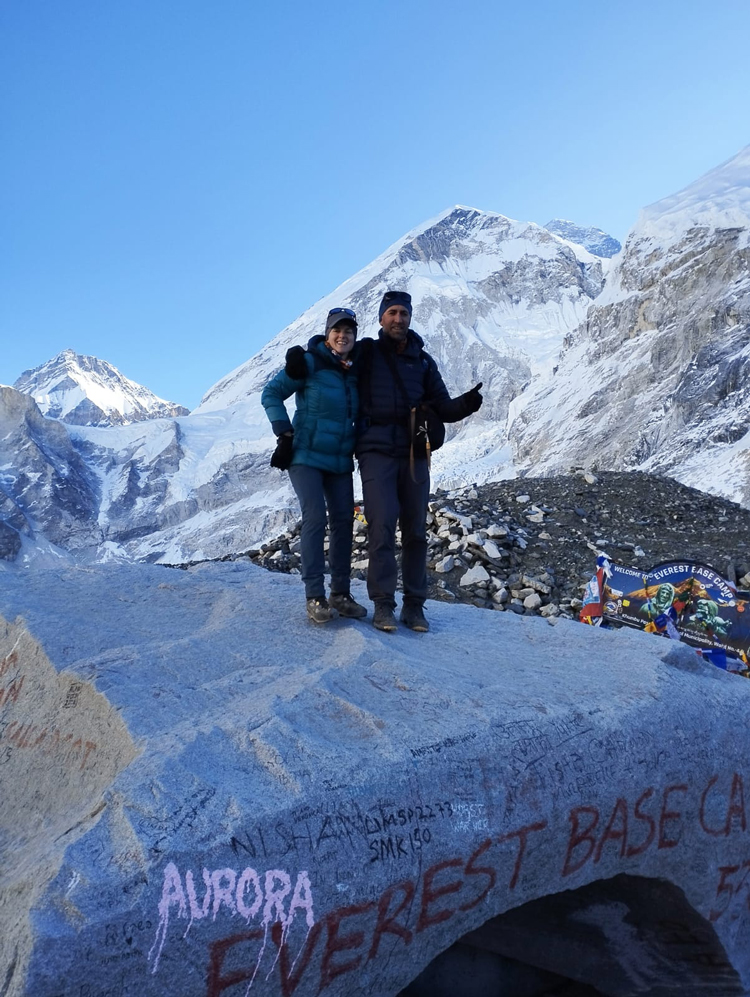
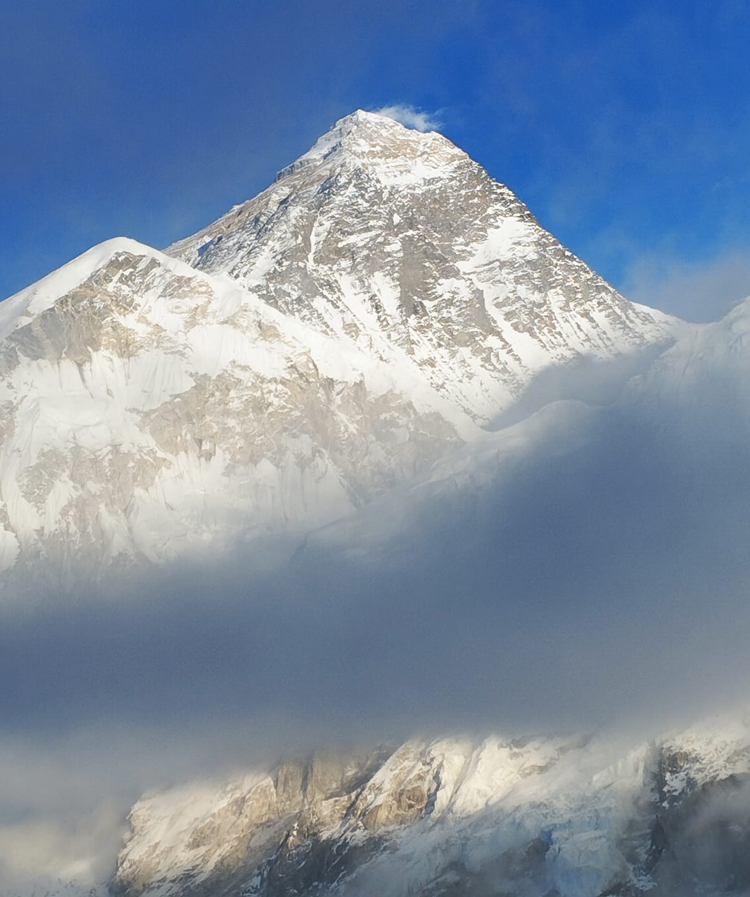
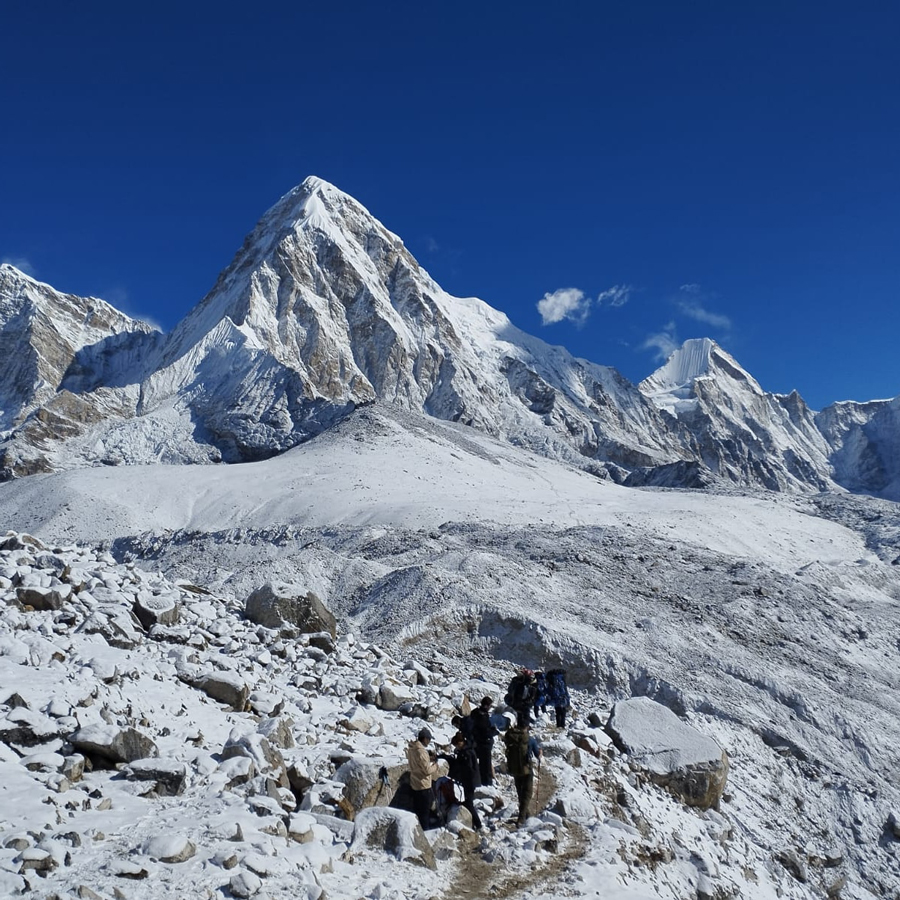
Highlights of Lobuche East Peak Climb
- Exciting blend of classic Everest Base Camp Trek with moderate alpine mountaineering.
- Land at the thrilling and short runway of Tenzing-Hillary Airport, the gateway of the Everest region.
- Walk through the forests of rhododendrons, conifers, green pastures, and glacial moraines within the Sagarmatha National Park.
- Pass through vibrant Sherpa villages, ancient monasteries, mani walls, stupas, and chortens.
- Explore popular Sherpa settlements like Namche Bazaar, and explore Everest’s spiritual hubs like Tengboche Monastery.
- Follow the main route to Everest Base Camp (5,364 m/ 17,598 ft) and Kala Patthar (5,550 m/ 18,209 ft).
- Traverse a quieter trail to Lobuche High Camp and spend the night at a tented camp.
- Cross glaciers, crevasses, ascend ice walls, and exposed ridges to reach the top of Lobuche East Peak (6,119 m/ 20,075 ft).
- Enjoy views of iconic and lesser-known peaks, such as Everest, Lhotse, Nuptse, Makalu, Ama Dablam, Pumori, Cholatse, Taboche, and Thamserku.
- Get a chance to experience high-altitude trekking and mountaineering while immersing in the local Sherpa culture.
Activity
Adventure Treks
Altitude
6,119 m / 20,075 ft (Lobuche East Peak summit)
Best Season
Spring (March to May) and Autumn (September to November)
Meals Included
16 breakfasts, 14 lunches, and 14 dinners
Transportation
Flight / Drive (if flights are directed to Ramechhap)
Destination
Nepal
Accommodation
2 nights Hotel stays in Kathmandu, lodges, and 1 night at a tented camp
Duration
17 Days
Region
Everest Region Treks
Start / End Point
Kathmandu/ Kathmandu
Nature Of Trek
Teahouse trekking, trekking peak climb
Difficulty
Moderate to Challenging
Lobuche East Peak Climb Overview
The Lobuche East is a moderately technical yet accessible trekking peak in the Everest (Khumbu) region of Nepal. It is an adventure that combines classic trekking with thrilling alpine climbing. Standing tall at a height of 6,119 m (20,075 ft), it is a perfect training ground for those seeking to step into the world of mountaineering or aiming for a 7,000 or 8,000 m expedition. The journey includes everything from high-altitude trekking, glacial travel, ice-climbing, peak ascent, and cultural immersion.
You will begin the trip with a short, scenic flight to Tenzing-Hillary Airport in Lukla. From here, your first phase of the Lobuche East Climbing journey begins. You will traverse a dense forest of rhododendrons, oaks, firs, and pines. The trail goes alongside the Dudh Koshi River Valley, taking you through Sherpa villages, suspension bridges, monasteries, mantra-inscribed mani walls, and chortens. Along the way, you can enjoy beautiful views of the snow-capped Himalayas peeking occasionally.
The main trekking trail takes you past villages like Phakding, Namche Bazaar, Tengboche, Pangboche, Dingboche, Lobuche, and Gorak Shep. Staying at the local teahouses in these villages gives you an opportunity to get a closer look at the Sherpa culture. You will also visit ancient monasteries and experience the deep-rooted religion and spirituality. Following the trail, you will ascend to Everest Base Camp (5,364 m/ 17,598 ft). Similarly, you will take a morning hike to Kala Patthar (5,550 m/ 18,209 ft) and enjoy the iconic mountain views.
Then, you will descend to Lobuche from where you will deviate from the main EBC Trek route. From here onwards, you will begin your Lobuche East expedition. You will ascend to High Camp (5,400 m / 17,700 ft) and prepare for the summit push. Your guide will also provide a pre-climb briefing and training. On the day of the summit, you will start around 2:00 AM and reach the top just in time for sunrise. The Lobuche East Peak offers mesmerizing views of the full Himalayan amphitheater. You can see Everest, Lhotse, Ama Dablam, Pumori, Cholatse, and Makalu. Likewise, you can see the sparkling glaciers, ridges, and snow fields.
Lobuche East Peak is ideal for those who want a complete Himalayan adventure in the Everest region. Despite being a 6,000 m trekking peak, it offers a true mountaineering summit experience. Even first-timers can take part in the climb with the help of an experienced climbing guide. Lobuche East is one of the best introductory trekking peaks, offering a rewarding and achievable challenge. If you want to get a taste of authentic mountaineering without extreme risk, this is the adventure for you!
17 Days Lobuche East Peak Climbing Outline Itinerary
Day 01:
Arrival in Kathmandu, transfer to the hotel.
Day 02:
Kathmandu - Lukla by flight, trekking to Phakding (2,610 m / 8,563 ft, 8 km or 3 hours walk).
Day 03:
Phakding - Monjo - Jorsalle - Namche (3,440 m / 11,290 ft, 11 km or 5-6 hours walk).
Day 04:
Hike to Everest View Hotel to see the world’s highest peak, Mt. Everest, and the other Himalayas views, visit Khumjung village, and back to Namche (6.6 km or 3-4 hours walk).
Day 05:
Namche - Kyangjuma - Phunki Tenka - Tengboche (3,860 m / 12,664 ft, 9 km or 5-6 hours walk).
Day 06:
Tengboche - Pangboche - Somare - Dingboche (4,410 m / 14,465 ft, 11 km or 4-5 hours walk).
Day 07:
Hike to Nangkartshang Peak (5,083 m / 16,676 ft) for acclimatization, then back to Dingboche.
Day 08:
Dingboche - Thukla - Lobuche (5,140 m / 16,863 ft, 8 km or 5-6 hours walk).
Day 09:
Trekking to Gorakh Shep (5,140 m / 16,863 ft, 11 km or 7-8 hours walk), Hike to Everest Base Camp (5,364 m / 17,598 ft).
Day 10:
Climb to Kala Patthar (5,550 m / 18,209 ft), trek down to Lobuche (4,940 m / 16,210 ft, 16 km or 7-8 hours walk).
Day 11:
Lobuche - High Camp (5,400 m / 17,700 ft, 5 hours walk), overnight at Tent Camp.
Day 12:
Wake up early in the morning and start at 2am for the Lobuche East summit (6,119 m / 20,075 ft). Enjoy the success, take a photo/video, trek down to Thukla (4,620 m / 15,157 ft), and overnight at a Lodge.
Day 13:
Contingency day in case of bad weather or not ready for the summit.
Day 14:
Thukla - Pangboche - Tengboche - Namche (3,440 m / 11,290 ft, 19km or 6-7 hours walk).
Day 15:
Namche - Monjo - Phakding - Lukla (2,840 m / 9,317 ft, 19 km or 6-7 hours walk).
Day 16:
Fly from Lukla to Kathmandu, then drive to your Hotel.
Day 17:
Departure for Home.
Lobuche East Peak Climbing 17 Days Itinerary
Arrival in Kathmandu, transfer to the hotel.
Activity
Airport pickup
Highest Altitude
1,345 m / 4,396 ft, Kathmandu
Accommodations
Kathmandu Guest House or similar
Your Lobuche East Peak Climbing journey starts the moment you arrive in Kathmandu. You will land at the Tribhuvan International Airport and go through immigration and visa formalities. Our team representative will be waiting for you, holding a placard with your name. They will greet you and transfer you to your hotel.
You will have time for refreshment. In the evening, we will hold a short briefing about the upcoming Lobuche East Peak Climbing. We will provide you with all the information and check your gear if you have brought it. Today is mostly about rest and preparation. But if you have time to spare, you can explore around your hotel or do last-minute shopping. You will spend the night in a hotel in Kathmandu.
Kathmandu-Lukla flight and trek to Phakding
Activity
8 km or 3 hours walk
Highest Altitude
2,610 m / 8,563 ft, Phakding
Accommodations
Lodge
Meals
Breakfast, Lunch, and Dinner
Our guide will come to pick you up from your hotel for a morning flight to Lukla. The short, scenic flight offers you your first glimpse of Nepal’s diverse landscapes. The twin otter will fly over green hills, valleys, and rivers. Similarly, you can see the snow-capped Himalayan ranges at a distance. You will land at one of the most adventurous airports in the world: the short airstrip at Tenzing-Hillary Airport in Lukla.
Lukla is the gateway to the Everest or Khumbu region. You will meet with your porter and support crew here and start your Lobuche East Peak Climbing journey. You will follow the main Everest trekking trail that descends and follows the Dudh Koshi River. It takes you through forests of rhododendrons and pine, while passing by small Sherpa settlements like Cheplung and Ghat. Similarly, you will cross suspension bridges decorated with colorful prayer flags and Buddhist mantras written on stone. Although short, the trek today gives you a taste of trekking on rugged terrain and a glimpse of the local Sherpa culture. You will stay overnight at Phakding. It is a popular Sherpa village that is located along the Dudh Koshi River.
Important Note: All flights operate from Ramechhap to Lukla and back to Ramechhap in April, May, October, and November. In such a case, trekkers must first drive from Kathmandu to Ramechhap around 2:00 AM, a 4- to 5-hour drive. The flight from Ramechhap to Lukla takes around 20 minutes.
Phakding - Monjo - Jorsalle - Namche Bazaar trek
Activity
11 km or 5-6 hours walk
Highest Altitude
3,440 m / 11,290 ft, Namche Bazaar
Accommodations
Lodge
Meals
Breakfast, Lunch, and Dinner
You will wake up, breathe in the fresh mountain air in Phakding. After breakfast, you will resume your trekking for the Lobuche East Peak Climbing. The trail goes north alongside the Dudh Koshi River, and you will cross several suspension bridges along the way. There are small traditional villages with monasteries, mani walls, prayer flags, and chortens dotted along the route. You will come across villages like Toktok, Benkar, and Monjo. At Monjo, there is a checkpost from where you will enter the Sagarmatha National Park.
The trail takes you to Jorsalle, the last settlement before Namche Bazaar. From here, the trail descends for a short while. Then, you will cross the famous Hillary Suspension Bridge that spans a river gorge. The real challenging ascent begins here. You will slowly climb through pine forests on a steep trail. It is a demanding climb, but just as you get closer to Namche Bazaar, you will get your first sighting of Mount Everest at a distance. Namche Bazaar is located in a natural amphitheater and will be an important step for the next two nights.
Acclimatization day at Namche Bazaar
Activity
6.6 km or 3-4 hours walk
Highest Altitude
3,880 m / 12,730 ft, Everest View Hotel
Accommodations
Lodge
Meals
Breakfast, Lunch, and Dinner
Today, you will take an acclimatization day at Namche Bazaar. It is crucial to allow your body to adapt to the growing altitude. You will follow the “climb high, sleep low” principle and take a side hike to the Everest View Hotel (3,880 m) and Khumjung village (3,780 m).
First, you will gradually start to climb through pine forests towards Syangboche airstrip. The trail also consists of stone steps. As you gradually climb uphill, you will pass by colorful prayer flags and stone cairns. Likewise, you can see beautiful mountain scenery. The Everest View Point is an excellent vantage point, and from its terrace, you can get panoramic views of Mount Everest, Lhotse, Nuptse, Ama Dablam, Thamserku, and other surrounding peaks. You can enjoy the view while sipping hot tea or coffee at the hotel.
From the Everest View Hotel, you will continue hiking towards the old Sherpa village of Khumjung. You can see traditional stone houses and fields around the village. There is also the age-old Khumjung Monastery, believed to house a mysterious “Yeti scalp.” The visit to Khumjung village offers a rich and immersive cultural experience. After the exploration, you will descend back to Namche Bazaar. With the remaining time, you can explore the local markets, alleys, or shops around the town. You will stay overnight at Namche.
Namche - Kyangjuma - Phunki Tenka - Tengboche trek
Activity
9 km or 5-6 hours walk
Highest Altitude
3,860 m / 12,664 ft, Tengboche
Accommodations
Lodge
Meals
Breakfast, Lunch, and Dinner
On day 5, you will leave Namche Bazaar and follow the trail towards Kyangjuma. The path is relatively gentle and gives you spectacular views of Mount Everest, Lhotse, Nuptse, and Ama Dablam. Upon reaching Kyangjuma, the trekking trail descends through rhododendron and pine forests. It takes you to Phunki Tenga, which sits beside the Dudh Koshi River. It is a popular rest stop among trekkers. You will cross a suspension bridge at Phunki Tenga, and the trail starts to ascend once more.
With the ascent, the climb also becomes more demanding. The forest gradually opens up, and you can see spectacular views of the surrounding mountains. Following the path, you will reach Tengboche village. It is home to the ancient Tengboche Monastery, the spiritual center of the Everest region. The monastery is also an excellent viewpoint that offers a spectacular view of Mount Ama Dablam and other surrounding peaks. You will stay overnight at Tengboche, so you can visit the monastery, where you may get to observe monks performing evening prayers. The spiritual atmosphere combined with the stunning mountain view is truly an unforgettable moment.
Tengboche - Pangboche - Somare - Dingboche trek
Activity
11 km or 4-5 hours walk
Highest Altitude
4,410 m / 14,465 ft, Dingboche
Accommodations
Lodge
Meals
Breakfast, Lunch, and Dinner
From Tengboche, you will continue ascending through the dense forest of the lower Khumbu Valley and enter the upper Everest region. You will start with a gentle descent through forests of rhododendron, juniper, and birch. The trail takes you to Imja Khola, and on the way, you will cross a suspension bridge. Then, the trail begins to ascend and takes you to one of the oldest Sherpa settlements in the Khumbu Valley, Pangboche. The village offers stunning views of Mount Ama Dablam and the surrounding mountain scenery.
As you ascend to higher altitudes, the landscape also changes into alpine meadows and green pastures. It also becomes more barren and rougher. Upon reaching Somare, the tree line gradually starts to disappear. From here, you can enjoy beautiful views of Mount Ama Dablam, Lhotse, and Island Peak. As you get closer to Dingboche, the valley opens up into a wide glacial valley. The view of stone-walled fields also begins to come into view. Finally, you will arrive at Dingboche, another important acclimatization stop for the Lobuche East Peak Climbing.
Acclimatization day at Dingboche
Activity
6 km or 4-5 hours walk
Highest Altitude
5,083 m / 16,677 ft
Accommodations
Lodge
Meals
Breakfast, Lunch, and Dinner
You will take another acclimatization day on this day. After breakfast, you will take a side hike to Nangkartshang Peak (5,083 m / 16,676 ft). You will follow the steep uphill trail that rises above Dingboche. It is a short hike, but the high altitude and rough terrain make it demanding. However, once you reach the Nangkartshang Peak, a wide and spectacular view opens up before you. You can see several iconic mountains, including Mount Nuptse, Lhotse, Ama Dablam, Cholatse, and Island Peak.
The hike to Nangkartshang Peak also helps in acclimatization. You will ascend to the vantage point over 5,000 m during the day and return to Dingboche for an overnight stay. It helps your body to adapt to the high altitude more effectively. After enjoying the views, you will descend to Dingboche. With the remaining time, you can explore around the village. Or, you can simply rest and hydrate for the upcoming Lobuche Peak Climb.
Dingboche - Thukla - Lobuche trek
Activity
8 km or 5-6 hours walk
Highest Altitude
5,140 m / 16,863 ft, Lobuche
Accommodations
Lodge
Meals
Breakfast, Lunch, and Dinner
On this day, you will leave Dingboche after breakfast and ascend out of Dingboche valley. The trail for Lobuche East Peak Climbing takes you to a higher altitude. The vegetation becomes sparse as the landscape grows more barren. You will come across glacial streams and rocky terrain. Due to the altitude, the air starts to get thinner. So, you have to maintain a steady pace and keep yourself hydrated. After trekking for some time, you will reach the small settlement of Thukla. It is an important rest stop right before the steep climb up to the Thukla Pass.
Climbing up the steep trail, you will come across a memorial section known as the Thukla Memorial. Here, you will see stone chortens and memorials dedicated to climbers and Sherpas who lost their lives on Mount Everest and nearby peaks. You can experience a powerful emotional moment as you pass through the area. The trail becomes gentler from the Thukla Pass. You can see the mountains like Lobuche East, Pumori, and Nuptse become closer. Following the glacier moraine of the Khumbu Glacier, you will reach Lobuche. You will rest here for the night.
Lobuche to Everest Base Camp, and Gorak Shep trek
Activity
11 km or 7-8 hours walk
Highest Altitude
5,364 m / 17,598 ft, Everest Base Camp
Accommodations
Lodge
Meals
Breakfast, Lunch, and Dinner
Day 9 is one of the most exciting days of the Lobuche East Peak Climbing. You will trek to the iconic Everest Base Camp. The trekking trail ascends through glacial moraines, debris, and rocky paths. The air gets thinner, so climbing becomes more challenging. Hence, it is important to maintain a slow and steady pace. As you continue moving forward, you can also see the surrounding mountain peaks and the Khumbu Glacier. After several hours of trekking, you will reach Gorak Shep. It is the last settlement before Everest Base Camp.
From Gorak Shep, you will begin your hike to the base camp. You will follow the trail that goes along the edge of the Khumbu Glacier. Finally, you will reach the Everest Base Camp at the foothill of Mount Everest. You can see the spectacular views of Mount Nuptse, Pumori, Lingtren, and Khumbutse. Additionally, you can see the beautiful Khumbu Icefall and glacial formations. In peak season, you can also see colorful expedition tents around the base camp area. Once you enjoy the views to your heart’s content, you will descend to Gorak Shep. You can rest and recover at a basic but cozy teahouse here.
Hike to Kala Patthar, trek down to Lobuche
Activity
16 km or 7-8 hours walk
Highest Altitude
5,550 m / 18,209 ft, Kala Patthar
Accommodations
Lodge
Meals
Breakfast, Lunch, and Dinner
It is another exciting day on the Lobuche East Peak Climbing itinerary. You will wake up early and hike to the iconic Kala Patthar viewpoint. You will leave in the dark with a headlamp lighting the path. The trail is steep and rocky, and the temperature is cold, so you need to layer up properly. You will reach Kala Patthar just in time for sunrise. With the first ray of the sun, the mountains slowly come into your view. From Mount Everest to Lhotse, Nuptse, and Pumori, you can witness one of the clearest and closest views of the mountains. It is one of the best spots to enjoy an unobstructed view of Mount Everest.
You can take your time enjoying the sunrise and photographing the panoramic views. Then, you will descend to Gorak Shep and towards Lobuche. A familiar trail takes you downhill through the Khumbu Valley. You will trek along rocky moraines and glacial valleys, and enter alpine terrain. Since you will be descending to a lower elevation, it will be slightly easier to breathe. Following the route, you will reach Lobuche, where you will stay for the night. You can rest and recover while enjoying the surrounding view and prepare for your climb to Lobuche Peak.
Lobuche - High Camp trek
Activity
3 km or 5 hours walk
Highest Altitude
5,400 m / 17,700 ft, High Camp
Accommodations
Tented Camp
Meals
Breakfast, Lunch, and Dinner
You will begin the final stage of the Lobuche East Peak Climbing. After breakfast at Lobuche, you will gradually begin ascending on rocky terrain and glacial moraines. The trail also deviates from the main Everest trail and takes you to a remote area of the Everest region. There are very few settlements along the way. With every step, the climb becomes challenging. You need to walk at a steady pace and control your breathing.
Following the rocky and uneven terrain, you will reach the Lobuche East High Camp (5,400 m / 17,700 ft). It sits in an isolated and exposed alpine landscape. After arriving at the high camp, you will set up the expedition-style tent camp. Your guide will conduct a pre-summit briefing, safety session, and gear check. Similarly, they will provide instructions on using climbing gear such as crampons, ice axes, harnesses, and fixed ropes. Your guide will brief you about everything related to a safe ascent, so make sure you listen and follow their instructions carefully. Spend the rest of the afternoon resting, recovering, and hydrating. You need to conserve your energy for the early morning summit push the next day.
Climb to Lobuche East summit, trek down to Thukla
Activity
12 km or 10-14 hours walk
Highest Altitude
6,119 m / 20,075 ft, Lobuche East Summi
Accommodations
Lodge
Meals
Breakfast, Lunch, and Dinner
Today will be the most thrilling, demanding, and long summit day. You will start early in the morning, around 2:00 AM. It is dark, and the temperature is freezing. You will slowly start to climb from high camp in the darkness, using a headlamp and under your guide’s guidance. First, you will navigate steep, rocky terrain that changes into snow and ice slopes. You will navigate glaciers and start to gain altitude. As you go higher, it becomes more technical, and you need to use the mountaineering gear for the climb. Your guide will assist you throughout the climb.
For the final stretch, you must walk on exposed ridges and climb steep snow slopes. The thin air and the snowy terrain make the progress slow and demanding. However, once you finally reach the summit, all your effort will be rewarded. You will be greeted with one of the most mesmerizing views of the surrounding Himalayas. The summit treats you with incredible views of Mount Everest, Lhotse, Nuptse, Ama Dablam, and other surrounding peaks. Likewise, a huge sense of achievement also washes over you. You can take some time to enjoy the views and celebrate your achievements.
Then you will descend the same route you ascended to High Camp and base camp. You will continue descending to Thukla. It is a long and physically tiring day. So, you can rest and recover once you reach Thukla.
Contingency day in case of bad weather or not ready for the summit.
Meals
Breakfast, Lunch, and Dinner
This day is designated as a contingency or buffer day. The Himalayan weather can change rapidly, regardless of the season. Hence, bad weather can prevent the planned summit climb. In such a case, the summit push is delayed or postponed to ensure climbers’ safety. In other cases, climbers may not be physically ready or properly acclimatized for the climb. They may require an extra rest day. Thus, this day provides a strategic safety buffer for climbers in the event of such events.
Thukla - Pangboche - Tengboche - Namche trek
Activity
19 km or 6-7 hours walk
Highest Altitude
4,620 m / 15,157 ft, Thukla
Accommodations
Teahouse
Meals
Breakfast, Lunch, and Dinner
After yesterday’s long summit push, you will begin your downhill descent today. From Thukla, you will rejoin the classic Everest Base Camp trail. You will descend through rocky terrain and alpine landscapes. As you continue descending, the landscape gradually becomes greener. The air also becomes thicker, and it becomes easier to breathe. You will climb downhill to Pangboche from where you can see a spectacular view of Ama Dablam.
The trail continues to descend through forests, and you will cross a suspension bridge over the Imja Khola. You will retrace your steps to Tengboche. There are several ups and downs along the way, and you will trek through forests of rhododendron and pine. Descending further, you will head towards the Dudh Koshi Valley. You will follow the trail until you reach Namche Bazaar. Enjoy the view or warm coffee with bakeries in the evening. You will rest here for the night.
Namche - Monjo - Phakding - Lukla trek
Activity
19 km or 6-7 hours walk
Highest Altitude
3,440 m / 11,290 ft, Namche Bazaar
Accommodations
Teahouse
Meals
Breakfast, Lunch, and Dinner
Today is the final trekking day in the Everest region. It is mostly downhill, with occasional ascents. You will leave Namche Bazaar and begin descending steeply towards the Dudh Koshi River Valley. The trail once again takes you through forests of pines while passing by small Sherpa settlements. Although descending is relatively easier than ascending, it can put strain on your knees. Use your trekking pole to balance yourself.
The trail takes you past colorful prayer flags, chortens, and mani walls. Upon reaching Monjo, you will exit the Sagarmatha National Park. Following the familiar path, you will reach Phakding. From here, you will ascend gradually towards Lukla. It will be the last climb for the end. Once you reach Lukla, you can celebrate the successful completion of the Lobuche East Peak Climbing. You can relax, rest, and reflect on your journey. You will spend the night in Lukla for your final night in the Everest region.
Fly from Lukla to Kathmandu, then drive to your Hotel
Activity
30 minutes flight
Highest Altitude
2,860 m/ 9,383 ft, Lukla
Accommodations
Kathmandu Guest House or similar
Meals
Breakfast, Lunch, and Dinner
Today is the final day in the Everest region. After breakfast in Lukla, you will take a flight to Kathmandu. The scenic flight offers one final aerial view of the snow-capped mountains and the diverse landscape. In peak season, your Lukla flight may be redirected to Ramechhap. Upon reaching Ramechhap, you will drive back to Kathmandu, a 4- to 5-hour drive.
Upon arrival in Kathmandu, our representative will assist with your transfer to your hotel. In the evening, you can explore around the city, go sightseeing, or shop around for souvenirs. Since this will be your last day here, you can also taste Nepalese cuisine or enjoy Kathmandu’s nightlife.
Important Note: All flights operate from Ramechhap to Lukla and back to Ramechhap in April, May, October, and November.
Departure for Home
Activity
Airport drop off
It is the final day of the Lobuche East Peak Climbing. Our representative will pick you up from your hotel. They will assist with your transfer at the Tribhuvan International Airport at least 2 hours before your scheduled departure. We wish you a safe flight back home. Thank you for choosing the Himalaya Trip for your Lobuche East Peak Climb in Nepal!
1 Night 2 Days Lobuche East Peak Climbing optional
If you want to join the Lobuche East Peak Climbing halfway through the Everest trek, we have the perfect 1 Night / 2 Days Lobuche East Peak Climbing package. Our team will meet you at Lobuche, from where you will start the climbing journey. From Lobuche, you will climb to High Camp and spend the night in a tented camp. The following morning, around 2:00 AM, you make a summit attempt. After reaching the summit, you will descend the same way back to Lobuche, Thukla, or Dzongla.
Day 01: Lobuche – High Camp (5,400 m, 5-6 hours walk), overnight at Tent Camp.
- Activity: 5-6 hours walk
- Highest Altitude: 5400 m High Camp
- Accommodations: Tent Camp
- Meals: Lunch, Dinner
Our team will pick you up at your Hotel in Lobuche, trek to Lobuche Base Camp, take a rocky, steep trail to High Camp, and overnight at the Tent Camp. In the afternoon, our climbing sherpa will teach you how to wear climbing gear and teach you some climbing techniques.
Day 02: High Camp – Summit – back to Lobuche / Thukla / Dzongla (depending on your schedule).
- Activity: 10-12 hours of climbing
- Highest Altitude: 6,119 m, Lobuche East
- Meals: Breakfast, Lunch
You will get up early in the morning and start climbing at 2:00 AM, as it will be windy in the afternoon. You will summit Lobuche Peak, take some photos and video, and enjoy the achievement. Return to High Camp and Base Camp, then follow the schedule itinerary to Lobuche, Thukla, or Dzongla.
Optional: 1 or 2 additional days are recommended in case of flight cancellation and bad weather on the Lobuche East Summit day.
Lobuche East Peak Climbing Map
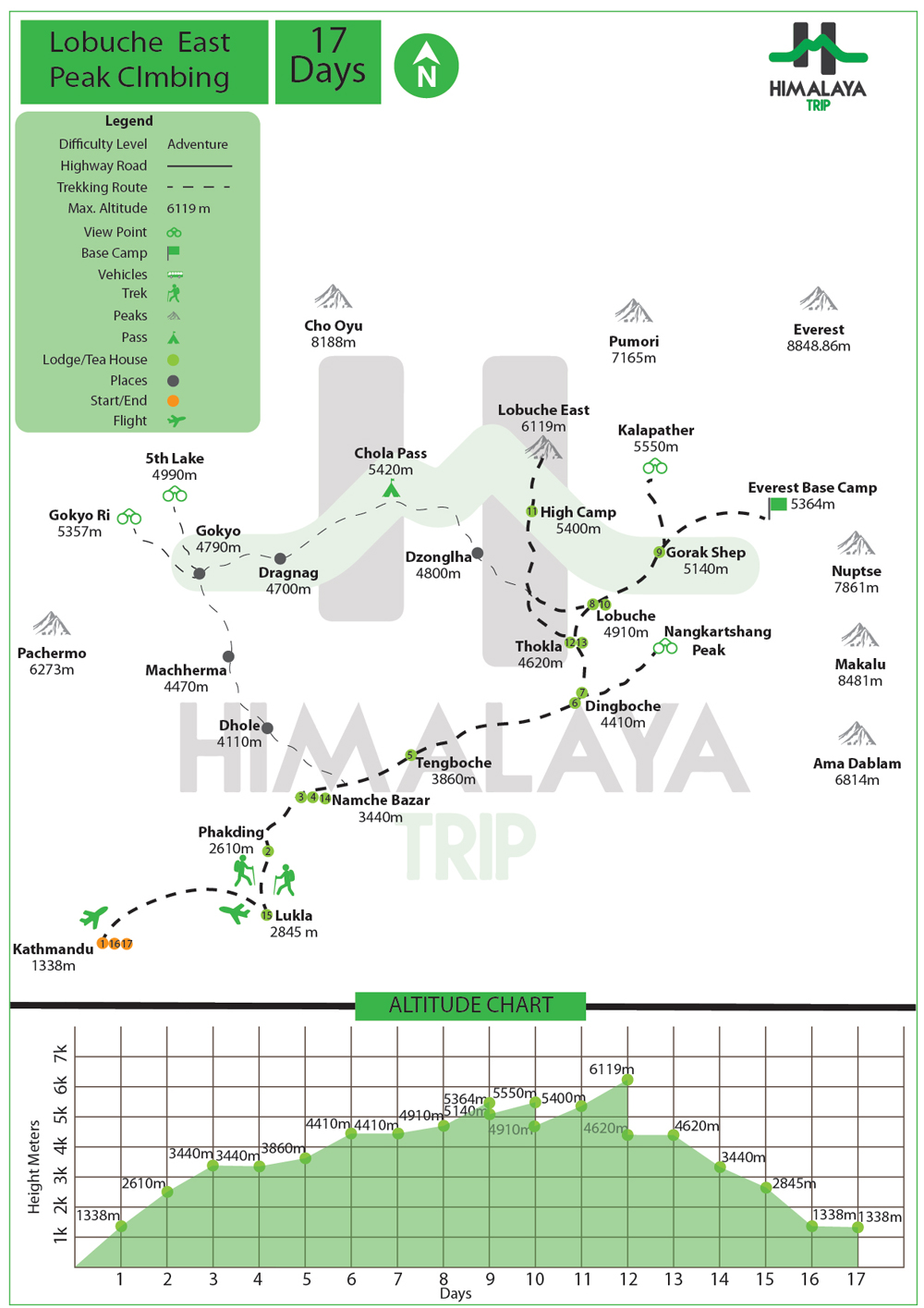
Whats included?
Everything you need for a safe, comfortable, and memorable trek — packed into one transparent price. Below is a full breakdown of what is covered in your Island Peak Climbing package.
Accommodation & Meals
- Lodge : Twin or triple sharing room ( 3 Nights Namche, 2 Nights Dingboche, 1 Night Lukla have attached bathroom and Phakding, Tengboche, Lobuche, Gorak Shep , Thukla have common room. Lobuche East Peak High Camp at Tent Camp. Hot Shower in Namche and Lukla.
- 2 Nights at Kathmandu Guest House in Kathmandu.
- Meals: 16 Breakfasts, 14 Lunches & 14 Dinners during the trek.
Transportation & Flights
- Transportation : Airport pick-up and drop off at Tribhuwan International Airport and Domestic airport by private vehicle.
- Kathmandu – Ramechhap – Kathmandu transportation if your flight is from Ramechhap.
- Flight: Kathmandu or Ramechhap – Lukla – Ramechhap or Kathmandu flight ticket.
Guide & Porter Services
- Trekking Guide: One licensed, English-speaking trekking guide whole trek and climbing sherpa from Lobuche to Lobuche East Peak summit and back.
- Porter service: one porter per two trekkers.
- Trekking/ Climbing Guide and Porters: Food, accommodation, salary, equipment and personal insurance etc.
Equipment & Safety
- Fingertip Pulse Oximeter — daily oxygen and pulse monitoring for altitude safety.
- First Aid Kit carried by the guide .
- Duffle Bag: One Duffle bag per trekkers on return.
Permits & Official Fees
- Lobuche East Peak Climbing Permit and Garbage deposit.
- Sagarmatha National Park fee and Khumbu Pasang Lhamu Rural Municipality entrance fee.
- 13% Government VAT and all official government charges.
Complimentary Extras
- Seasonal fresh fruit en route — pomegranates & apples.
- Lobuche East Peak Climbing Map and Himalaya Trip T-shirt.
- 24/7 emergency support line available during your entire trek.
What’s excluded?
- International airfare and visa fee (15 days for USD 30 and 30 days for USD 50).
- Lunch and Dinner in Kathmandu.
- All the drinks, such as Coke, beer, and mineral water.
- Personal climbing gear & clothing (also available for hire).
- Your travel insurance should include emergency Rescue.
- Tips for staff.
Available dates & Prices
If you are two or more people, private trip is available any date, providing a fantastic opportunity. If you are solo travellers, our fixed group trips are thoughtfully scheduled and offer specific departure dates.
Group Discount Pricing
Price per person — the more you travel together, the less you pay
No. of Persons
Price per Person
-
1 PersonUSD 2,449
-
2 - 4 PaxSave 12% USD 2,149
-
5 - 9 PaxSave 14% USD 2,099
-
10+ Pax Best ValueSave 16% USD 2,049
Create Your Private Trip With
Your Own Itinerary and Dates
We are more than happy to design an itinerary tailored to your schedule and preferred route. Simply share your preferred travel dates, group size, and contact and travel details, and one of our travel experts will get in touch to help plan your journey.
Once your trip is confirmed, you’ll travel exclusively with your own group, enjoying a more personalized and flexible experience.
Price of Lobuche East Peak Climbing for Spring and Autumn:
Lobuche East Peak Climbing prices differ between the Spring and Autumn seasons, as the permits have different prices. Spring (March, April, May) costs US$ 350 per person, and Autumn (September, October, and November) costs US$ 175 per person.
The price of Lobuche East Peak Climbing in the spring season:
The permit price for Lobuche East Peak Climbing is US$ 350 per person in the spring season (March, April, May). This will increase the overall cost of the climb. The Lobuche East Peak Climbing price ranges from US$ 2,225 to US$ 2,625 per person, depending on the group size.
The price of Lobuche East Peak in the Autumn Season :
The price of Lobuche East Peak Climbing is US$175 per person in the Autumn season (September, October, and November), which will help reduce the overall package price by US$ 175. Lobuche East Peak Climbing price is from US$ 2149 to US$ 2,449 per person, depending on the group size.
What Makes Lobuche East One of Nepal’s Best Climbing Peaks?
Lobuche East Peak offers a balance of accessibility, moderate technical mountaineering, and a rewarding experience that makes it one of Nepal’s best climbing peaks. It is especially a perfect choice for first-timers stepping into the world of mountaineering. Let us explore more in depth:
An ideal “First Himalayan” summit
Lobuche East is often called the first real Himalayan peak and a popular choice for the first 6,000 m summit. It is situated between trekking and technical climbing. The peak just exceeds the altitude of 6,000 m, so you get to experience real high-altitude mountaineering. You need basic mountaineering skills, but nothing advanced or overly technical. The Lobuche East Peak introduces you to snow, ice, and fixed rope sections. With the help of an experienced guide and basic training, you can still climb the peak. It offers a perfect introduction to mountain climbing in Nepal. Lobuche East Peak is accessible to any climbers with good fitness, endurance, and determination.
Authentic expedition without extreme logistics
Despite being 6,000 m, Lobuche East Peak offers a true expedition-style climbing experience. Moreover, there is no need for extreme logistics for 7,000 or 8,000 m. You will ascend from Lobuche to High Camp and stay in an expedition-style tent. You will start your summit push early, around 2:00 AM. From the high camp, you will traverse glaciers, crevasses, and snowy fields. Similarly, you will climb on steep alpine slopes and walk on the narrow trail on the ridge. The use of climbing gear further enhances the authentic mountaineering experience. But unlike real expeditions, you do not need multiple base camp rotations, weeks of acclimatization camps, or heavy Sherpa logistics.
Trek on the main Everest trail
Another reason Lobuche East is one of the best climbing peaks is that it also offers classic trekking. You will start from Lukla and follow the iconic Everest Base Camp Trek route. Along the way, you will pass by famous Sherpa villages like Namche Bazaar, Tengboche, Dingboche, etc. Similarly, you will get to enjoy the classic Everest trekking scenery and the warm mountain hospitality. Most itineraries include a hike to Everest Base Camp and Kala Patthar. It is a perfect opportunity to get the best of trekking and mountain-climbing experiences in a single journey.
Spectacular panoramas and scenery
Lobuche East Peak also offers unparalleled and unforgettable scenery. From the start of the journey to the end, you will get to enjoy the views of diverse landscapes and snow-capped mountain vistas. At the beginning, you will trek through the lush valley of the Dudh Koshi River. As you ascend to higher elevations, the scenery becomes more striking, with glacial valleys, snow-covered landscapes, and giant peaks. Then, the most unforgettable views can be seen from the summit of Lobuche East. The mountain views from Everest to Makalu, Lhotse, Ama Dablam, Pumori, and Nuptse, you can catch them all in one sweeping view. The extraordinary scenery is one of the main reasons Lobuche East is among the country’s best climbing peaks.
Technical Skills Required for Lobuche East Peak Climb
Lobuche East has moderate technical sections and requires basic mountaineering skills. Although it is not as technical as 7,000 or 8,000 expeditions, climbers must be able to use mountaineering gear for the summit day.
Here are some technical skills you need for the Lobuche East Climb:
Crampons:
These are metal spikes attached to the mountaineering boots. These spikes help climbers walk safely on ice and hard snow. They avoid slipping on icy slopes. You will have to learn how to walk on crampons with a steady, flat-footed technique known as the French technique. Walking on crampons is one of the first skills for peak climbing. You will use crampons to climb on the route above High Camp.
Harnesses:
A harness is safety equipment used to secure climbers to the rope. It helps climbers connect to the rope so they don’t fall if they slip during the climb. Harnesses are essential gear for glacier travel and climbing steep slopes. Before the climb, your guide will teach you how to wear and adjust the harness. You need to learn to use it to stay connected while moving through exposed sections. Similarly, you must also learn how to attach yourself to fixed ropes using carabiners.
Ice axes:
All climbers must also learn to use basic ice axe skills for the Lobuche East Peak Climbing. You have to practice holding and using the ice axe while walking on snow slopes. It offers balance and support while climbing on steep sections. Similarly, you must practice the self-arrest technique that stops a slide if you accidentally fall.
Fixed ropes:
The fixed ropes are installed on steep or exposed slopes of the mountain by guides. It is one of the most crucial skills for the summit push on Lobuche East. Your guide will teach you how to clip into ropes using carabiners. You must learn to move step by step while staying attached to the fixed ropes. Similarly, you must be able to maintain balance while ascending or descending on the icy slopes.
Ascenders:
The ascender, or jumar, is a mechanical device used to climb fixed ropes. While it may look complicated, using ascenders is quite easy. Your guide will teach you how to attach the jumar to the rope. You must also be able to slide it up the slope safely while standing. Similarly, you have practice using ascenders with your harness and safety system, and rest while staying clipped in.
Required Permits for Lobuche East Peak Climb
All climbers must obtain three permits for the Lobuche East Peak Climb. These include the Sagarmatha National Park Entry Permit, the Khumbu Pasang Lhamu Rural Municipality, and the Nepal Mountaineering Association (NMA) Climbing Permit. Solo climbing is not permitted for trekking peaks in Nepal. Additionally, these permits can be obtained via a registered trekking agency. There are multiple checkpoints along the Everest trail, where you must show these permits.
Nepal Mountaineering Association (NMA) Climbing Permit:
This permit is necessary for the actual summit climb of the Lobuche East Peak. It is issued by the Nepal Mountaineering Association (NMA) and is only valid for a specific season and expedition period. The NMA Climbing Permit costs are as follows:
| Season | Cost per person |
| Spring (March to May) | USD 350 |
| Summer (June to August) | USD 175 |
| Autumn (September to November) | USD 175 |
| Winter (December to February) | USD 175 |
Khumbu Pasang Lhamu Rural Municipality Permit:
This is a local permit necessary for all treks and climbs in the Everest region. The Khumbu Pasang Lhamu Rural Municipality Permit replaced the traditional TIMS (Trekker’s Information Management System) Card in the region. The fund collected from the permit is used to develop local infrastructure and support the community. The Khumbu Pasang Lhamu Rural Municipality Permit costs around USD 25 per person and can be obtained at the local municipality counters in Lukla.
Sagarmatha National Park Entry Permit:
The trekking trail from Monjo and the Lobuche East Peak itself lies within the Sagarmatha National Park. The park is a UNESCO World Heritage Site and a habitat for numerous wildlife, including rare and endangered species like the red panda, snow leopard, and more. Hence, the permit is mandatory for trekking in the Everest region.
The funds from permits help conserve the national park and maintain trails. Similarly, it helps regulate tourism to minimize its environmental impact. The Sagarmatha National Park Entry Permit costs around USD 25 per person and is issued by the Department of National Parks and Wildlife Conservation.
Note: Climbers must also pay a refundable garbage deposit of USD 500 per group to obtain the NMA Permit. It helps ensure that climbers bring back all waste from the mountain and dispose of it properly. After completing the climb and all waste has been properly collected and brought back, the deposit is refunded.
Mountain Views from the Summit of Lobuche East
Reaching the summit of Lobuche East is a rewarding experience, not only for the huge sense of achievement but also for the mountain views. At a height of 6,119 m, a magical, panoramic view unfolds before you, along with glaciers and icefalls. There are very few trekking peaks that provide such a close-up mountain scenery. Here is a complete list of all the Himalayan peaks that you can watch from the Lobuche East summit:
- Everest (8,848.86 m): The world’s highest mountain is the main highlight among the mountain views from the Lobuche East summit. It offers a unique perspective of Everest. The mountain stands tall above the surrounding giants, giving you a clear sense of its massive scale.
- Lhotse (8,516 m): You can see the mountain rising to the south of Everest. From the mountain’s steep faces to striking walls of ice and rocks, you can see Lhotse clearly from the summit.
- Nuptse (7,861 m): To the west of Lhotse, you can see Nuptse with its distinct jagged ridges. Its ridges make it stand out among other peaks. Likewise, you can see the peak’s massive, wall-like south face rise from the Khumbu Glacier.
- Ama Dablam (6,812 m): The elegant pyramid shape of Ama Dablam also offers a striking visual treat to climbers from the top of Lobuche East. Its beautiful shape, along with the steep ridges, stretches in the southern horizon.
- Pumori (7,161 m): You will see Pumori rise above the Khumbu Glacier. The snow-covered slopes of the mountain and its isolated position make it easily identifiable from other peaks.
- Makalu (8,485 m): The fifth-highest mountain in the world appears to the southeast on the horizon. Its sharp, symmetrical pyramid and clean shape easily catch your eye. You can see its steep ridges drop sharply on all sides, even from a long distance.
- Cholatse (6,440 m): The peak rises in the western-southwestern horizon from the Lobuche East summit. Cholatse looks sharp with its knife-edge ridgeline, steep rock, and ice faces. It creates a pleasant contrast with other surrounding mountain peaks.
- Taboche (6,495 m): It stretches in the southern-southwestern horizon from the Lobuche East summit. Taboche offers a visually balanced look with its sharp and pyramidal shape. It creates a beautiful pair with the nearby Cholatse mountain.
- Thamserku (6,608 m): Standing on the southwestern horizon, Thamserku is also visible from the top of Lobuche East. Its distinctive triangular form, icy summit, and isolated appearance are visible from the summit.
Lobuche East Peak Climb vs Island Peak vs Mera Peak
The Lobuche East Peak, Island Peak, and Mera Peak are the three popular trekking peaks in Nepal. Lobuche East is well-known for its technical but manageable climb. Island Peak is a technical climb, suitable for aspiring climbers. On the other hand, Mera Peak is Nepal’s highest trekking peak but requires minimal technical climbing skills. These three different peaks cater to different types of climbers. Here is a complete comparison between them:
| Features | Lobuche East Peak | Island Peak | Mera Peak |
| Region | Everest region | Everest region | Hinku Valley region |
| Altitude | 6,119 m | 6,189 m | 6,476 m |
| Difficulty | Moderate to challenging | Challenging | Moderate |
| Alpine grading | PD+ (Peu Difficile Plus) | PD+ (Peu Difficile Plus) | PD (Peu Difficile Plus) |
| Crowd level | Moderate | High | Low to moderate |
| Success rate | 70% to 80% | 70% to 85% | 70% to 90% |
| Fitness requirement | Basic mountaineering and gear handling | Strong mountaineering skills | Basic trekking and using crampons |
| Technical sections | Steep snow slopes, fixed ropes, and an exposed ridge | Glacier crossing, fixed ropes, and steep headwall (40 and 50°) | Mostly navigating snowy trails and minimal technical climbing |
| Main risk | Crevasses and a steep, icy ridge | Ladder crossing, crevasses, and steep headwall | Altitude sickness and long duration |
| Summit view | Mount Everest, Lhotse, Nuptse, and Ama Dablam | Close view of the Lhotse range, Makalu, and Baruntse | Mount Everest, Lhotse, Makalu, Kanchenjunga, and Cho Oyu |
| Best for | First-timers seeking a real alpine peak with challenges | Mountaineers seeking training or experience for higher peaks | Beginner looking for 6,000m summit experience |
Best Time for Lobuche East Peak Climb
Spring (March to May) and autumn (September to November) are the best times for the Lobuche East Peak Climb. These are also peak seasons for trekking and climbing in Nepal. The weather, temperature, and climbing conditions are the most stable on Lobuche East. Likewise, it is also the best time to enjoy excellent mountain views.
Spring (March to May)
Spring is also the pre-monsoon season in Nepal. The weather is favorable, with warm temperatures. The trekking trails are lush, and the lower rhododendron forests are in full bloom. Due to stable weather, the snow conditions are also safe for climbing. Another reason why spring is an ideal time for Lobuche East Peak Climbing is the longer daylight hours. The visibility is great, and there is no obstruction like monsoon haze.
- Lower elevations (Namche-Dingboche): 5°C to 15°C (day) / -5°C to -10°C (night)
- High Camp (5,400 m): -5°C to -10°C (day) / -10°C to -20°C (night)
- Summit (6,119 m): -10°C to -20°C
Autumn (September to November)
Autumn is the post-monsoon season and is a popular time of the year for trekking and climbing. The weather is the most stable with mild temperatures. There is no rainfall, so the trail is dry and the sky is clearest. Similarly, the visibility is excellent with crisp air that is great for photography. The snow at the Lobuche East Peak is usually firm and stable. It makes the use of crampons and fixed rope climbing safer. The temperature is slightly cold in autumn but offers predictable summit conditions.
- Lower elevations: 10°C to 18°C (day) / 0°C to -5°C (night)
- High Camp (5,400 m): -6°C to -12°C (day) / -12°C to -22°C (night)
- Summit (6,119 m): -12°C to -22°C
Who is Lobuche East Peak Climb Suitable For?
The Lobuche East Peak Climb is suitable for those who want to experience a real Himalayan climbing adventure without a full expedition-level commitment. Anyone with good fitness and basic mountaineering skills can join the climbing journey. Even first-timers who want to enter the world of mountain climbing can join the climb. However, they must be ready to learn the skills and prepare for it accordingly. The Lobuche East Peak Climb is also suitable for adventurers seeking something more than trekking. It is suitable for adventurers who enjoy challenges and high-altitude adventures. Similarly, the climb is ideal for experienced climbers as a training ground before their 7,000- or 8,000-m expedition.
Although Lobuche East Peak is an accessible and manageable trekking peak, some climbers may find it extremely challenging. Beginners with no prior trekking or high-altitude exposure may struggle with the climb. At high altitude, there is a high risk of altitude sickness and fatigue. The climb combines multiple days of high-altitude trekking on diverse terrain. Additionally, the summit push is long and physically and mentally demanding. Those with low fitness and poor endurance will struggle with the climb. Likewise, those who are not comfortable with heights or exposure to the elements can find Lobuche East challenging. Hanging on fixed ropes on steep terrain or walking on the narrow ridges with steep drops on either side is not for the faint of heart.
Anyone who wants to attempt the Lobuche East Peak Climbing must first assess their health and fitness. Climbers with good health and fitness, adventure seekers, and experienced mountaineers will find the climb more manageable. On the other hand, complete beginners, climbers with low fitness, and those expecting a non-technical climb will find Lobuche East extremely challenging.
Lobuche East Peak Climbing Difficulty
Lobuche East Peak is a moderate trekking peak with an alpine grading of PD+ (Peu Difficile Plus). While it is one of the most accessible climbing peaks, it still demands good fitness, proper acclimatization, and basic mountaineering skills. The main difficulty of the climb comes not from extreme technicality but from altitude, terrain, weather, and a long summit day.
It is important for all climbers to understand that Lobuche East Peak is more difficult than trekking. It is a physically and mentally challenging climb that requires some commitment and skill. Unlike trekking, you have to navigate glacial terrains, rocky ridges, snow slopes, and fixed-rope sections. The transition from trekking to climbing can come as a surprise for first-time climbers. Climbers must have good cardiovascular fitness. They must be able to hike for 6 to 8 hours per day while carrying a daypack. Similarly, they must be able to walk on steep and uneven terrain.
The altitude is a real challenge for the Lobuche East Peak. Since the peak’s height is 6,119 m, there is a high risk of altitude sickness. Even seasoned trekkers and climbers can experience fatigue and altitude-related sickness symptoms. This is exactly why acclimatization is crucial for the climb. It significantly increases the chance of reaching the summit safely. Then comes the long summit day. You will have to start early in the morning from the High Camp. You will have to climb through darkness and cold temperatures. Depending on the conditions and individual pace, the ascent and descent can take 8 to 12 hours or more. It is more about endurance and determination than strength.
One factor that may catch climbers off guard is the exposed summit ridge. Although it is not extremely technical, it is narrow with steep slopes on both sides. Many climbers feel the top to be more exposed than they expected. The combination of altitude, exposure, and fatigue makes the final section more mentally challenging. Therefore, all climbers must prepare themselves physically and mentally for the Lobuche East Peak. They must also choose an itinerary with adequate acclimatization to increase the chances of a safe and successful climb.
Summit Success Rate and Factors That Affect It
The summit success rate of the Lobuche East Peak is 70% to 80%. However, it depends heavily on the season, weather, route conditions, and the climber’s fitness and skill. The peak is manageable and accessible for well-prepared climbers. Having said that, reaching the summit is never guaranteed. It requires proper preparation, adequate acclimatization, favorable weather, and professional support to reach the summit of Lobuche East Peak.
Climbers with strong cardiovascular fitness, strength, and endurance can better handle the physical demands of Lobuche East Peak. Mental strength is equally important. One must remain calm, positive, and determined throughout the journey. Before the climb, you must trek for multiple days at high altitude. For High Camp, you must make a long summit climb. If you are familiar with using mountaineering gear, you can move more efficiently. It also increases summit success.
Hiring an experienced guide and support team also increases your chances of successfully reaching the summit of Lobuche East. They will continuously monitor weather conditions, assess route conditions, manage pacing, and provide overall support. Moreover, they can identify early signs of altitude sickness and ensure your safety throughout the journey. To further increase the success of your Lobuche East Peak climb, you must choose the right season and itinerary, with strategic acclimatizations. All these factors combine to determine the success of the Lobuche East Peak Climbing.
Why Climb Lobuche East Peak with Himalaya Trip?
Himalaya Trip is one of the leading trekking operators in Nepal with experienced staff. But this is not the only reason to climb Lobuche East Peak with us. Here are all the advantages of choosing to climb with us:
- We have years of operational experience in the Everest region and managing smooth logistics for summiting Lobuche East Peak. Our team has complete regional expertise and understands the terrain, routes, and weather patterns in depth.
- Our guides are government-certified, experienced, and trained for trekking and peak climbing. From fixed-rope routes to monitoring altitude sickness symptoms and high-altitude rescue, they are trained to ensure climbers’ safety and provide technical support.
- For us, your safety is the biggest priority. Hence, our guides and support crews provide full support from start to finish. They will provide pre-climb technical briefing, rope safety management, weather monitoring, emergency response readiness, and more.
- Our Lobuche East Peak Climbing itinerary includes proper acclimatization schedules and a hike to Everest Base Camp for better adaptation to the high altitude.
- We provide personalized support to our clients, tailoring a trip to their needs, experience level, and preferences. Our guides provide pre-trip guidance, equipment assistance, proper gear checks, and other personalized client support.
- Last but not least, we have strong local connections. So, rest assured. We provide efficient logistics, reliable services, coordination, and immersive trekking and climbing experiences.
Essential Equipment for Lobuche East Peak Climbing
Clothing
- Moisture-wicking thermal layers (top & bottom)
- Fleece jacket or insulated jacket
- Softshell jacket
- Heavy down jacket (suitable for high camp & summit)
- Waterproof/ windproof jacket
- Waterproof/ windproof pants
- Lightweight inner gloves
- Insulated mountaineering gloves
- Sun hat or cap
- Warm beanie
- Neck gaiter or buff
Footwear
- Warm trekking socks
- Summit socks
- Gaiter
- Trekking boots with good ankle support (broken-in)
- Mountaineering boots
Equipment
- 60-70 L Duffel bag (carried by porter)
- 40-50 L Backpack
- Rain cover
- Trekking pole
- Mountaineering harness
- Crampons
- Helmet
- Ice axe
- Ascender & descender
- Carabiners
- Climbing ropes
- Prusik loops or safety slings
- Sleeping bag (rated -15°C to -20°C or higher)
- Sleeping bag liner
Miscellaneous
- Headlamp with extra batteries
- Power bank
- Camera
- Trekking map
- Personal toiletries
- First aid kit
- Water purification tablets or a portable filter
- Trekking maps
Renting climbing gear in Lobuche or Dingboche:
Climbing gear can be rented in Lobuche or Dingboche. This is a convenient option for climbers, as it eliminates the hassle of carrying gear from Kathmandu. Lukla flight weight limit is 15 kg (5 kg hand luggage + 10 kg baggage), and you have to pay an extra fee of USD 1 per additional kg. Extra weight also increases the porter cost as a single porter is shared by two trekkers (10-12 kg per trekker). Hence, it is recommended to rent from Lobuche or Dingboche. It is a more practical, cost-effective, and hassle-free solution for Lobuche East Peak climbers.
Lobuche East – One Peak, A Lifetime of Memories
Lobuche East Peak climbing includes legendary Everest Base Camp 5364m and Kala Patthar 5550m from close view of Mt. Everest and panorama view of other Himalayas.

Trip Reviews
We haven't found any particular reviews for this trip. If you'd like to view all our reviews, please view All Reviews.


Cassandra & Cedric
Three Passes & Everest Base Camp

Pippa Jephcott
Pikey Peak Trek
Majid, Sara and Shane
Annapurna Circuit Trek
Reviews from the globe

Hi! Im Sara, from Spain! Good morning! Yesterday we arrived from our 11-day trekking in Gokyo. There were 3 people from Spain, and I don’t know how to express how happy I felt. From the beginning, Himalaya Trip has been attentive to us, with a welcome at the hotel and...

Incredible!
Hi! Im Sara, from Spain!
Good morning!
Yesterday we arrived from our 11-day trekking in Gokyo.
There were 3 people from Spain, and I don’t know how to express how happy I felt.
From the beginning, Himalaya Trip has been attentive to us, with a welcome at the hotel and explanation of the route, rental of necessary equipment, etc.
The most important thing for us has been the ease and comfort with which Ramesh (our precious guide) has taken care of us at all time.
Attentive to the food, to make sure we didn’t get cold, adapting the route day by day according to the needs of the team.
I only have words of gratitude for Ramesh, who I would recommend for any trekking in the world.
In addition to being a great guide and knowing all the mountains of Nepal perfectly, he is a great person, with a big heart.
We hope to repeat in the not too distant future and hopefully it can be with him, since he is already part of our family.
Thank you for everything, from the bottom of my heart.
Thanks!!!!


Had an incredible experience doing the Mardi Himal trek with Himalaya Trip. Our guide Jay and our two porters Umesh and Masak were all simply incredible people. I’m a photographer so always have odd requests for weird areas to access for better angles or even simply just extending time in...
Couldn’t recommend enough
Had an incredible experience doing the Mardi Himal trek with Himalaya Trip. Our guide Jay and our two porters Umesh and Masak were all simply incredible people.
I’m a photographer so always have odd requests for weird areas to access for better angles or even simply just extending time in certain areas and all requests were met with so much help from the team. Highly recommend

I had an amazing time trekking with Surpa, particularly as this was my first solo trek. Beautiful views doing the Mardi Himal trek over 4 days, Surpa was a great guide who organised everything so well for me, kept me well fed, supported a good pace the whole way and...
Mardi Himal: fantastic trek & wonderful guide
I had an amazing time trekking with Surpa, particularly as this was my first solo trek. Beautiful views doing the Mardi Himal trek over 4 days, Surpa was a great guide who organised everything so well for me, kept me well fed, supported a good pace the whole way and always cheerful. Would recommend, and I would happily have him as my guide again in the future. The organisation and booking with Himalaya Trip was great, really responsive on emails and Harka was so helpful in organising everything and meeting me in Kathmandu for a briefing before the trip. Thanks so much!
Our 4 day Mardi Himal Trek with guide Milan and porter Plekta was a wonderful experience. The manager Harka Gurung met with us over coffee in Kathmandu and briefed us about expectations as this was our first trek. After that our guide met us at our hotel in Pokhara, helped...
Once in a lifetime experience in the Himalayas
Our 4 day Mardi Himal Trek with guide Milan and porter Plekta was a wonderful experience. The manager Harka Gurung met with us over coffee in Kathmandu and briefed us about expectations as this was our first trek. After that our guide met us at our hotel in Pokhara, helped us rent equipment, and handled all logistics in between. Our first time in the Himalayas was unforgettable between all the unbelievable landscapes and scenery, and we were lucky to have MIlan and Plekta with us to experience it all. I can’t begin to describe how ethereal sunrise is over the base camp, but hopefully you’ll be able to experience it soon!
TRIPS YOU MAY LIKE
Everest Base Camp Trek
14 Days
Adventure Treks
USD 1,349 per person
Island Peak Climbing
18 Days
Adventure Treks
USD 2,199 per person