Winter and Monsoon Special Offer! Get 5% off on all trekking packages in Nepal . Visit during June , July, August, December , January and February and take advantage of this limited-time deal… Read the full flood notice.

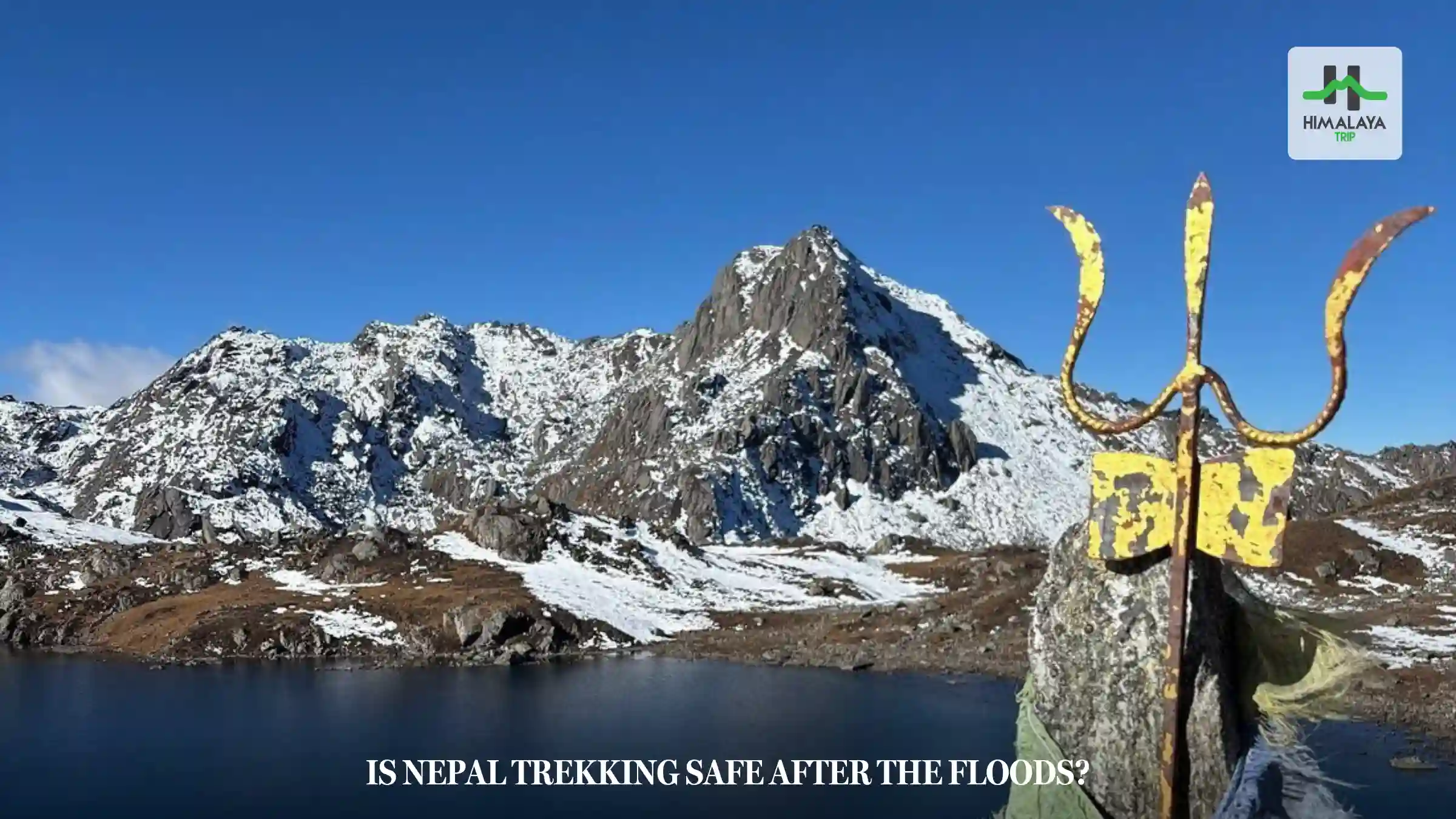
Is Nepal Trekking Safe After the Floods?
For most of the country, yes. Everest, Annapurna, Manaslu, Kanchenjunga, Pokhara, Kathmandu, Chitwan, and Lumbini are open and running as usual. The disaster is concentrated in one river corridor on the Nepal-China border, not across the whole country.
A single word like “safe” cannot cover a country with dozens of river, mountain ranges and trekking regions that operate almost independently of each other. One corridor was devastated. Most of Nepal was not touched. This article breaks down what happened, why the fear is understandable, and what you actually need to check before you travel.
Table of Contents
What Happened in Nepal’s August 2026 Floods?
On the morning of August 26, 2026, a mass of ice and rock broke away from a glacier in Langtang National Park, near the Nepal-China border. The resulting debris flow and flash flood traveled nearly 100 km down the Lende Khola and Trishuli River, burying and destroying buildings and infrastructure, including the Rasuwagadhi border crossing between China and Nepal.
Some early reports suggested that an earthquake caused the collapse. Later, scientists said that weak rock beneath the glacier was the main cause. Some researchers also said that warmer-than-usual temperatures may have played a role.
The Impact on People
The numbers moved fast in the first two weeks, and they are still moving. According to Nepal’s Ministry of Foreign Affairs situation bulletin, 1,357 bodies had been recovered by September 9, 2026, with roughly 5,075 people still unaccounted for. The ministry said that these numbers are not final yet, as search and identification work is still ongoing.
| Date | Bodies recovered | People missing | Source |
| Sept 1, 2026 | 987 | ~4,000 | NDRRMA |
| Sept 2, 2026 | 1,114 | 3,916 | NDRRMA |
| Sept 4, 2026 | 1,259 | 5,000+ | Nepal Police |
| Sept 6, 2026 | 1,349 | ~5,083 | Nepal Ministry of Foreign Affairs |
| Sept 9, 2026 | 1,357 | ~5089 | Nepal Ministry of Foreign Affairs |
Nearly 12,000 people had been rescued as of early September, and around 84,270 people, including 32,000 children, were affected in some way. Foreign nationals were among the missing, including Indian, American, Australian, British, Ukrainian, Malaysian and Canadian citizens. Anthony Albanese, Australia’s prime minister, said 34 Australians were among those missing in the first days after the disaster.
Why Are Travelers Worried About Visiting Nepal Right Now?
The worry is fair. The images out of Rasuwa and Nuwakot are severe, homes buried under mud, bridges gone, hydropower plants destroyed. Search and recovery work was still active as of September 8, and both Nepal and China have kept outside assistance limited, working mainly with their own teams alongside specialists from India, Australia, and South Korea.
There is still a real and ongoing risk in the affected area. The remaining glacier ice and broken rock may still be unstable after such a large rock-and-ice avalanche. However, this does not mean you should avoid Nepal. It means you should avoid this specific corridor until engineers confirm that the area is safe and stable.
There is also some good news. The lake that formed in the crater created by the glacier collapse has now drained by reducing one of the risks in the area. A disaster in one valley does not automatically mean danger in another, but from a distance, on a news feed, it can look that way.
Which Parts of Nepal Are Actually Affected?
The flood followed a single, connected waterway: the Bhote Koshi into the Trishuli, running through Rasuwa, Nuwakot, Dhading, Gorkha, Tanahun, Nawalparasi and Chitwan. It did not touch the Dudh Koshi valley that leads to Everest, and it did not touch the Budhi Gandaki that runs through the Manaslu region.
The Trekking Agencies’ Association of Nepal (TAAN) confirmed that the flash floods of August 26 did not affect the Everest, Annapurna, Manaslu, Kanchenjunga, or Makalu trekking destinations. The disruptions TAAN listed were specific: the Kailash route via Rasuwagadhi and Kerung, Langtang access through Trishuli-Betrabeti, Ganesh Himal access through Dhunche and Syabrubesi, and some Manaslu road areas.
The US State Department has kept Nepal at Level 2: Exercise Increased Caution, a rating that was in place before the floods and is mainly related to political conflict. The advisory has not been changed to a flood warning for the entire country.
How Is Nepal’s Tourism Industry Responding?
Tour operators are working hard to correct the “Nepal is flooded” narrative before it costs the country its peak autumn season. Rajendra Lama, a tourism entrepreneur with more than 20 years of experience who has been coordinating rescue support with the Nepal Mountaineering Association, said that “we have a crisis in one part of the country, but we’re open elsewhere.“
This reassurance comes as part of a major international relief effort. By September 7, 2026, international groups and NGOs had helped more than USD 820 million to Nepal for recovery, with support from the United Nations Fund for responding to Loss and Damage and the World Bank. That money is going toward rebuilding roads, bridges and homes in the affected districts, not toward the parts of the country that were never touched.
Has Nepal Recovered From Disasters Like This Before?
Nepal’s tourism sector has faced major challenges before. The 2015 Gorkha earthquake caused huge damage in the Kathmandu Valley and central hill districts. It also caused a sharp drop in tourist arrivals in the months that followed. However, several main trekking areas saw little or no major structural damage. The Annapurna and Everest regions reopened within weeks, and tourism start to recover over the next few seasons. This showed that a disaster in one part of Nepal does not always stop tourism across the entire country.
The current situation follows a similar pattern. The recent disaster has caused serious damage in specific areas while many other tourist destinations are open. Recovery work is focused on the districts that were directly affected. Trekking areas such as Annapurna and Everest are welcoming visitors when local authorities confirm that routes are safe.
Is It Safe to Trek in Nepal Right Now?
Yes, in most regions. Here is the latest report on trekking conditions in different parts of Nepal:
| Region | Status | Notes |
| Everest (Khumbu) | Open, unaffected | Base Camp, Gokyo and Three Passes routes fall outside the flood-affected area |
| Annapurna | Open, unaffected | Base Camp, Circuit, Ghorepani-Poon Hill and Mardi Himal routes are on a separate river system |
| Manaslu | Open, minor road watch | Trail itself unaffected; some road areas need confirmation |
| Kanchenjunga | Open, unaffected | Outside the disaster zone entirely |
| Makalu | Open, unaffected | Outside the disaster zone entirely |
| Upper Mustang | Open, unaffected | Outside the disaster zone entirely |
| Kathmandu, Pokhara, Chitwan, Lumbini | Open, normal operations | Not in the flood path |

Which Trekking Routes Are Currently Affected or Closed
To help you make informed choices, the table below outlines specific routes affected by recent flooding compared to standard open alternatives.
| Route / Corridor | Current Operational Status | Primary Issue | Recommended Alternative |
| Pasang Lhamu Highway (Betrawati to Timure) | Restricted / Closed to Tourists | Highway washouts and bridge damage | Fly to Lukla or drive to Besisahar / Pokhara |
| Direct Syabrubesi Trailhead | Restricted Access | Road damage along Trishuli River | Start from Sundarijal via Helambu / Gosaikunda |
| Kailash via Rasuwagadhi/Kerung | Closed | Riverbank damage | Use Kerung border alternative when open |
What Should You Check Before You Book or Travel?
- Confirm your specific route, not the country as a whole. A trek to Everest and a trek to Langtang are two different questions with two different answers right now.
- Check the Nepal Ministry of Home Affairs, NDRRMA, and Nepal Tourism Board for the latest district-level advisories before you finalize plans.
- Ask your operator for their current road and trail status, not their status from two weeks ago. Conditions on approach roads change faster than trekking trails do.
- Watch the monsoon forecast, separate from flood recovery news. Nepal’s Department of Hydrology and Meteorology expected the monsoon to remain active until early September 2026.
- Carry travel insurance that covers delays, rerouting, and evacuation. This is good practice in Nepal every monsoon season, flood or no flood.
- Register with your embassy or consulate if you are traveling independently near any border region.
- Keep an itinerary buffer of one or two days around Kathmandu or Pokhara. Domestic flight delays and short-notice road closures are normal during the tail end of monsoon season, separate from flood recovery.
- Avoid donating gear or cash through unverified social media appeals. Route support from trusted organizations such as UNICEF, CARE or Nepal’s official relief funds if you want to help.
Conclusion
Nepal is not closed, and the whole country is not unsafe. A specific 72-kilometer area covering parts of Rasuwa, Nuwakot, Dhading, Gorkha, and Tanahun was badly affected by the floods. Recovery work is still going on, and the exact number of missing people is still being confirmed. However, areas outside this disaster zone are operating normally. If you are traveling to Everest, Annapurna, Manaslu, Kanchenjunga, Makalu, Upper Mustang, Kathmandu, or Pokhara, there is no flood-related reason to cancel your trip.
Before booking your next trek, check your route with Himalayatrip. We can help you see exactly where your route goes, so you can make your decision based on facts rather than guesswork.